
Practical guide · Water fountains & bowls
Stainless steel versus ceramic cat water fountains
Compare steel and ceramic cat fountains by handling, damage, cleaning access and design. Separate material choice from capacity, water flow and filter compatibility.
The short answer
Start with the exact model and the job it needs to do
Choose by the actual fountain’s cleaning access, handling, damage risks and supported parts. Steel can dent; ceramic can chip or crack. Both need physical washing and separate pump care. Compare capacity, flow and noise as design features rather than assuming the material determines them.
Stainless steel and ceramic can both be practical fountain materials. The useful comparison is how the particular fountain comes apart, how easily you can carry and wash it, what damage looks like and which replacement parts it needs. Material alone does not determine cleanliness, noise or whether a cat will use the water.
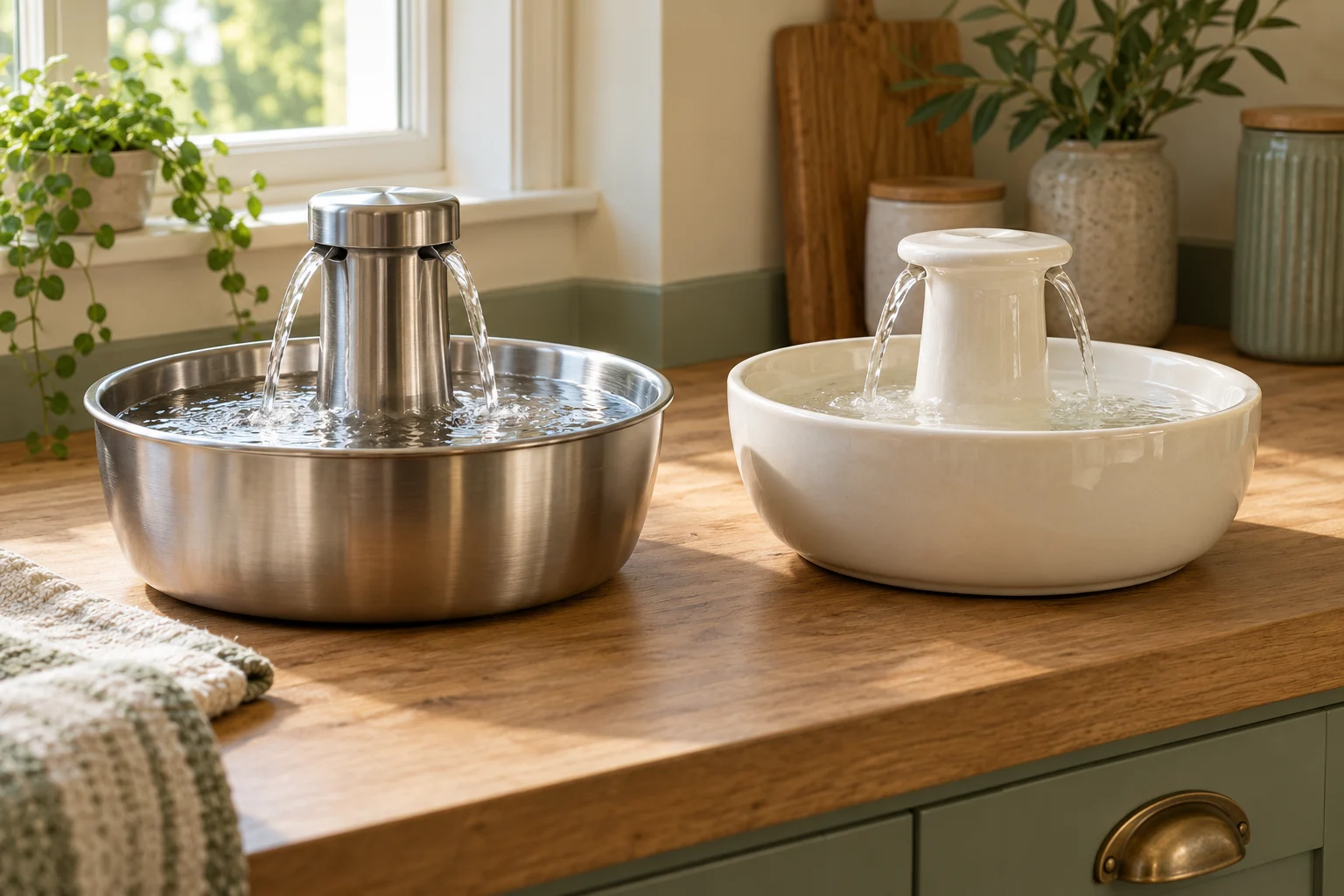
The two PetSafe examples below are deliberately different designs. The steel 360 is a larger free-falling-stream fountain; the ceramic Streamside is a smaller bubbling model. Their capacity and flow differences are product differences, not proof that steel always holds more water or ceramic is always quieter.
Compare the ownership trade-offs
| Decision | Stainless steel | Ceramic | Check on the actual product |
|---|---|---|---|
| Carrying to the sink | May be easier to handle in a lighter bowl design | Often feels substantial and needs careful handling | Empty first; compare actual part weight and grip |
| Damage | Inspect for sharp dents, rough seams, corrosion and loose fittings | Inspect for chips, hairline cracks and damaged glaze | Remove a damaged food-contact part from use |
| Cleaning | Permitted steel parts may support dishwasher care | Permitted ceramic parts may support dishwasher care | Pump, seals and electrical parts have separate instructions |
| Noise | Splash, pump contact and resonance depend on design | Splash, pump contact and resonance also depend on design | Water level, assembly and flow setting matter |
| Filters | No single steel-fountain filter standard | No single ceramic-fountain filter standard | Match exact model, carbon cartridge and pump foam |
| Cat preference | Finish and shape may interest or deter an individual cat | Finish and shape may interest or deter an individual cat | Keep a familiar drinking option during introduction |
Both materials need regular physical cleaning, including the hidden water path and pump. Compare the actual shape, handling and maintenance rather than expecting the finish alone to keep water clean or change your cat’s drinking behaviour.
Steel example: Drinkwell 360 Stainless Multi-Pet
A larger steel bowl with selectable streams
PetSafe Drinkwell 360 stainless-steel fountain
A 3.8 litre steel-bowl fountain with interchangeable rings for one to five free-falling streams. The selected Amazon listing uses a one-gallon title: confirm the supplied UK power equipment before ordering.
Check: Larger footprint than the ceramic example
View on Amazon ↗PetSafe’s UK 360 stainless-steel model has a nominal 3.8 litre capacity and a listed 36.3 × 36.3 × 23.6 cm exterior. Interchangeable spout rings provide one to five streams. That makes flow arrangement and the wider footprint part of the buying decision alongside the bowl material.
The selected Amazon offer uses a “one gallon” title. Confirm the supplied power equipment and UK suitability on the actual offer before purchase; a similar overseas model name is not proof that the plug and adaptor match your home. Do not substitute an unapproved power supply.
The bowl and tower support top-rack dishwasher care under the maker’s instructions, while the pump needs separate hand cleaning. A large washable bowl can still be awkward in a small sink or crowded dishwasher. Measure the cleaning space, not just the patch of floor where the fountain will stand.
Ceramic example: PetSafe Streamside
A smaller ceramic fountain with bubbling flow
PetSafe Streamside ceramic fountain, off-white
A 1.8 litre ceramic fountain with a low bubbling outlet. The UK maker lists a 25.9 × 25.9 × 13.7 cm exterior; handle the separate bowl and tower carefully during washing.
Check: Ceramic can chip or crack
View on Amazon ↗The UK Streamside is a 1.8 litre ceramic fountain with a listed 25.9 × 25.9 × 13.7 cm exterior. Its low bubbling outlet offers a different presentation from the 360’s free-falling streams. It may suit a smaller station, provided there is room to approach and you can maintain its own refill routine.
The ceramic bowl and tower can be cleaned on the top rack as directed. Handle them separately and carefully rather than carrying a full assembled fountain by its upper section. Avoid knocking the tower against the sink or stacking heavy cookware against it.
If a rim chips or a crack appears, stop using the affected part and ask about a supported replacement. Do not glue a water-contact crack or decide a damaged edge is acceptable because it sits below the waterline. The material decision includes how you would replace a broken component.
Compare access to the dirty areas
Before buying, look for an understandable dismantling sequence, reachable corners and a pump that can be cleaned according to its manual. A polished visible surface is only one part of the water path. Hair and residue can also collect in the intake, housing, outlet and small channels.
Unplug before dismantling. Wash the permitted parts, rinse them thoroughly and clean the pump by its own procedure. Do not put the complete electrical assembly into a dishwasher because the bowl is dishwasher-safe. Let the manufacturer’s instructions determine what can be removed and how.
Where hard-water deposits build up, use the permitted descaling method and keep treatment away from parts or media that are not covered by it. Do not leave cleaning solution circulating for the cat to encounter. Refill with fresh water after the final rinse and check normal operation.
Our fountain cleaning guide explains that routine in more detail. Choose a material and shape you can comfortably maintain repeatedly, rather than relying on a finish that looks clean from across the room.
Separate material from pump and water noise
A rattling pump, low reservoir, poorly seated tower or falling stream can create noise in either material. A heavy ceramic bowl does not guarantee silence; a steel bowl does not guarantee a loud fountain. Surface contact and the particular design also influence what you hear.
If noise develops in a fountain you already own, check the permitted water level, assembly and pump condition before replacing the whole product. Disconnect it for hands-on inspection. Do not add improvised pads inside the water path or modify the pump housing to suppress a rattle.
For a cat that hesitates around moving water, retain a familiar bowl and introduce the fountain gradually. Compare fountain versus bowl and introducing a fountain before assuming a different material will solve the reluctance.
Check the consumables before committing to a finish
The steel 360 takes the cylindrical carbon family, while Streamside uses the round carbon format. They share a supported foam family in PetSafe’s UK parts list, but that shared foam does not make their carbon cartridges interchangeable.
Use Drinkwell filter compatibility to record both parts. A replacement pack labelled “for steel and ceramic fountains” may refer only to foam. Read the actual component rather than concluding that any filter in the pack will fit either fountain.
Include filters, routine cleaning and electricity in the ownership decision. The running-cost tool lets you enter explicit assumptions. Capacity does not establish electrical consumption, and material alone does not establish the annual filter bill.
Choose the product that fits your routine
Choose steel if the particular bowl, handling and layout suit you and its supported parts are available. Choose ceramic if you like the actual shape and can handle the components carefully. Neither choice removes the need to inspect for damage or maintain a separate drinking option during cleaning or power loss.
For a small home, map the full footprint with enough access to lift parts out. For multiple cats, consider several suitable drinking locations rather than expecting one large reservoir to resolve competition. The water-bowl placement guide helps with that wider arrangement.
Product and maintenance references
PetSafe’s UK 360 stainless-steel model and Streamside ceramic model support the product specifications. The separate carbon, round carbon and foam listings identify consumable families.
Frequently asked questions
Is stainless steel automatically more hygienic than ceramic?
No material keeps a dirty fountain clean. Inspect the condition and wash all permitted water-contact parts and the pump as directed. Cleanability depends on access and routine as well as the surface.
Are ceramic cat fountains always quieter?
No. Pump condition, water level, flow design, assembly and contact with surrounding surfaces can all affect sound. A bubbling ceramic model and a free-falling steel model differ in more than material.
Can I put a steel or ceramic fountain in the dishwasher?
Only the parts the manufacturer permits. The two examples support top-rack care for their bowl and tower, while the pump needs separate hand cleaning. Do not wash the complete electrical assembly that way.
Do the Drinkwell steel 360 and Streamside use the same filters?
They use different carbon formats: cylindrical for the 360 and round for Streamside. PetSafe lists a shared foam family for these models, which does not make the carbon cartridges interchangeable.
Should a chipped ceramic fountain be repaired with glue?
Stop using the damaged water-contact part and ask about a supported replacement. A glue repair has not been established as suitable for the fountain’s water path, cleaning and animal contact.