
Practical guide · Cat trees & perches
How to choose a cat tree
Measure usable beds, plan the route between levels and compare assembly, materials and replacement parts before buying a cat tree.
The short answer
Start with the job your cat needs it to do
Choose a cat tree by measuring the cat’s resting space, the complete furniture outline and the route between levels. Then check assembly, any required restraint and how the parts can be cleaned or replaced. Use the examples below to see how a lower den, broad single perch and compact ramp tree answer different needs.
Start with three observations
Before comparing towers, watch where your cat rests, where they scratch and how they move between levels. A cat that curls into a covered corner may value a den more than a high exposed shelf. Another that stretches across a broad cushion may need a generous flat platform, even if a smaller round basket looks neater in the room.
Write down the job you want the tree to do. Is it a window lookout, an enclosed resting place, a route to climb or a scratching surface beside the sofa? A piece that combines all of them can be useful, but only when the activities belong in the same part of the home.
Notice access as well as destination. Does the cat already use intermediate furniture to reach a higher place? Do they prefer lower surfaces? A new change in movement deserves your vet's attention. Choosing more reachable furniture can be sensible, but a purchase should not be used to explain away that change.
Measure the cat’s resting space
Measure a familiar sleeping patch while the cat is elsewhere, using the outline of how they normally lie rather than a forced pose. Include the area occupied by the body and head. For a stretching cat, a bed that only fits a curled outline may not offer a comfortable choice.
Now compare the usable interior, not merely the platform or fabric's outer size. Ask whether a stated diameter includes raised sides, thick upholstery or a cushion. A nominal 50 cm bed can leave less flat room inside. For a cave, check the floor area, opening width and internal height as separate measurements.
Hammocks need another distinction: the supported resting shape can differ from a rigid platform of the same diameter. A flexible basket may suit a curled posture but give less useful length for stretching. A photograph of a small cat using it cannot establish fit for your own larger cat.
If large-cat fit is the first requirement, our large-cat tree comparison gives examples with published platform dimensions. If the room is the tighter constraint, use the small-home guide alongside the same resting-space measurements.
Map the complete furniture outline
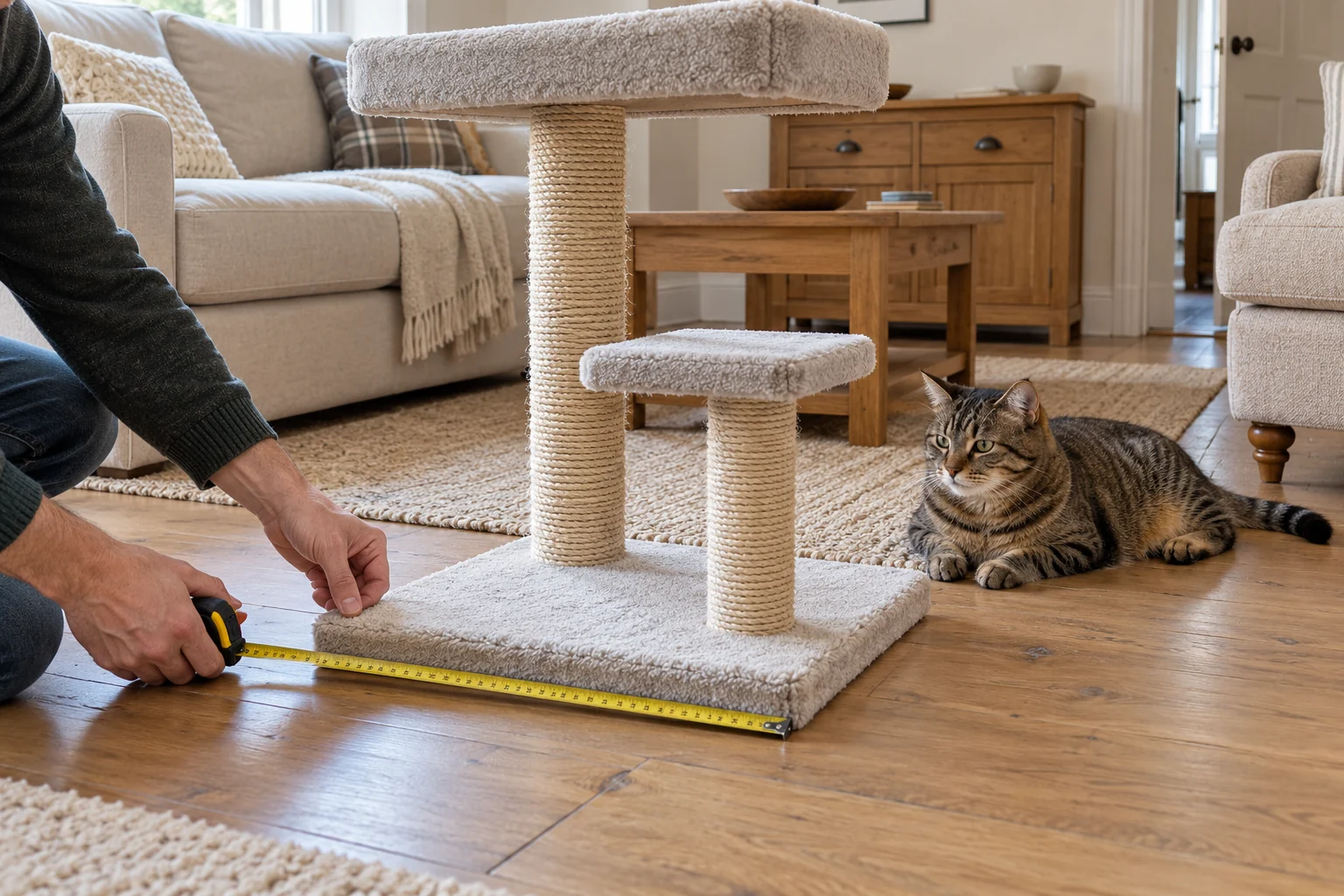
Begin with the base panel, then mark the widest allowed arrangement of beds, steps, ramps and other projections. The base may sit neatly in a square while an upper lounge extends well outside it. Some models allow different component positions, but only use arrangements supported by their instructions.
Finally allow a working area around the outline. A cat needs space to approach and get down; you need space to clean, lift cushions and reach structural connections. Open the nearby door, move the curtains and pull out a chair while the outline is marked. The room should still work in ordinary daily use.
Do not rely on a gap that is exactly the width of one uncertain listing measurement. Obtain the selected drawing when the fit is tight, and account for skirting boards or other surfaces that affect where the base can sit. Windows, controls and ventilation still need access after installation.
Compare three different shapes
A lower den and platform
Lower wooden-style tree
Catit Vesper Base, walnut
A lower wooden-style tree with a two-entry cube and removable cushions. Its 56 cm square base suits a measured corner, while the den and raised platform offer different resting positions.
Check: Base is wider than many slim towers
View on Amazon ↗The Vesper Base illustrates a lower furniture-style arrangement: a two-entry den and raised resting surface on a 56 cm square base. Its approximate 84 cm overall height can suit a room where a very tall tower would feel intrusive. That does not make its base narrow or establish that every cat can manage the step.
Check how both cube entrances face the room and whether the cushion can be removed in the proposed position. Catit's model information identifies removable hand-washable pieces and replacement parts. Those ownership details can matter as much as a finish that matches the furniture.
One broad supported perch
Single raised bed
TRIXIE XXL Klara cat tree, grey
A single elevated resting bed on a 20 cm diameter sisal post, with a 60 cm square base and 100 cm overall height. Check the usable bed interior separately; the base dimensions do not establish the sleeping area.
Check: Inner bed size needs confirming separately
View on Amazon ↗The TRIXIE XXL Klara illustrates the decision to buy one substantial resting place rather than several small levels. Its 60 cm square base, 20 cm diameter post and 100 cm overall height give you concrete measurements to compare. The bed’s usable interior must be checked separately; the base does not establish its sleeping area.
A direct route to a single bed can be simpler for one cat and less suitable for another that needs intermediate steps. A thick column and broad platform do not answer that access question. Confirm the interior remaining inside the border and cushion through the manufacturer's drawing and specifications.
A compact plush tree with a ramp
Compact plush tower
Feandrea compact cat tree with ramp
A plush-covered 96 cm tree with a cave, raised perch and sisal scratching ramp. It offers several activities within a listed 48.5 cm square outline, provided the final platform positions and restraint fit your room.
Check: Plush-covered panels need their own cleaning routine
View on Amazon ↗The Feandrea example combines a cave, upper perch and scratching ramp in a listed 48.5 cm square by 96 cm high arrangement. It shows how one piece can provide several activities when floor space is limited. The ramp gives another lower approach, but the whole route to the top still needs assessing.
Fixed plush and the supplied anti-tip kit add questions about care and installation. Read the selected model instructions before deciding where it goes. The useful comparison is how the complete structure works in your home, not the biggest advertised number of activities.
Trace a route from floor to top and back
Follow each movement the cat would need to make. Compare the gaps, platform widths, approach angles and places to turn. A narrow intermediate step can limit the usefulness of a broad top bed; a good route down is as important as the route up.
In a multi-cat home, notice where one cat could wait across a doorway or control a passage. Several beds on one trunk may still depend on one bottleneck. Offer separate resting choices elsewhere as appropriate, rather than expecting one large tower to provide every resource.
Cats Protection's indoor-cat guidance describes opportunities to climb, scratch and rest. Use that context to build a useful environment without assuming the tallest piece automatically supplies the most useful route.
Read assembly and restraint instructions before ordering
Check how the base, columns and platforms are joined and whether a wall restraint is supplied or required. Establish where the restraint must attach and what wall construction and fixings are appropriate. Do not choose a corner first and improvise a fixing system afterwards.
Furniture load claims need a defined scope. Is the number for one hammock, one platform, the whole structure or the product's own weight? If the maker does not explain it, ask. A static maximum does not become a guarantee about jumping, several cats landing together or an incorrectly assembled connection.
Leave the assembly tool and instructions accessible for later checks. Inspect the joints and materials as the manufacturer directs, including after moving the tree. New looseness, cracks, damaged threads or a failing restraint require attention before normal use continues.
Choose materials around actual scratching and cleaning
Sisal rope, woven sisal, jute, seagrass and carpet are different surfaces. Observe what the cat already uses and compare the actual scratchable section. The whole column length may include bare ends, brackets or a cap. A platform attached halfway up can also interrupt an otherwise long stretch.
For a cat that scratches the sofa arm in a different part of the room from the preferred sleeping place, a separate tall post can give you more placement freedom. The tree's scratching section does not have to be the only surface offered.
Cleaning needs a component-by-component view. Rigid boards may have a wipeable finish, while fixed plush, removable fabric and foam inserts have different directions. Hand-washable cushions are not machine-washable simply because they detach. Keep liquids and cleaners within the maker's allowed methods and allow adequate drying.
Check replacement support while the model is identifiable
A spare column is useful only when its length, diameter, thread and fixing arrangement match. A replacement cover also needs the exact cushion size and shape. Keep a photograph of the label or the model code with the assembly sheet so future orders are not based on a faded picture.
Check whether the parts you are likely to wear out are sold separately and which revision they fit. Do not assume a generic M8 description alone establishes a compatible complete connection. The screw engagement and supported arrangement matter alongside the thread name.
Repairable consumable wear and structural damage are different decisions. Replacing a worn scratching surface will not fix a cracked platform or stripped joint. Use supported replacement parts and seek the maker's guidance when the structure is uncertain.
Your five checks before buying
0 of 5 checks complete
Sources and where to compare next
This practical guide uses Catit and RHR model specifications, the selected Feandrea brand listing and Cats Protection's home-environment guidance. The product examples illustrate different shapes rather than a measured stability ranking. The cat-tree hub links the two detailed buying guides and helps you compare a tree with separate resting and scratching equipment.
Plan the room before choosing a larger structure: where to put a cat tree covers windows, landing routes, doors and shared access.
If the main aim is a view and resting place rather than several climbing levels, compare window perches for cats. Assess the exact supported mounting arrangement and access route before trading a floor-standing tree for a window fixture.
Frequently asked questions
What should I measure before buying a cat tree?
Record your cat’s comfortable resting outline, the usable bed and cave dimensions, the base, the widest assembled furniture outline and clear approach space. Also check the gaps between levels. An overall height and one base width do not establish whether the cat or the room will fit.
Are taller cat trees always better?
No. A useful resting platform and a practical route matter more than height alone. A cat may prefer one broad reachable perch, an enclosed den or a sequence of levels. Match the structure to observed habits and movement, while keeping the room and any required restraint workable.
Can I judge stability from the thickness of the posts?
Post diameter is only one detail. The base, joints, platform support, restraint, assembly and condition also matter. Read the exact manufacturer instructions and establish what any load number describes. Do not infer a complete safety or jumping guarantee from a thick column.
Which cat-tree materials are easiest to clean?
Look at permitted care for each part rather than naming one universal best material. A wipeable board, fixed plush panel, removable cover and foam insert can require different methods. Check how easily parts come off and dry, and whether compatible replacements are available.
Should the tree be my cat’s only scratching place?
Not necessarily. Scratching and resting may happen in different parts of the home, and some cats use several orientations or surfaces. A separate post or pad can be placed beside an existing scratching habit while the tree provides a useful resting or climbing position.