
Practical guide · Cat carriers & travel
How to measure your cat for a carrier
Measure your cat’s length, standing height, width and weight, then compare internal carrier space, door openings and handling. Avoid misleading outside dimensions.
The short answer
Check body room, openings and load separately
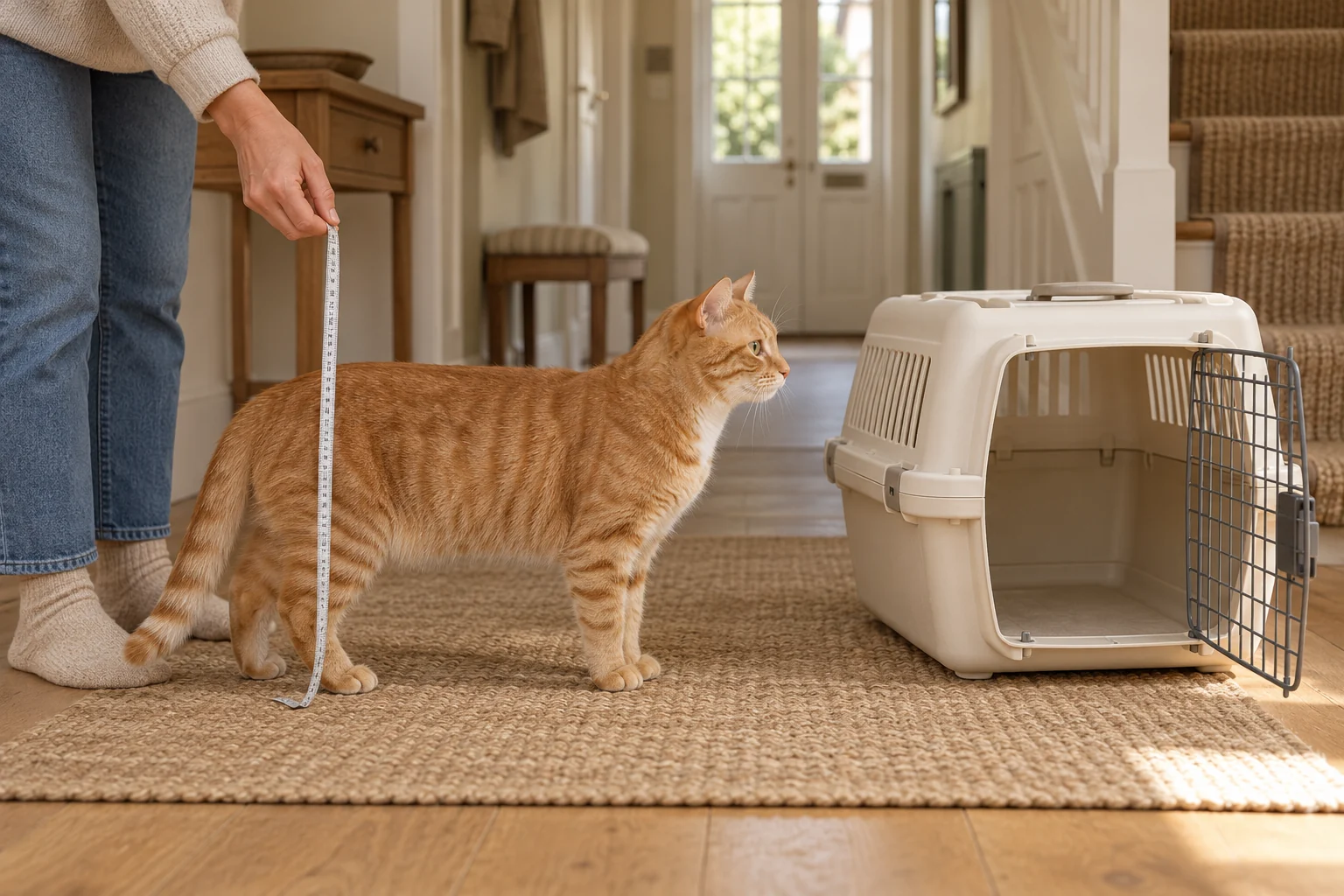
Measure your cat standing naturally: nose to tail base, floor to the top of the head, and body width. Record weight separately. Compare those figures with the carrier’s usable inside space and clear door opening, allowing comfortable standing, turning and lying down. Outside dimensions and a kilogram limit alone cannot confirm the fit.
Carrier size is often described with a maximum weight, an outside length and a photograph of a cat. Those details help identify a model, but they leave several important questions unanswered. The interior may taper towards the roof, the entrance can be narrow, and thick bedding takes away height.
Measure before choosing, then check the assembled carrier at home well before the journey. A calm fitting session is more useful than discovering an awkward entrance on the morning of a vet appointment. For larger choices after measuring, see our large-cat carrier comparison.
Prepare without restraining the cat
Use a soft tape, a notepad and a quiet moment when the cat is standing naturally. You do not need to hold the tape tightly against the body. Estimate beside the cat and repeat later if they move. Avoid lifting the chin, stretching the body or holding a tail out to obtain a neat number.
A side-on photograph beside a known object can help you record proportions. Keep the camera roughly level with the cat; a close wide-angle photograph can distort the nearest part. Treat the result as a planning estimate, not a laboratory measurement.
If your cat dislikes measuring, start with broad estimates and ask your veterinary team for help choosing a suitable carrier. An anxious measuring session can make the equipment introduction harder. Safety and a comfortable fit matter more than a falsely precise measurement.
Record body length
Note the distance from the nose to the base of the tail while the cat stands normally. This helps compare body room between carriers, but do not simply choose an inside floor exactly that length. The cat also needs to turn, settle and move into a natural resting position.
Look at the current carrier if you have one. Is the cat pressed against the door or back while lying normally? Do they have to curl tightly because the floor is narrow? These observations provide context for the new measurements.
A long cat may outgrow a carrier without becoming much heavier. Equally, a broad cat may need more width despite a modest length. Keep the length note alongside the other measurements rather than treating it as the only deciding number.
Record standing height and width
Measure from the floor to the top of the head in a relaxed standing posture. Note whether upright ears or a tall natural posture need extra clearance. Do not press the head down to make an existing carrier seem large enough.
For width, observe the body at its broadest useful point and compare the room needed to turn. Coat volume can make a long-haired cat look wider, but the cat should not have to push through a tight opening. The clear door width and the widest internal floor width are separate measurements.
Curved roofs deserve attention. A carrier can be tall in the centre but much lower towards the sides. Ask for usable internal dimensions or a diagram rather than assuming the whole inside is a rectangular box matching the outside measurements.
Weigh separately and check the exact model
Use a recent reliable weight if available. If you weigh at home, use an appropriate stable method that your cat tolerates; do not balance them on an unsuitable small scale. A veterinary weight is useful when the figure is uncertain or the cat is close to a carrier’s limit.
Read the maker’s guidance for the exact model and version. Product families often contain several sizes, while marketplace pages may combine generic descriptions. Do not transfer a larger model’s load limit to a smaller carrier because their names are similar.
Consider the combined load you will carry, including the carrier, bedding and any attached accessories. A carrier that technically fits the cat may still be difficult for you to hold level through a station or up stairs. Plan the actual route and get help with handling if needed.
Ask for usable internal space
Write two sets of carrier measurements: outside dimensions for storage and travel arrangements, and usable internal floor and height for the cat. Mark missing information clearly. Never fill the internal column with an outside measurement because that is the only number in the listing.
Add the bedding you intend to use before judging height. A thick cushion can reduce room and may bunch near the door. A secure, suitably thin absorbent layer is easier to assess than several loose blankets piled together. Keep ventilation openings clear.
The carrier must allow comfortable repositioning, not just entry through the door. Cats Protection recommends a strong, secure, easy-clean design with adequate ventilation and room to lie comfortably and adjust position.
Measure openings independently
A top hatch may help with access, but check the clear opening rather than the full lid outline. Hinges, handles and framing can reduce the gap. A cat that can fit inside should not have to be squeezed through an unnecessarily tight hatch.
A front-opening carrier with a removable upper shell offers a different approach. Removing the top can help training and some veterinary examinations, but it is not the same as an opening that can be used during ordinary carrying. Always reassemble every required fastening before transport.
If you are comparing opening styles, our top-opening carrier guide separates those features. Do not assume a larger front door compensates for a cramped interior, or that the ability to open the roof makes a carrier suitable for every journey.
Use these models as measurement examples
The Ferplast Atlas 20 Deluxe Open has outside dimensions of 57.6 × 37.4 × 33 cm, with top and front access. The exact maker guidance for this model is up to 8 kg. Those details make it a useful smaller comparison point; they do not establish that a particular cat fits inside.
Top-access option
Ferplast Atlas 20 Deluxe Open carrier
A hard carrier with front and top openings, side clips and a removable cotton cushion. The top access and detachable shell are useful details to compare when planning how to load, clean and reassemble it.
Check: Select the 20 Deluxe Open model carefully
View on Amazon ↗The Atlas 30 has a larger 60 × 40 × 38 cm outside size and a different load guide. It is a front-opening design; the removable upper shell should not be confused with a dedicated top hatch. Compare the inside space and handling rather than choosing by the higher number alone.
Larger front-entry box
Ferplast Atlas 30 carrier, black
A front-entry rigid carrier with a 60 × 40 × 38 cm exterior and listed maximum load of 15 kg. Body room and doorway fit still need measuring.
Check: No top-opening hatch
View on Amazon ↗Neither example is described here as universally airline approved or crash tested. Transport operators have their own requirements. Check the exact carrier, journey and securing instructions before relying on it for a specific service.
Confirm the fit in a calm home session
Place the assembled carrier on a stable floor with the door secured open. Let the cat investigate voluntarily. Familiar bedding and a few permitted food rewards can help create a normal resting association. Keep the process gradual; do not close the door just because the cat finally steps inside.
Once the cat is comfortable, observe normal standing, turning and lying. Watch whether the head presses against the roof, the body is wedged between the walls or the door frame restricts movement. Recheck with the intended bedding, then introduce a brief closed-door stage and a level lift only when the cat is ready.
Stop and simplify if the cat becomes distressed. Difficulty entering may reflect fear as well as fit, so a bigger carrier alone may not solve it. Ask your vet about a plan for severe travel anxiety, and keep practice separate from an urgent departure where possible.
Finish the fitting notes
Carrier measuring checklist
0 of 5 checks complete.
Keep those notes for future purchases as your cat grows or their mobility changes. Recheck the carrier’s latches, shell and handle before each journey, even when its size remains suitable.
Once the fit is right, introduce the carrier at home in gradual stages. Keep the routine practical with the carrier cleaning guide.
Fit is only one part of the transport plan. Check carrier condition and the supported car restraint method separately before the first journey.
Once internal fit and supported weight are clear, use hard versus soft cat carriers to compare access, structure, storage and cleaning. Recheck usable space with the liner in place whichever format you choose.
Frequently asked questions
Should I measure to the end of the tail?
Use nose to tail base for the body-length note, rather than pulling the full tail straight. The final fit must still let the cat lie in a normal position and adjust comfortably. Do not assume a body-length number alone defines the required internal floor length.
How many centimetres should I add to the measurements?
There is no single extra allowance that guarantees a good fit across carrier shapes. Curved roofs, sloping sides and bedding change the space. Use measurements to shortlist, follow the maker’s fitting guidance and confirm that your cat can stand, turn and lie comfortably in the assembled carrier.
Does an 8 kg carrier suit every cat below 8 kg?
No. A weight limit describes the maker’s load guidance, not the cat’s body shape or usable space. A long, lean cat may need a larger interior than a shorter cat of the same weight. Check both the fit and the exact model’s permitted load.
Can I put two cats in a bigger carrier?
Use a separate carrier for each cat. Cats Protection advises individual carriers even for cats that normally get along. Shared space can become uncomfortable during a stressful journey, and opening one large carrier creates extra handling and escape risks.
Does a top-opening carrier always offer more room?
No. The opening style changes how the cat enters and how you can access them; it does not establish interior size. Check the clear top hatch and inside dimensions separately. A removable upper shell is also different from a dedicated top hatch.