
Buying guide · Scratching posts & pads
Best horizontal cat scratchers
Compare a compact curved pad and a larger cardboard lounge, then choose usable scratch length, material, placement and replacement routine.
The short answer
A compact pad or a larger lounge?
Choose the Amazon Basics curved two-pack for a compact cardboard scratching surface you can place in more than one room. Compare the ComSaf lounge when you have space for a larger sofa-shaped surface. Measure the usable area your cat can scratch and stand on, then check that the whole unit stays put during use.
Compare the options
| Option | Listed outside size | Useful distinction | Check first |
|---|---|---|---|
| Amazon Basics curved pads | 41.9 × 20.6 × 4.1 cm each | Two separate compact pads | Usable width and floor grip |
| ComSaf lounge | 67 × 29.5 × 23.5 cm | Larger sofa-shaped surround | Seat area and approach height |
Match the scratcher to the movement
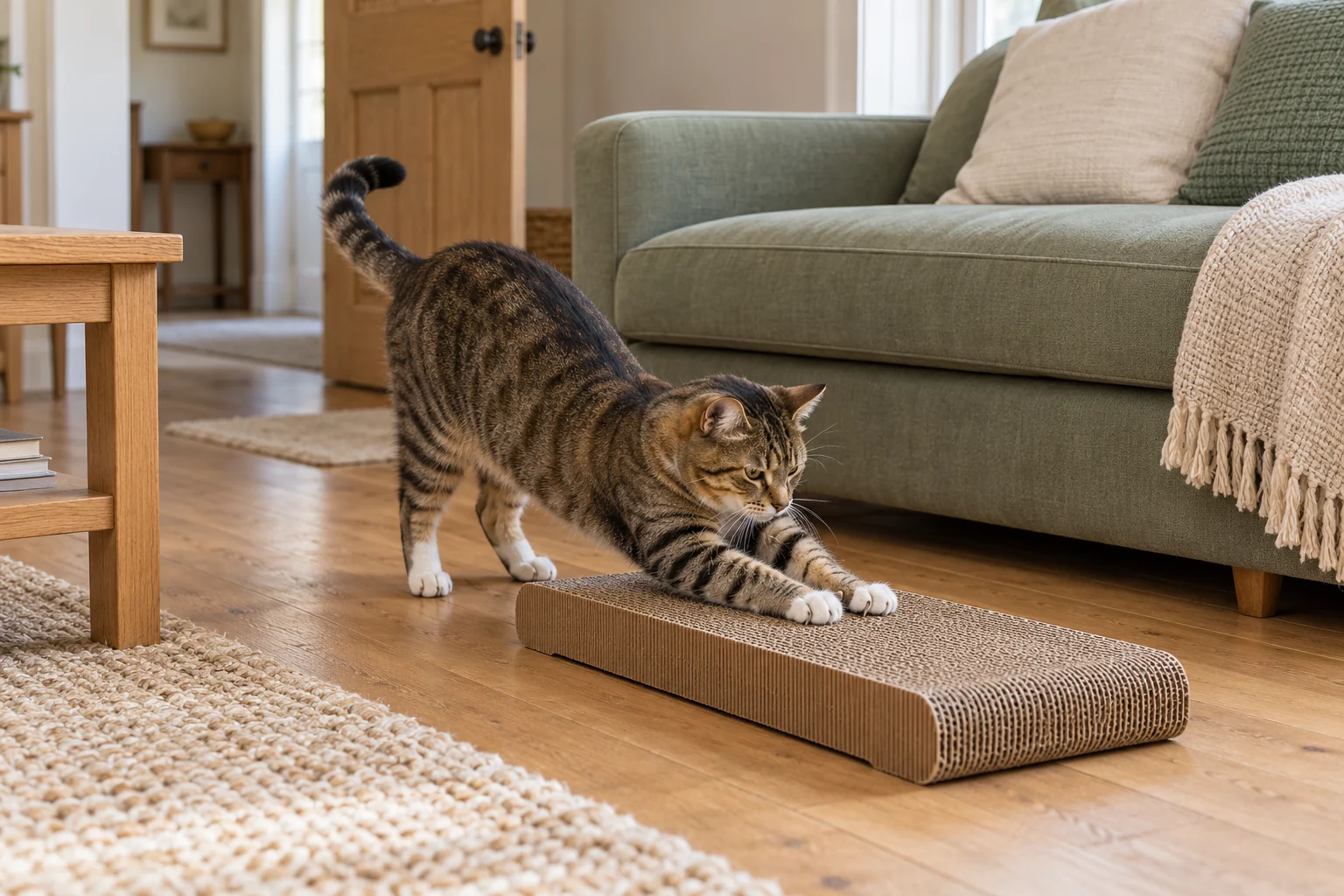
The best horizontal cat scratcher gives your cat a useful place to brace and pull its claws along a surface close to the floor. It is a particularly relevant choice when the existing target is a rug, carpet or the flat part of a stair. A tower is not an equivalent replacement simply because it contains more sisal.
Watch what the cat actually does before shopping. Does it stand on the material with the back paws while reaching forward? Does it pull along a curved edge, or scratch and then lie on the same patch? Those observations help distinguish a compact pad from a larger cardboard lounge. They also tell you where the new surface needs to go.
Our shortlist compares two documented cardboard shapes rather than pretending every cat needs the largest model. The Amazon Basics pads are smaller and easier to distribute. The ComSaf lounge asks for more room and has raised surrounding sections.
Amazon Basics curved pads: compact separate choices
Amazon Basics curved cardboard scratch pads, 2 pack
Best for: Horizontal scratching in more than one spot
Two curved, double-sided cardboard pads for a cat that prefers scratching near floor level. The separate pads also let you offer a surface in two places without buying two large pieces of furniture.
What stands out
- Both cardboard faces can be used
- Easy to position beside an existing scratching spot
Keep in mind
- Cardboard wears and can shed pieces
- Check that the pad does not slide on your floor
- 2 pads
- 41.9 × 20.6 × 4.1 cm each
- Catnip included
The selected Amazon Basics package contains two curved cardboard pads, each listed at 41.9 × 20.6 × 4.1 cm. That is useful when a cat has more than one established scratching location, or when you want one near a resting area and another beside an existing carpet habit. You do not have to arrange both together as one larger object.
The modest width is a real limitation to assess. A cat needs enough surface for its chosen movement, and a narrow pad may not support the way a broad-bodied cat braces. The measurements describe each complete pad, not a guarantee that every centimetre is equally comfortable to stand on. Compare its outline with the patch your cat already uses.
The low curved profile is less of a furniture commitment than a cardboard sofa. It can fit beside a chair without creating a new raised resting station, provided it stays outside the walking route. Check the position on the actual floor: a light pad that shifts during the first pull may be less appealing than its material suggests.
Catnip is included in the selected package. It is an optional introduction aid, not proof the scratcher will suit the cat. You can evaluate the surface and location without adding it. Keep loose packaging and any unused sachet out of reach.
Best fit: a compact cardboard option for separate scratching places. Main compromise: relatively little width and length for a larger stretching movement.
ComSaf lounge: a larger cardboard resting shape
ComSaf 67 cm cardboard scratcher lounge
Best for: A larger cardboard resting and scratching choice
A broad sofa-shaped cardboard scratching surface with raised surroundings. Compare the usable seat and scratch area, not just its 67 cm exterior length.
What stands out
- More floor area than a compact pad
- Combines a resting shape with a scratching surface
Keep in mind
- Outside dimensions include the surrounding sides
- Cardboard sheds and must be replaced when worn
- 67 × 29.5 × 23.5 cm outer size
- Corrugated cardboard surface
- Sofa-shaped surrounds
ComSaf's sofa-shaped model has a listed exterior of 67 × 29.5 × 23.5 cm. It takes up more floor space than one of the compact pads and provides raised surrounding sections around its cardboard seat. Compare it if your cat already likes scratching and resting on a broader horizontal object.
The outer dimensions include those surrounds. Do not treat the full height as the step onto the scratching surface, or the entire length as unobstructed sleeping space. If fit is close, ask for the usable seat dimensions and actual approach height. A photograph of a curled cat does not establish that your own cat can stretch or turn comfortably.
The lounge can work as a deliberate piece of cat furniture beside a sofa. That also means you need to plan around its whole shape when cleaning, opening doors and moving through the room. It should not force a person or another cat to step over it to reach a doorway.
Cardboard is a consumable scratching surface even when the product is styled as furniture. Expect to collect loose fragments and inspect the seat and joins as they wear. We do not repeat the listing's broad claims that it will protect all furniture, last a set time or fit every large cat.
Best fit: a larger cardboard lounge where the usable surface suits the individual cat. Main compromise: more room occupied, including raised sections that do not add flat scratching area.
Compare usable surface rather than the box size
Three measurements help: the complete footprint, the part the cat can scratch, and the approach height at the chosen side. A long shaped object can have a narrower middle. A high backrest can make a lounge look substantial without making its seat broader. Ask which dimensions a diagram actually describes.
A rough paper outline on the floor can reveal whether the scratcher belongs beside the sofa or would obstruct the room. Compare that with your cat's normal scratching patch while the cat is elsewhere. There is no need to position or stretch a cat against a ruler.
For a cat that wants an upright stretch as well, compare our tall scratching-post guide. Choosing a horizontal pad does not mean removing a vertical surface the cat already uses. Different locations and orientations can serve different parts of the day.
Cardboard, sisal and the replacement routine
Both products here use cardboard, so the comparison is mainly about shape, usable space and positioning. Corrugated cardboard can shed small pieces as it is scratched. Include the surrounding floor in your cleaning routine, and look for a surface that remains structurally usable rather than judging only its colour.
A woven sisal mat is a different material choice. Check how it lies flat, whether edges curl and what its backing does on your flooring. A product described as non-slip still needs checking in its actual position. Do not assume a loose mat can be attached to a wall or wrapped around a furniture leg unless that use is supported.
Before buying a frame with replaceable inserts, identify the exact refill size and fixing arrangement. A replacement that is merely similar in length may leave gaps or move inside the holder. These two selected products should be assessed as the packages actually supplied; we do not promise a universal refill system.
Put it beside the habit you want to support
Cats Protection's scratching guidance supports offering a horizontal pad for a cat that scratches horizontally, alongside a sturdy upright outlet when appropriate. The broad principle is to match the action and location rather than hide all scratching furniture in an unused corner.
Start near the existing target, with enough room for the cat to stand and move away. A scratcher placed under a low table may fit the room's storage plan but restrict the actual movement. Beside a favourite resting area is another useful position to consider.
Our placement guide explains how to evaluate a location and make gradual changes. Keep several household resources accessible rather than grouping every cat item into one contested corner.
Introduce it without forcing the cat
Put the scratcher down securely and allow voluntary investigation. Avoid taking the cat's paws and dragging them across the surface. If the cat chooses it, respond calmly and leave the arrangement predictable. A noisy or shifting object can undermine an otherwise sensible location.
If it is ignored, change one feature at a time. For example, keep the position but offer a different orientation, or keep a familiar material while adjusting the location. Changing shape, scent, room and surrounding furniture together makes the result harder to interpret.
Do not punish scratching. It is a normal activity, and a replacement purchase does not explain every change in behaviour. If scratching becomes widespread or is concentrated around conflict with another cat, consider the wider situation with appropriate professional advice.
Keep the floor and surface usable
Lift the scratcher periodically to clean underneath and inspect its underside. Remove loose worn pieces that could interfere with standing or catch on a claw, following the maker's directions. Replace an item that is damaged or no longer provides a secure surface.
Avoid adding household adhesives, coatings or cleaning products to cardboard unless the manufacturer permits them. Turning a light pad into a fixed object with an improvised attachment can create new edges or an unstable join. Choose a product and position you can maintain as supplied.
Sources and selection
Product dimensions and package details come from the selected Amazon UK brand listings. Cats Protection provides the behaviour and positioning context. These are practical comparisons of documented shapes, with no invented durability trials, preference scores or claims that buying one scratcher will resolve every furniture habit.
If you are choosing between fibres as well as shapes, compare sisal and cardboard scratchers, including the difference between woven sisal and rope.
If your cat seeks a sloping working surface, compare angled cardboard scratchers alongside the familiar floor pad.
Frequently asked questions
Are horizontal scratchers better than scratching posts?
They serve different positions. A cat that scratches a carpet may use a floor pad, while one stretching up a sofa arm may prefer an upright post. Offer a surface that matches the observed action; some cats use both. Neither orientation is universally better.
How big should a horizontal cat scratcher be?
Look for enough supported surface for the cat to brace and scratch in its usual position. Compare the flat or curved usable section, not just the outside length. Raised sides, a narrow waist and decorative ends can make a large-looking product less useful.
Can I turn a cardboard scratcher over?
Only if the selected design is intended to provide another usable side. A shaped lounge, backing or glued assembly may not work upside down. Check the product instructions and replace a pad when the remaining surface or structure is damaged rather than assuming every face is interchangeable.
Where should I put a scratch pad if my cat scratches the carpet?
Start beside the part of the carpet the cat already chooses, while keeping the walking route clear. Make sure the pad does not slide on that floor. Keep other scratching options available and watch whether the cat can approach and brace comfortably.
Will a cardboard lounge stop my cat scratching the sofa?
There is no guarantee. The surface, position, orientation and stability all matter, and scratching may also be part of communication or insecurity. Provide an appropriate outlet without punishment. Widespread or newly changed scratching may need advice about the wider household situation.