
Practical guide · Carriers & travel
How to secure a cat carrier in a car
Secure a carrier using its exact instructions and the vehicle handbook. Includes the manufacturer-supported Catit Cabrio belt route and a practical pre-journey check.
The short answer
Start with the exact model and the job it needs to do
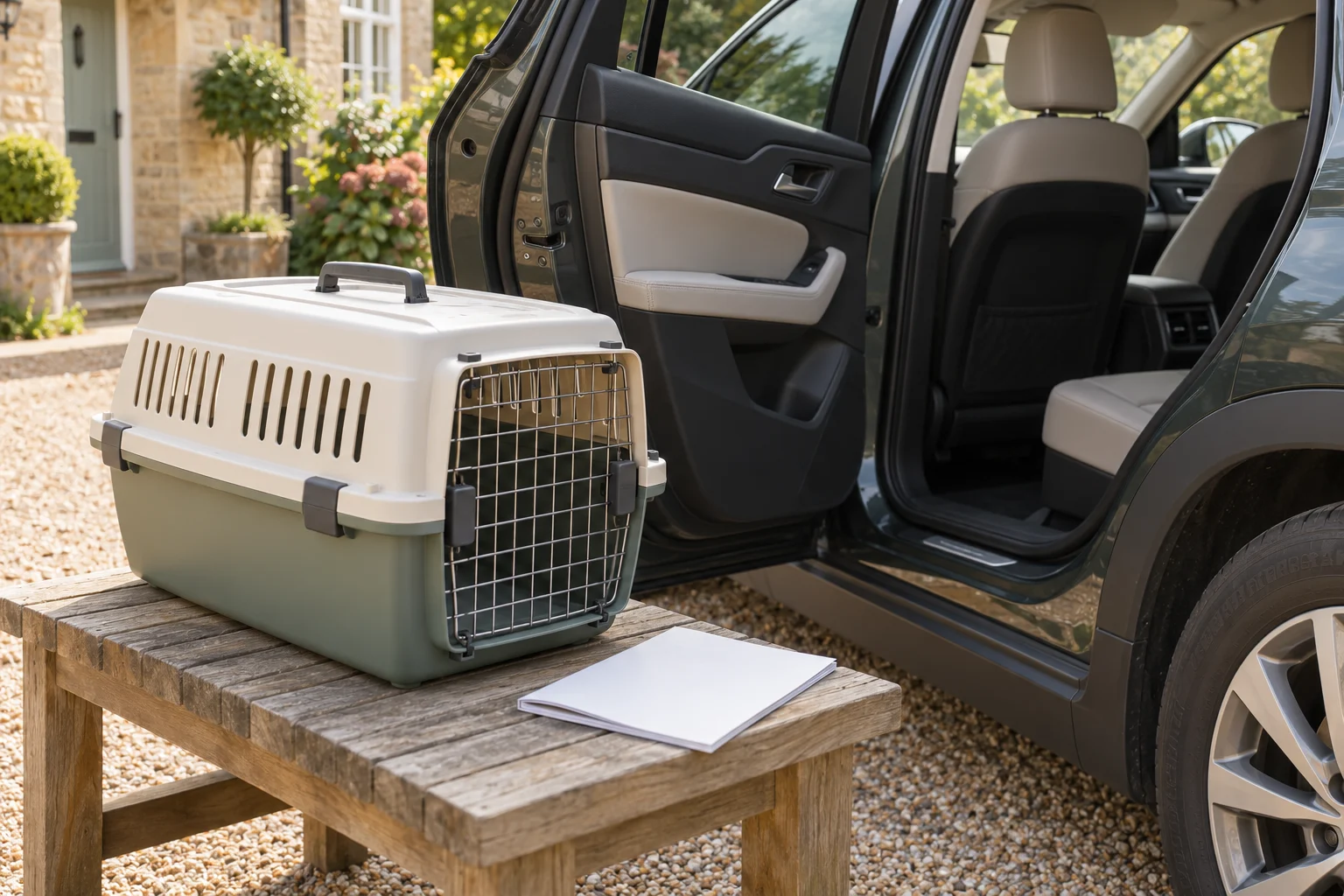
Use the exact carrier instructions and vehicle handbook, with the cat contained and ventilation clear. The Catit Cabrio manual shows its seat belt passing through the moulded handle before buckling; that method must not be generalised to another carrier’s handle. A belt feature alone is not a crash-testing claim.
Secure a cat carrier using the carrier’s exact transport instructions and the vehicle handbook. A carrier that sits on a seat without restraint can move during braking or a turn. Equally, a belt placed around a random handle is not automatically the intended securing method for every model.
Prepare the carrier, belt route and ventilation before putting the cat into the car. Keep the cat inside a properly closed carrier for the journey. If you cannot establish a supported arrangement, ask the carrier maker and vehicle supplier rather than improvising a universal solution.
Understand the restraint requirement
Highway Code Rule 57 says animals should be suitably restrained so they cannot distract the driver or injure themselves or people if the vehicle stops quickly. It lists a pet carrier among suitable restraint approaches. It does not provide one belt path for every carrier, vehicle and seating position.
A statement that a carrier has a seat-belt feature is also different from independent evidence of crash testing. Do not assume a conventional travel carrier has a certified crash-performance rating because a belt can pass through it. Use any specific testing claim only with evidence for that exact model and installation.
For ordinary planning, the practical questions are whether the carrier can be installed as instructed, whether the vehicle permits that arrangement and whether the cat remains contained and ventilated. More accessories are not automatically a better answer if they alter the intended belt path.
Check the carrier and car while the carrier is empty
Place the empty carrier in the intended position and read both sets of instructions. Identify the actual securing points on the carrier and check that the belt can reach and latch without extension, twisting or an improvised connector. Confirm the carrier sits stably rather than balancing on an edge.
Do not obstruct a door, buckle, seat mechanism or the driver’s controls. Keep the carrier away from a position where an airbag could strike it; use the vehicle handbook and carrier instructions when choosing the seat. A front passenger seat is not a default solution for a cat that is vocal in the back.
Consider ventilation around the carrier, including air outlets, surrounding luggage and any light cover. Never pack bags tightly over the vents or use heavy bedding that blocks the door. Keep loose luggage secured separately so it cannot move into the carrier during travel.
Catit Cabrio: a model-specific belt example
Wide-opening carrier
Catit Cabrio carrier, turquoise
A rigid carrier with a wide-opening upper section and front access, designed to make the inside easier to reach. It can remain open at home as a familiar resting space between visits.
Check: Outer dimensions do not establish inside fit
View on Amazon ↗The Cabrio manual illustrates placing the carrier on the vehicle seat and passing the conventional seat belt through the moulded carrier handle, then fastening the vehicle buckle. Use the illustrated orientation and belt routing in that manual for this exact model, drawing the belt into its normal secure position without changing the route.
This instruction belongs to the Cabrio. It does not establish that another carrier’s carry handle is a restraint point. A handle can have a different structure, attachment or purpose even when it appears similarly positioned.
Read the original diagram before installation and confirm the arrangement is suitable in your vehicle. If the belt geometry does not allow the illustrated method, do not add an unapproved extender, clip or strap to force it. Ask for a supported alternative or choose a carrier that can be installed correctly in the available vehicle.
Keep restraint, carrying and animal harnesses separate
A carrier’s shoulder strap is primarily a carrying feature unless its maker explicitly gives it a vehicle-restraint role. Do not clip a vehicle belt to a random strap ring or loop an extra strap around the door to create a different restraint system.
Do not attach a cat’s collar or harness to an improvised point inside the carrier to compensate for an unsecured box. A separate animal-restraint product has its own fit and installation requirements. Mixing unrelated systems can add entanglement or loading problems without establishing that either works as intended.
A footwell may be mentioned in guidance for some transport arrangements, but it should not be treated as a universal alternative to the exact carrier instructions. Check the model and vehicle rather than pushing any carrier into a space where doors, vents or structure are compressed.
Use lining that fits without changing the restraint
A washable absorbent carrier-floor layer
rocket & rex reusable carrier pads, pack of two
Two washable multilayer pads with absorbent material and a waterproof backing. The listed 17.5 × 11 inch size needs matching to the actual carrier floor; it is not a universal fit.
Check: Do not cut through the sealed multilayer edge
View on Amazon ↗A suitable absorbent pad can help manage an accident during a vet journey. The selected reusable pad has to fit the actual carrier floor; its stated size is not a universal fit. Keep a clean spare separately so it remains usable if the first becomes wet.
The pad is not a restraint component. Do not let thick layers alter the cat’s usable room, cover vents, interfere with a door or obstruct the carrier’s belt points. Check for sliding and bunching before travel, and use the carrier maker’s permitted floor arrangement.
Compare carrier liners and absorbent pads for the difference between absorbency, waterproof backing and draining fleece. Comfort and containment are related practical concerns, but a soft lining does not secure the carrier to the car.
A practical departure sequence
- Inspect the carrier’s structure and closures, then fit the clean suitable liner while it is empty.
- Confirm the vehicle position and exact restraint route in advance, with the required instructions available.
- Load the cat calmly in a secure indoor space and close every intended door, zip and lock.
- Carry with the base supported as appropriate, place the carrier in its planned position and secure it using the supported method.
- Check the buckle, belt route, stable position and clear ventilation before starting the engine and moving off.
Make the final check with the car parked. Do not reach back to adjust a carrier or deal with an escaped cat while driving. Pull over safely before addressing a problem, and keep doors and windows controlled so the cat cannot escape when you stop.
Before moving the car
0 of 5 checks complete.
Protect ventilation and containment throughout the journey
Keep the cabin comfortable and avoid placing the carrier in direct sun. A cover should be light and arranged so it does not block ventilation or interfere with the restraint; remove or adjust it if it traps heat. Never leave the cat unattended in a parked vehicle.
At a stop or destination, do not open the carrier in an unsecured car park to reassure the cat. Move into the controlled environment agreed with the vet or destination before opening. For a distressed or unwell cat, contact the vet for specific handling and journey advice rather than repeatedly interrupting containment.
The vet-visit preparation guide covers appointment details and spare bedding. If a door or shell is doubtful, use when to replace a carrier before relying on any belt arrangement.
Road, welfare and manufacturer references
Read Highway Code Rule 57, Cats Protection’s travel guidance and the Catit Cabrio manual, including its vehicle diagram. The manufacturer’s diagram supports the Cabrio example; it is not a universal installation diagram for other carriers.
Frequently asked questions
Can any cat carrier be secured by threading the seat belt through its handle?
No. The handle route illustrated here is supported for the Catit Cabrio. Other handles may be intended only for carrying. Follow the exact carrier and vehicle instructions.
Does a seat-belt-compatible carrier mean it is crash tested?
No. A securing feature and independent crash-performance evidence are different claims. Do not infer a certification from a belt slot, handle or general travel description.
Should I put the carrier on the front passenger seat?
Do not treat that as the default. Choose a position permitted by the carrier instructions and vehicle handbook, considering airbag risk and secure installation. Cats Protection describes securing a carrier on a back seat.
Can an absorbent pad help secure the carrier?
No. A liner manages the carrier floor and possible accidents. It is not a vehicle restraint, and it must not interfere with closures, ventilation or the supported belt route.
What should I do if the cat becomes distressed while I am driving?
Keep driving attention on the road and stop safely before addressing a problem. Keep the cat contained in an unsecured location, maintain ventilation and contact the vet for individual advice if the cat is unwell or severely distressed.