
Buying guide · Cat beds & resting
Best low-entry cat beds
Compare flat fleece and a reversible fabric pad without raised rims. Look at the approach, floor grip and usable resting area before choosing a cat bed.
The short answer
A rimless surface with a usable approach
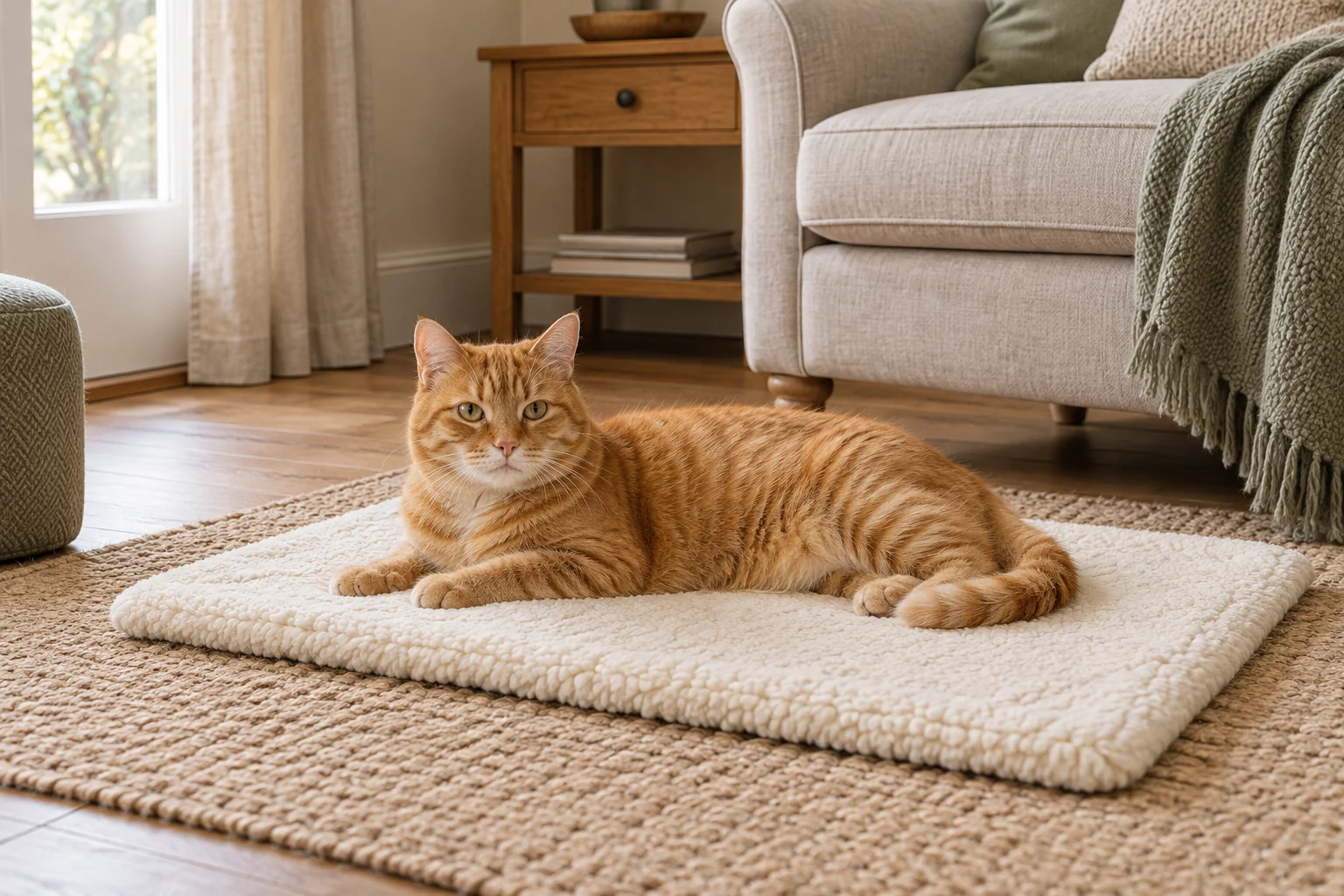
Start with a rimless mat rather than assuming a bed with a dipped front has easy access. Vetbed Original offers a broad fleece surface; the K&H Self-Warming pad is a smaller reversible fabric option with no electrical supply. Check the actual edge thickness, grip and room for your cat to settle. Neither is a treatment or a guarantee of comfortable access.
Compare the options
| Option | Listed full size | Sleeping arrangement | Check before choosing |
|---|---|---|---|
| Vetbed Original | 40 × 30 in / approx. 102 × 76 cm | Broad fleece mat | Original backing and floor grip |
| K&H Self-Warming pad | 53.3 × 43.18 cm | Reversible fabric pad; no electricity | Actual edge thickness and usable room |
Remove the barrier you actually see
A low-entry cat bed should make the approach and settling movement manageable. A dipped front can look inviting while still leaving a substantial step onto a thick cushion. A bed without any raised surround is a clearer starting point when crossing a bolster is the problem.
Watch the whole sequence: walking towards the bed, stepping onto it, turning, lying down and getting up again. A product can be easy to enter but too narrow to turn on, or soft enough that a cat has trouble finding stable footing. Choose around the individual rather than an age label.
The two selected options are a rimless fleece mat and a reversible fabric pad. They give you different sizes and surfaces without adding a high perimeter. New discomfort or reduced movement needs your vet's advice.
Vetbed Original: a broad fleece resting surface
Petlife Vetbed Original, grey 40 × 30 in
Best for: A flat fleece resting surface
A flat washable fleece with the Original green backing. The selected listing is a generous 40 × 30 inch piece, useful when you want a continuous resting surface rather than a bed with raised sides.
What stands out
- No bolster reduces the flat sleeping area
- Can be washed separately from surrounding furniture
Keep in mind
- Original backing is not the Non-Slip range
- Check the supplied care label rather than borrowing another backing’s wash settings
- 40 × 30 in listed size
- Original green backing
- Machine-washable mat
The selected Vetbed Original is listed at 40 × 30 inches, approximately 102 × 76 cm. It offers a broad uninterrupted fleece surface rather than a small bed surrounded by raised sides. That can be useful when a cat tends to stretch out or prefers being able to approach from more than one direction.
The measurements refer to the full piece. Decide how much of that outline you can leave flat in a quiet location; folding excess material underneath can create a thicker uneven edge. If adapting the mat's size is part of your plan, follow the maker's directions for the exact supplied product rather than assuming every backing can be altered in the same way.
This is the Original family with green backing, not the separate Non-Slip family. Check how it behaves on your flooring. A fleece surface that moves as the cat steps on can lose the access advantage of having no bolster. Keep any suitable support beneath it flat, and do not build a stack of loose layers.
Petlife's Vetbed Original information identifies the product family and its care context. Use the supplied care label for temperatures and drying. We do not transfer a wash temperature from a different listing, backing or Vetbed version.
Choose it for: a broader fleece area without raised sides. Main check: whether the actual backing and whole arrangement stay secure on the chosen floor.
K&H Self-Warming pad: a smaller rimless option
K&H Self-Warming pet pad, oatmeal/chocolate
Best for: A flat fabric pad with no raised surround
A reversible fabric pad without a raised bolster, listed at 53.3 × 43.18 cm. It uses no electricity; treat the self-warming description as a material feature, not a temperature guarantee.
What stands out
- No raised perimeter to climb over
- No plug or power cable
Keep in mind
- Confirm floor grip and supplied care label
- International package and instructions may vary
- 53.3 × 43.18 cm listed size
- Reversible fabric pad
- No electricity required
The selected oatmeal/chocolate K&H pad is listed at 53.3 × 43.18 cm, roughly 21 × 17 inches. Its reversible fabric surface and absence of a raised perimeter give a different footprint from the larger Vetbed piece. Compare it when you want a smaller sleeping patch that can remain fully flat.
Check the actual usable dimensions against how your cat rests. A pad that fits a curled body may leave the head or limbs unsupported when the cat changes position. Rimless does not mean size is irrelevant: the cat still needs a comfortable surface for its ordinary sleeping outline.
The product uses no electricity. Its self-warming description is a material feature, not evidence that it reaches or maintains a particular temperature. Do not treat it as an adjustable heater or combine it with another heat source without explicit manufacturer support.
The Amazon UK listing identifies an international product, so confirm the selected size, package and care instructions before ordering. Check the backing and stability in its actual position. Neither a familiar brand name nor a fabric photograph establishes how much grip the underside provides on smooth flooring.
Choose it for: a smaller reversible fabric pad without a raised rim or power cable. Main check: edge thickness, floor grip and whether the resting area really fits the cat.
Flat does not mean zero height
Record the edge the cat must cross, including the mat, any underlay and the floor beneath. A thick mattress can have no bolster yet still require a larger step than a thin fleece pad. A folded blanket beneath the front edge can also change the route.
Keep the resting surface flat and avoid rolled corners. Notice what happens when the cat places weight near the edge: does it bunch, slide or compress unevenly? An arrangement that looks neat while empty may behave differently during turning or standing.
Do not describe a mattress as accessible solely because its name contains senior, orthopaedic or low profile. Compare its actual height and structure, and ask for missing measurements when they determine the choice. Individual advice about support or movement takes priority over a general buying guide.
Match the usable sleeping area
Look at a familiar sleeping patch while the cat is elsewhere. Include the space occupied by the head and ordinary changes in posture. A broad rimless surface can offer more usable area than a larger outside bed with substantial bolsters, but only if it stays supported and flat.
A simple paper outline is useful for comparing the two sizes with the room. Leave room beside the pad for standing and turning rather than fitting the last corner tightly between a chair and cupboard. The route out matters as well as the space occupied while lying down.
For multiple cats, keep separate resting choices. One broad mat does not establish that cats want to share it, and placing all beds in one narrow corner can leave the same approach vulnerable to being blocked. Spread useful options through suitable areas of the home.
Position matters as much as the rim
A floor-level option avoids adding the height of a sofa or shelf. It still needs a calm, dry place where the cat is not frequently stepped over or disturbed. Keep it clear of door swings, busy routes and equipment that starts unexpectedly.
Think about temperature without turning the bed into a heating project. Avoid placing fabric where it contacts a heater or where a cat cannot move away from an excessively warm spot. Follow all product instructions and any veterinary advice about the cat's needs.
If the cat already has a familiar bed, provide the new choice nearby where practical. Removing the old resting place immediately can change several things at once. Voluntary use provides more useful information than repeatedly carrying the cat onto a new pad.
Check grip as a complete arrangement
Backing, underlay and flooring work together. A non-slip layer may hold against the floor while the top pad still shifts over it. A loose rug can move with the bed. Test the whole setup gently before the cat uses it and observe ordinary access afterwards.
Do not use improvised tape, adhesive or a raised surround that creates new edges to cross. If a product will only remain usable with extensive alteration, another model may be a more practical choice. Keep the setup simple enough to lift, inspect and clean.
Any mat or bed can become less stable when damp, dirty or damaged. Include the underside and surrounding floor when checking its condition, rather than assessing only the visible sleeping fabric.
Cleaning while keeping a resting choice available
Both fabric condition and access matter after washing. Follow the exact label, dry the item fully and check whether the edge has curled or the filling has changed shape. Do not assume a bed is ready because the surface feels dry while deeper material remains damp.
Our washable cat-bed guide focuses on which components can go into a machine and how their routines differ. This guide's priority is the approach and usable surface. A washable bed with high sides can be an excellent cleaning choice but still answer a different access need.
Having another familiar resting option helps while one item is being cleaned. It also lets you compare whether the cat chooses a different surface or position without removing every other option.
Sources and boundaries
The selected Amazon UK brand listings establish the packages and stated dimensions; Petlife identifies the Vetbed Original family. Floor grip, edge thickness and individual fit still need checking on the supplied items. These are equipment choices, with no promise of pain relief, controlled heat or treatment of reduced mobility.
For access and care after purchase, use bed placement and the washing routine. A flat mat still needs a secure position and fully dry layers.
For a flatter resting surface without a powered element, compare non-electric self-warming mats. Check that the mat lies securely without raising the step into an existing bed or covering the only comfortable place to move away.
Frequently asked questions
What makes a cat bed low entry?
Consider the actual floor-to-sleeping-surface step and whether a raised rim must be crossed. A flat pad removes a bolster but still has thickness. Check its edge on the surface where it will be used, rather than relying on low-entry or senior-friendly wording.
Is a flat mat better than a bed with sides for an older cat?
It can remove a barrier, but an older cat’s preferences and movement vary. Compare the route, support, warmth and usable area, and keep a familiar option available. New difficulty settling, standing or moving deserves veterinary advice rather than being attributed to the old bed alone.
Does the K&H self-warming pad need plugging in?
The selected Self-Warming pet pad does not use electricity. Its warming description refers to the product’s material design, not a controlled temperature. It is different from an electric heated bed; follow the supplied instructions and do not add unsupported heating equipment.
Can Vetbed Original be used on a slippery floor?
Check the supplied backing and its actual behaviour on that floor. Original green backing is distinct from the Non-Slip product family, so do not transfer grip claims between them. The whole mat and any suitable support underneath must stay flat and secure during approach and standing.
Should a low-entry bed be placed on a sofa?
Putting a flat pad on a sofa does not create floor-level access. The cat still needs to reach the sofa and leave it. If reducing the step is the main aim, assess a suitable floor position first and consider any individual veterinary advice about movement or support.