
Practical guide · Play & enrichment
How to rotate cat toys
Create a manageable toy rotation with supervised play, safe storage and easy cleaning. Match toys to your cat’s response rather than a rigid replacement calendar.
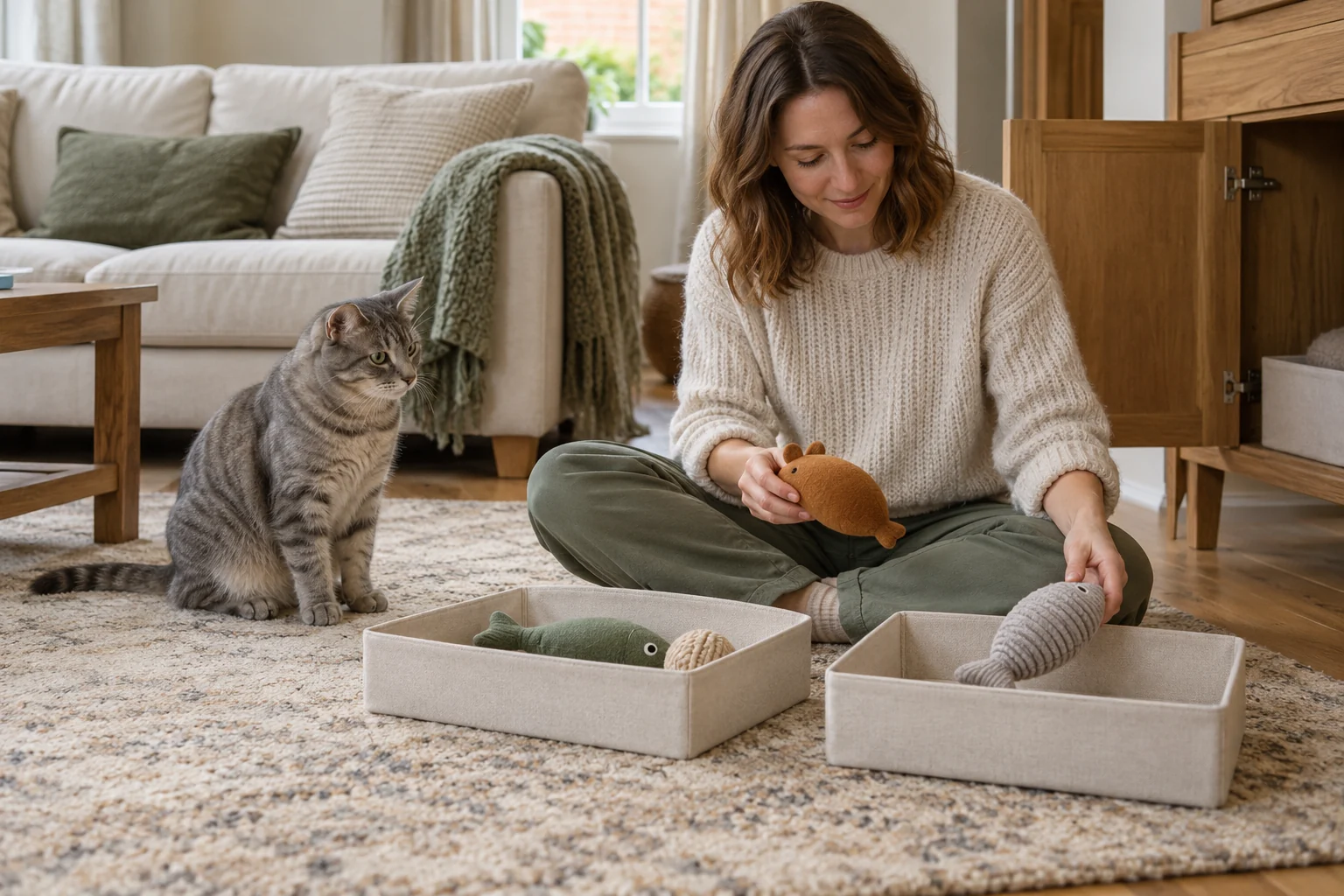
The short answer
Rotate a few choices, inspect every return
Keep a small selection available, reserve wand and string toys for supervised games, and store the rest securely. Swap one or two safe items when interest fades, while keeping familiar resting places and scratching outlets. A rotation should help you notice preferences and inspect equipment; it does not require a weekly shopping list or a rigid timetable.
A floor covered in toys does not necessarily provide a varied day. Some items may be ignored, others may have become damaged, and the most interesting game may still depend on a person moving one simple lure. Rotation is a way to organise those choices, rather than a reason to buy more.
Start with what your cat uses already. This guide focuses on keeping a useful selection, storing it safely and changing the routine deliberately. For low-cost activities beyond bought toys, see indoor enrichment on a small budget.
Sort toys by how they should be used
Make three groups: items that need a person present, items suitable for independent use in your household, and items awaiting cleaning or replacement. Read the instructions and inspect each toy rather than sorting by appearance alone. A large-looking toy can still have a small attachment that comes loose.
Wands, ribbons, elastic and toys with long lines belong in the supervised group. A cat that has previously ignored a cord may chew it another day. Put damaged items out of reach immediately instead of leaving them in the storage basket as something to mend eventually.
Cats Protection’s play guidance recommends changing toys around, inspecting wear and avoiding unattended items that can be eaten or cause tangling. Build those checks into the rotation itself, so storage never turns a known hazard into tomorrow’s surprise.
Notice the action your cat enjoys
Watch whether the cat follows a slow floor movement, bats a rolling object, hides before pouncing or holds a larger soft toy. Note the time and setting as well as the object. A toy offered while the cat is sleepy may receive a different response when they are naturally alert.
Try a game on a clear rug rather than repeatedly presenting the same toy in a crowded corridor. Change one element at a time. If you swap the toy, location and movement together, you cannot tell which part helped.
Treat watching and stalking as engagement too. A cautious cat may spend time observing before approaching. Do not push the toy into their face or increase speed simply because they have not pounced. Give them a route away and a chance to choose.
Create two small sets
One set can contain a suitable rolling or batting item and an accessible hiding option. The other can offer a different texture or movement. Keep the supervised wand stored separately so it does not accidentally become part of the unattended selection.
A set is a practical household grouping, not a prescription for a fixed number of objects. In a small room, one useful item in a clear place may be better than several scattered across a walkway. For several cats, spread resources and offer separate play opportunities rather than making them compete around one basket.
Keep favourite safe items when they remain useful. Rotation should not mean taking away every familiar thing on a schedule. Beds, litter trays, water and essential scratching outlets are continuing resources, not novelty toys to withdraw for effect.
Use a simple rotation record
A note on your phone or inside a cupboard can record what was offered, the response and any maintenance needed. You do not need scores, an app or a complicated spreadsheet. A few specific observations are enough to avoid repeatedly buying the same unsuccessful type.
| Activity | Example observation | Next useful change |
|---|---|---|
| Slow floor chase | Cat stalked and caught the lure calmly | Repeat a short game later |
| Rolling toy | Ignored on slippery flooring | Try a safe clear rug while supervised |
| Tunnel exploration | Cat entered but another pet blocked the exit | Move it and provide separate access |
| Food search | Food was easy to retrieve without chewing the tray | Keep the challenge simple before increasing it |
Use the record to simplify, not to make the cat complete a programme. Stop an activity that repeatedly frightens or frustrates them. A cat can enjoy a familiar game without needing a harder version every time.
Keep the wand as an invitation to play together
The Cat Charmer provides a simple fabric lure on a hand-held wand. It can be brought out for a short chase-and-catch game, then put away completely. Its value comes from controlled movement and interaction, rather than leaving the strip on the floor for later.
For interactive play
Cat Dancer Cat Charmer wand
A hand-held polycarbonate wand with a colourful fabric strip for interactive chase-and-catch games. The supplied colour varies; keep the whole toy for supervised use and store it securely afterwards.
Check: Fabric can be chewed or swallowed; supervise closely
View on Amazon ↗Inspect the fabric and attachment before each use. Let the cat catch the lure, then reduce tension rather than pulling hard against teeth or claws. If the cat tries to swallow fabric, stop that game and choose another activity. Our wand-safety guide covers setup, catches and storage in detail.
Colour or pattern is a minor consideration compared with condition and the cat’s response. Do not replace a sound toy solely because a different colour is marketed as more exciting. Likewise, no material should be treated as indestructible.
Change the setting with a suitable tunnel
A tunnel can add hiding and approach choices to a room. The Vesper Tunnel offers a curved fabric layout and a removable cushion; its overall dimensions describe the whole arrangement, not the clear opening. Check that your cat can enter, turn where needed and leave without being blocked.
Explore and hide
Catit Vesper Tunnel, grey
A foldable fabric tunnel with a peekaboo opening and a removable round cushion. It gives a cat somewhere to explore and pause, and can be put away when you need the floor space back.
Check: Check usable tunnel space, not just outer dimensions
View on Amazon ↗You might offer a tunnel during one rotation and return to a clear open play area during another. Keep it away from door swings and inspect the structure before unfolding it. Follow the exact care instructions and remove any attachment that requires active supervision when play ends.
A tunnel does not need to be constantly repositioned if the cat uses it as a comfortable familiar rest. For other layouts and smaller options, see cat tunnels for home use.
Inspect and clean before storing
Check seams, eyes, bells, fasteners, fabric strips and any exposed support. Put a suspect toy in a separate closed container pending repair or disposal. Do not mix it back into the clean set because only one small part looks loose.
Follow the care label for washable toys and let them dry fully before closing the storage box. Avoid assuming that every fabric toy can share a washing-machine programme. Electronic, cardboard, glued and catnip-filled items can have very different care requirements.
Store food puzzles clean and dry, without old food hidden in a recess. Keep their small removable parts together. A puzzle returned after a break should still be easy to use; absence does not make a difficult mechanism an appropriate starting challenge.
Make storage work for everyone at home
Choose a cupboard or secure container the cat cannot open, with cords fully inside. A wand standing upright in an open basket can leave its lure reachable even when the handle seems out of the way. Check the storage place from the cat’s climbing routes as well as from the floor.
Agree which items need supervision and where used toys go. That matters when another person tidies up, a child wants to play or a visitor brings a gift. Keep manufacturer instructions with any toy whose cleaning or replacement parts are specific.
In a multi-cat home, offer some one-to-one play and observe whether one cat consistently takes over. Rotating the object does not resolve blocked approaches or competition by itself. More space between activities may be more useful than a larger toy collection.
Adjust the routine to the response
Bring a stored item back when it would add a useful choice, not merely because a calendar says it is due. A few brief games can suit a cat better than one long session. End while the interaction remains manageable, with chances to catch and settle.
If interest fades, review the movement, timing and difficulty before shopping. If the cat’s usual activity changes sharply, involve your vet. A rotation is successful when the cat has enjoyable choices and the household can keep the equipment safe and clean.
Choose different play movements: ball tracks offer a captive moving target, while kicker toys provide something to grip and wrestle.
Food-contact toys need their own cleaning routine. For feather wands, identify supported replacement attachments before throwing away an otherwise sound complete toy.
Frequently asked questions
How many cat toys should I leave out?
There is no useful fixed number for every cat or room. Leave a manageable selection of suitable independent-play items, then inspect how they are used. Keep wand toys, loose strings and anything that could be swallowed or tangled away unless a person is actively supervising.
Should I change all the toys every day?
You do not need to. Change a small part of the selection and watch the response, keeping familiar safe favourites when they are still enjoyed. A complete daily change can make it harder to identify what your cat likes and creates extra cleaning without a clear benefit.
Does putting a toy away make it interesting again?
It may, but it is not guaranteed. Movement, location, texture and the way a person plays can matter as much as novelty. Try a shorter, easier game or a different approach before assuming the cat needs a new product.
Can I leave a tunnel out between games?
Only if the particular tunnel is suitable for that use, stable and in good condition. Remove loose toys or cords that need supervision and check for exposed supports, damaged seams or trapping points. Keep the route through the room and the tunnel’s exits clear.
What if my cat suddenly stops playing?
Look at timing and the difficulty of the game, but do not explain a marked change only as boredom. New reluctance to move, changes in appetite or other unusual behaviour need veterinary advice. Offer easy choices without forcing activity while you investigate.