
Practical guide · Water fountains & bowls
How to clean a cat water fountain
Clean the reservoir, drinking surface, filter and serviceable pump parts in the right order. Includes PIXI-specific care, limescale checks and safe reassembly.
The short answer
Clean the bowl, filter and pump as separate tasks
Unplug the fountain before handling it, provide a separate fresh-water bowl, then clean the reservoir and drinking surfaces, deal with the filter separately and service the pump only as the exact manual allows. Rinse thoroughly, reassemble correctly and fill to the specified level before restarting. A fresh filter or flowing water does not replace physical cleaning.
A fountain has several surfaces that need attention: the visible drinking area, the reservoir, small water passages and serviceable pump parts. Clear water at the top does not tell you whether the hidden parts are clean. Likewise, replacing a filter does not remove residue from the bowl.
This guide gives a practical order of work, with a specific standard Catit PIXI example. Use the instructions for your exact fountain whenever a part, cleaner or maintenance interval is uncertain. Our easy-clean fountain comparison helps if the current design is too awkward to maintain.
Identify the model before taking it apart
Find the name, model code and manual while the fountain is dry and disconnected. Similar-looking models may have different pumps, filter holders and dishwasher permissions. A standard PIXI, a stainless-top PIXI and a Smart or UV model should not be treated as one identical assembly.
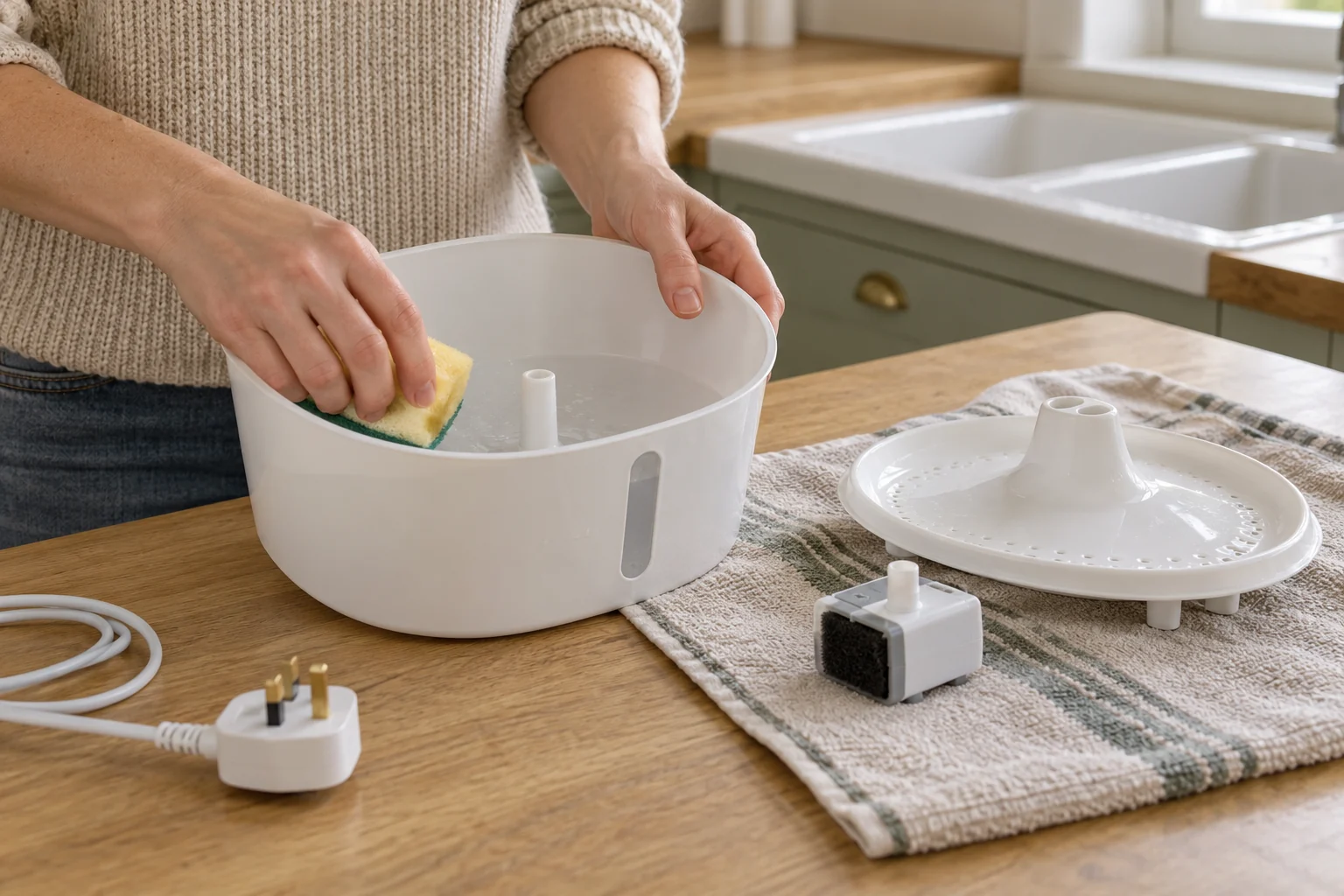
Keep a photograph or the manual’s parts diagram nearby. Lay out a clean towel for removable parts so a small cover or seal does not disappear beside the sink. If something resists removal, check the instructions rather than forcing a clip or pulling on the power cable.
Separate the maintenance tasks in your notes: refreshing water, washing surfaces, rinsing or replacing filters, and cleaning the pump. Completing one does not automatically complete the others. A short repeatable routine is easier to maintain than waiting until the fountain becomes unpleasant to handle.
Prepare a safe cleaning space
Offer fresh drinking water in a separate clean bowl before removing the fountain. Choose a stable work area with room to keep electrical connections away from splashes. Use clean tools reserved for the task, such as a soft sponge and appropriately sized soft brushes where the manual allows them.
Disconnect power before handling or removing parts. Keep the adapter and connections dry. If a socket or plug is wet, do not touch it; isolate the supply safely and obtain appropriate help. Stop using equipment with damaged cables, cracked electrical parts or unexplained leaks.
Do not lift a pump by its cable. Keep small removed parts away from children and pets. These preparations make it easier to clean carefully without rushing to provide the cat’s only water source again.
Empty and clean the reservoir and drinking surface
Pour away old water and remove visible hair or food particles. Separate the washable bowl parts from the filter and electrical components. Work over a surface where small parts cannot disappear down a drain.
Use the cleaning method approved for those parts. Pay attention to seams, corners, spouts and the underside of the drinking plate rather than wiping only the visible centre. A brush should reach a passage without scratching it or becoming stuck.
Rinse until no cleaning residue remains. Inspect in good light and feel accessible surfaces with a clean hand; if an area remains slippery or dirty, it needs further attention using the permitted method. Do not cover an unresolved problem by adding fragrance or a stronger chemical.
Clean serviceable pump parts deliberately
Consult the pump diagram before opening it. Many small fountain pumps have a removable front cover and impeller assembly, but the opening method is model-specific. Do not pry into sealed electrical housing or remove parts not intended for user maintenance.
Place components in order on the towel. Remove accessible hair and debris carefully, rinse permitted parts and inspect for damage. Keep a soft brush separate from tools used on dirty household drains or harsh cleaners. If a seal or tiny shaft is displaced, find the correct fitting information before reassembly.
Do not test a pump on a dry worktop. Refit it and fill the fountain correctly before restoring power. If it still fails, leaks or makes unusual noise after the manual’s checks, leave it disconnected and contact the manufacturer rather than attempting an electrical repair.
Standard PIXI: the important model-specific details
The Catit PIXI manual for models 43715–43720 specifies cleaning the fountain and rinsing the filter every three days, with pump cleaning weekly. It calls for a soft sponge, non-abrasive cleanser and thorough rinsing. The filter is rinsed without soap; replacement is normally every three to four weeks, or sooner for debris or restricted flow.
For the pump, the manual shows removal of the cover, impeller cap and impeller, followed by rinsing and careful reassembly. Keep the pump fully submerged during operation. The stainless-top model has separate dishwasher guidance for its top; that is not blanket permission for the standard plastic fountain or electrical parts.
Visible water level
Catit PIXI drinking fountain, white
The standard white PIXI fountain has an illuminated water-level window and uses the PIXI filter family. It is worth comparing if you want an easy visual reminder to check the water, alongside a routine for washing the reservoir and pump.
Check: Needs power, pump cleaning and replacement filters
View on Amazon ↗The linked product is a standard white PIXI. This example helps explain the care sequence; you do not need to replace a functioning fountain merely to follow a cleaning guide. Keep the exact manual with the item you actually own.
Treat filters as a separate compatibility task
Remove a filter before washing the bowl parts. Check its family, shape and product code before replacing it. A filter that can be pressed into a holder is not necessarily the right filter for that fountain.
For the PIXI family, the linked genuine six-pack is a relevant replacement option. It is not a Flower or Mini Flower filter. Our Catit filter compatibility reference compares the different families and explains why pack count alone is not a reliable identifier.
For PIXI fountains
Catit PIXI genuine filters, 6 pack
The six-pack PIXI filter format, part 43722. Match it to the PIXI fountain family; a Flower or Mini Flower filter is a separate choice.
Check: Not a full-size Flower or Mini filter
View on Amazon ↗Store unused filters clean and dry in their packaging. Do not add soap, disinfectant or descaler to a filter unless its own instructions expressly require a method. A scheduled replacement reminder can be useful, but inspect the actual condition as well.
Handle limescale without guessing a recipe
Mineral deposits can build up around water lines and narrow passages. The suitable removal method depends on the material and the part. A technique permitted for a removable bowl may not be permitted for a pump, coated surface or seal.
Ask the manufacturer for the approved method when the manual is unclear. Do not transfer a social-media vinegar recipe across every fountain. Avoid abrasive scraping that could damage the surface, and never mix cleaning chemicals. Rinse and inspect before putting any treated component back into service.
Hard-water deposits may make a routine need adjusting, but they do not justify running the fountain with additives in the drinking water. Clean components separately using approved instructions, then refill with suitable fresh drinking water.
Reassemble and check the first flow
Compare the assembled parts with the diagram. Make sure the pump is seated, passages align and any required covers are fitted. Confirm the filter is prepared and positioned as instructed, rather than leaving it blocking an outlet.
Fill to the specified level before switching on. Dry the exterior and check connections remain dry. Once running, observe the flow and listen for unusual sounds. Look around and beneath the fountain for leaks without moving it by the cable.
Keep the separate bowl available while you confirm normal operation. If the flow is poor, disconnect before adjusting anything. A fountain that repeatedly needs topping up far beyond normal use may have a leak or assembly problem that deserves investigation.
Make the routine easy to repeat
Check water level and visible condition daily, and refresh water as needed. Keep the deeper cleaning schedule from the manual somewhere convenient. Adjust sooner when food, hair or residue appears rather than waiting for the next planned task.
Locate the fountain where you can lift it without stepping over cables or other equipment. Water-station placement affects maintenance as well as drinking access. An awkward corner can turn a simple wash into a job that keeps being postponed.
A change in drinking or urination is not something to explain solely through fountain cleanliness. Speak with your vet about a sustained change, while keeping clean water freely available.
Check before returning it to use
Fountain cleaning checklist
0 of 5 checks complete.
Keep the tools and instructions together for next time. A fountain is easiest to live with when its care is a regular small task rather than an occasional complete rescue.
If you are reconsidering the upkeep, compare a cat fountain with a water bowl by daily care and the cat’s actual drinking choice.
If the unit becomes noisy, work through the fountain noise checks before ordering parts. The running-cost guide and calculator separates electricity, filters and other ownership costs.
For other brands, use the separate Cat Mate and PetSafe Drinkwell references. Their carbon and foam parts should not be inferred from the PIXI example.
Frequently asked questions
Can the whole cat fountain go in the dishwasher?
No. Dishwasher permission applies to specified removable parts, not automatically to the pump, cable, adapter, electronic base or filter. Check the exact model and part instructions. A stainless top on one version does not make another version’s plastic components dishwasher safe.
Should I wash the filter with soap?
For the PIXI filter discussed here, Catit says to rinse it without soap. Follow the instructions for your exact filter, and replace it when required rather than trying to clean it indefinitely. Keep filters separate while washing the fountain’s removable bowl parts.
How often should I clean a fountain?
Use the exact manual as the baseline and inspect daily for debris, residue, water level and flow. For the standard PIXI family cited here, Catit specifies fountain cleaning and filter rinsing every three days and pump cleaning weekly. Other models, heavier use or visible contamination may need a different routine.
Can I use vinegar to remove limescale?
Only if the maker explicitly permits it for the exact part, with its stated method and rinsing. Do not apply a universal vinegar ratio to every pump, coating, seal or filter. Never mix cleaning chemicals, and do not return a part to use while cleaning residue remains.
Why is the pump noisy after cleaning?
Check the water level, seating of the pump and the order of reassembly against the manual while the unit is unplugged. Trapped debris or an incorrectly fitted cover can affect flow. Do not repeatedly run it dry or attempt electrical repairs; stop using damaged or persistently faulty equipment and contact the maker.