
Buying guide · Litter & cleaning
Best large open litter trays
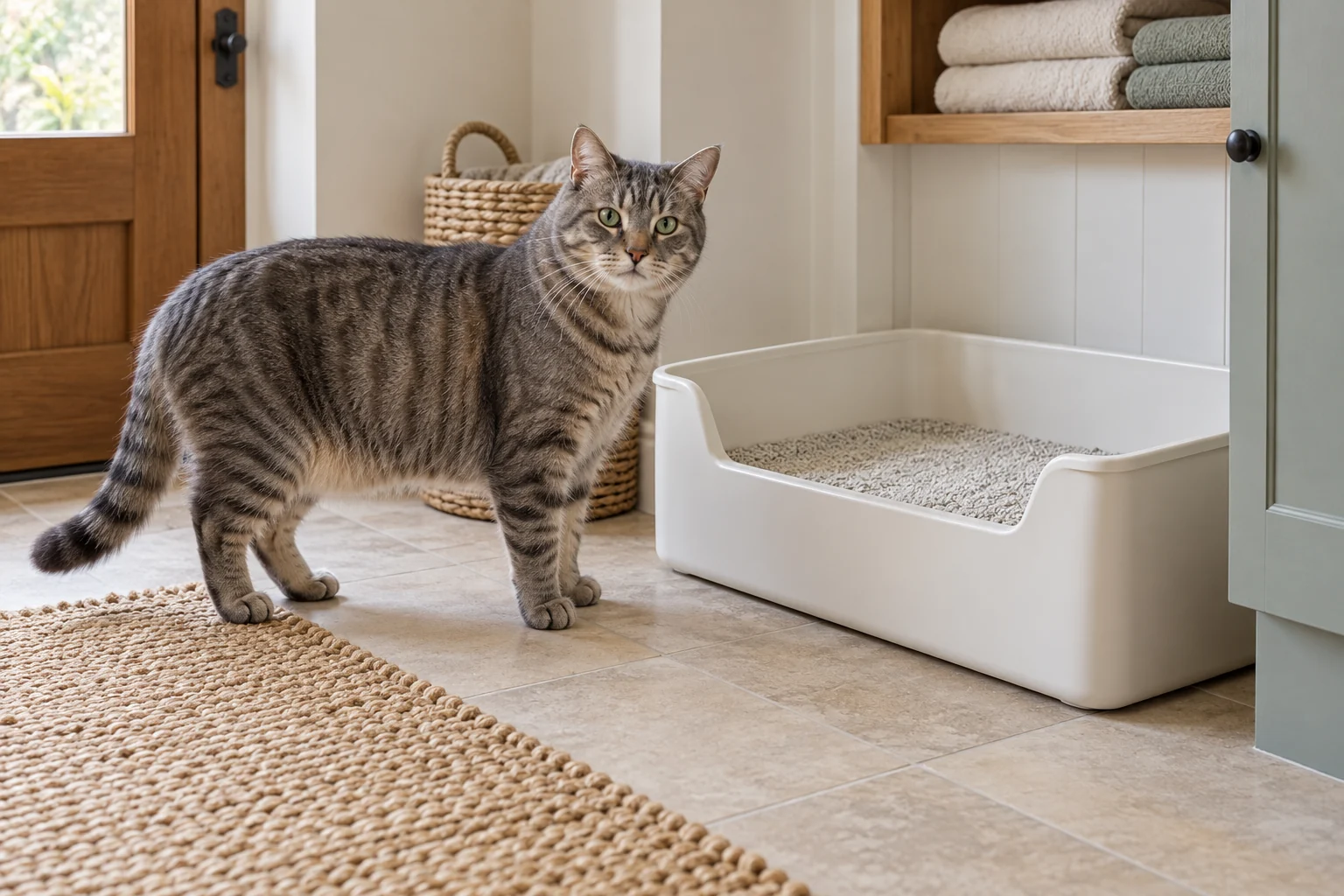
Compare roomy open litter trays by outside size, usable floor, entrance and cleaning access. Understand the trade-off between higher walls and a lower step.
The short answer
Compare inside room and the actual entrance
Compare the TRIXIE Primo XXL for the largest listed outer footprint here, the Suhaco for higher surrounding walls, and the Vealind XL for a stated lower corner entrance. Measure the usable inside floor and actual entry separately. A large outside rectangle does not prove that a cat has enough turning or toileting space.
Compare the options
| Tray | Listed exterior | Entry information | Primary reason to compare |
|---|---|---|---|
| TRIXIE Primo XXL open | 71 × 56 × 25 cm | Confirm exact front lip | Broader outside footprint |
| Suhaco high-sided | 61 × 48 × 31 cm | Lower front; exact height needed | Higher surrounding walls |
| Vealind XL | 60 × 40 × 15 cm | 7.5 cm corner lip | Lower documented step |
Compare the outside floor allocation, then check the entrance
An open tray must fit the home and give the cat usable space. The following area calculation answers the first question only; entry height and the inside floor still need their own checks.
| Tray | Published outside length × width | Calculated rectangle | Access or sizing distinction | Source |
|---|---|---|---|---|
| TRIXIE Primo XXL open | 71 × 56 cm | 0.3976 m² | Widest rectangle here; exact front lip and inside floor need confirmation | [1] |
| Suhaco high-sided | 61 × 48 cm | 0.2928 m² | High rear walls do not specify the height of its lower doorway | [2] |
| Vealind XL | 60 × 40 cm | 0.24 m² | Selected listing gives a 7.5 cm corner entrance | [3] |
The Primo’s outside rectangle is 65.7% larger than the Vealind rectangle. This does not establish the same percentage of extra usable toileting floor.
A smaller entry step and a larger inside floor answer different needs. Compare both before choosing the smallest exterior simply to save room.
Sources for this comparison
- TRIXIE Primo XXL specification — 71 × 56 cm outline; colour/model distinction retained in the guide.
- Selected Suhaco dimensions — Selected catalogue exterior dimensions; exact ASIN B0D78W1566.
- Selected Vealind dimensions — Selected catalogue exterior dimensions; exact ASIN B0G1H47BJT.
Large needs to mean usable space
A large open litter tray should offer more than an impressive label. Your cat needs space on the inside floor to turn, dig and position normally, along with an entrance it can use. The outside rectangle is useful for planning the room, but it includes walls, curves and any projecting rim.
Open trays remove the roof from the comparison. They do not necessarily have low sides or a low doorway. A high rear wall may help with containment while the front lip remains a separate access question. Start by distinguishing those measurements instead of comparing only the highest wall.
The three options below serve different priorities: a broader open footprint, tall surrounding sides and a stated lower corner entrance. Compare the usable floor, entry and approach separately. A new toileting problem needs a vet's advice, including if changing the tray appears to help.
TRIXIE Primo XXL: the broader outer footprint
TRIXIE Primo XXL open litter tray
Best for: A larger open tray with a removable rim
An open tray with a removable rim and a large 71 × 56 cm outer outline. The selected 40175 is the open version, distinct from a hooded Primo XXL Top.
What stands out
- Generous exterior outline
- Open top and detachable rim
Keep in mind
- Usable floor is smaller than the rim outline
- Check the actual entry height
- 71 × 56 × 25 cm outer size
- Selected model: 40175
- Removable rim
The open Primo XXL has an overall outline of 71 × 56 × 25 cm. That gives you a substantially different room-planning rectangle from many compact trays. Its removable rim helps distinguish it from a plain low pan, while leaving the top open for ordinary access and scooping.
The selected Amazon model is 40175, the open tray with a blue/white title. TRIXIE's Primo XXL specification lists the same 71 cm length, 56 cm width and 25 cm height for the grey/white colour sibling, model 40174. Confirm the selected colour and model rather than buying the similarly named hooded Primo XXL Top.
The family uses a removable rim with Easy Click clasps and rubber feet. Check that the rim is secured in the supplied arrangement and that all feet contact a suitable floor. Detachable parts make it possible to reach joins during full cleaning; they do not eliminate the need to clean those joins.
Neither the product's height nor its large exterior supplies a precise entrance measurement or flat inside-floor drawing. Ask for those if they determine your cat's fit. A wide top opening can taper down to a smaller base, and the rim may occupy part of the area seen from above.
Choose it for: the broadest stated outer footprint in this comparison. Check first: inside-floor dimensions, front step and the exact open model.
Suhaco: higher surrounding walls
Suhaco high-sided open litter tray, grey
Best for: Higher walls around an open tray
An open-top pan with a listed 61 × 48 × 31 cm exterior and high surrounding walls. Check the front lip and inside floor before choosing it for access.
What stands out
- High surrounding walls
- Top remains open for scooping
Keep in mind
- No universal no-spill promise
- Entry height needs confirming
- 61 × 48 × 31 cm outer size
- Open top
- Lower front opening
The selected Suhaco tray is listed at 61 × 48 × 31 cm externally. Its taller surrounding sides and lower front opening create a different balance between containment and access. Compare it when you want an open top while retaining more wall around the back and sides.
Do not read the full 31 cm height as the entrance, or interpret the words low entry as a precise lip measurement. The actual front floor-to-lip height and opening width need confirming. A lower doorway relative to a tall back can still be too much of a step for an individual cat.
The brand listing makes broad claims about spills and cleaning. We do not turn these into a guarantee that litter will stay inside or that a larger pan allows care to be postponed. Digging, toileting posture and the amount of litter near the opening still affect what leaves the tray.
Its high sides also need room during cleaning and refilling. Check that you can lift and move the empty pan through the room's doorway and reach the corners at your cleaning location. A tray can fit its permanent floor space yet remain awkward to carry to a sink or bath.
Choose it for: high surrounding walls without a roof. Main compromise: the actual entry remains a measurement to establish, and the larger wall area needs cleaning access.
Vealind XL: a stated lower corner entrance
Vealind XL low-entry litter tray
Best for: A rectangular tray with a lowered corner
An open tray listed at 60 × 40 × 15 cm with a 7.5 cm corner entrance and an exit pedal. It provides a larger rectangular outline without asking the cat to climb over the full side wall.
What stands out
- Separate entrance measurement
- Higher rear wall than the entrance
Keep in mind
- Outer dimensions do not give usable inside space
- Pedal and corner opening need to suit the cat’s approach
- 60 × 40 × 15 cm outer size
- 7.5 cm listed entrance
- Exit pedal
Vealind's selected XL is listed at 60 × 40 × 15 cm outside, with a 7.5 cm corner entrance. Its overall width is less than the other two choices, so compare the inside space carefully before favouring the lower opening. A low step is useful only when the cat also has enough usable floor.
There is a pedal by the corner opening. Include it when planning where the cat stands before entering and how it turns to leave. A mat placed immediately against it may add another edge or texture to negotiate. Leave the route clear while you work out whether the arrangement suits the cat.
This option shows why the largest wall height and the entrance should be recorded separately. It is not a level-access tray: a 7.5 cm step remains. Our low-entry tray guide explores that trade-off and another two-entrance design in more detail.
Choose it for: a documented lower corner opening when the inside dimensions fit. Main compromise: less listed outer width and a corner approach with an additional pedal.
Measure floor, opening and occupied space
Ask for the flat inside length and width, the front lip measured from the outside floor, and the width of the usable doorway. Record whether the quoted dimensions include the removable rim. These are more useful questions than asking whether the tray is extra large.
Cats Protection's tray-sizing discussion uses approximately one and a half times the cat's length from nose to tail base as a size guide. Use generous usable space and the cat's ordinary posture as context; do not substitute a breed average or a photograph of a curled sleeping cat.
Mark the outer outline on the floor while the tray is not there. Then leave additional room for entry and exit, opening the nearby door and approaching with a scoop. The space occupied during use extends beyond the plastic itself.
An open top does not remove every bottleneck
A tray placed between a washing machine and a cupboard can still have only one narrow approach. A high-sided pan in an enclosure may add another opening to pass through. Evaluate the complete route from the room, rather than treating the tray as an isolated purchase.
For cats with different movement needs, keep the entry question separate from containment. Do not raise the tray on a platform to keep the surrounding floor cleaner without accounting for the extra height. If a mat curls or shifts, it can undermine an otherwise manageable entrance.
In a multi-cat home, notice whether another cat waits along the route or blocks the room. Buying a larger pan does not create a second exit from a confined room. Separate suitable locations can offer more useful choice than adjacent trays that all depend on one doorway.
Plan litter control around access
Higher walls can help contain some displaced litter, but the opening remains an escape route for granules. Keep an appropriate litter depth for your cat and the product rather than filling near the entrance lip simply because the rear wall is tall.
A mat is an optional accessory, not a requirement to surround every tray with a difficult surface. Check how the cat walks on it and whether it stays flat. The litter equipment hub includes a separate mat example; measure it as part of the whole arrangement, not as extra usable tray floor.
Avoid promising that one tray shape will resolve all tracking or accidents. Those outcomes depend on more than dimensions, and new changes in toileting or movement should be discussed with a vet.
Cleaning a larger pan
A larger tray contains more surface to scoop, wash and inspect. Consider where the full clean happens and how the detached rim is handled. Remove trapped debris from clasps and joins, follow the maker's permitted cleaning methods and allow the tray to dry before refilling.
Check for scratches, cracks and damaged edges, particularly around handles, corners and detachable parts. Do not improvise cut-outs that leave an unknown edge or weaken a side. If the access needed is not supplied by the product, compare a purpose-designed alternative.
Cats Protection's toileting guidance provides the broader context for cleanliness and separate household resources. The important routine continues regardless of the pan's capacity or marketing name.
For maintenance, follow the litter-tray cleaning routine. Compare mats and scoops only after preserving an easy approach to the tray.
Sources and shortlist limits
TRIXIE's model-family specification supports the Primo dimensions and rim construction. The selected Amazon UK brand listings supply the Suhaco and Vealind dimensions and entrance description. Inside-floor measurements need confirming where not supplied. No model is presented as fitting every large cat or preventing every spill.
Before choosing a footprint, calculate the litter tray size your cat needs. The covered versus open tray comparison then helps separate enclosure from usable space.
If you prefer a smooth metal shell, compare stainless-steel litter trays without compromising usable floor area or entry.
Frequently asked questions
How large should an open litter tray be?
Cats Protection uses roughly one and a half times the cat’s length from nose to tail base as a sizing guide. Compare that with usable inside space, not the outer rim. The cat also needs room to turn and use its ordinary toileting posture without being restricted.
Are high-sided trays the same as top-entry trays?
No. A high-sided open tray still has an open top and usually a lower doorway. A top-entry design asks the cat to enter through the top. Compare the actual route and threshold; neither a tall rear wall nor an open top tells you how easy the entrance will be.
Will a large tray stop litter being kicked out?
More space and higher walls can change containment, but there is no universal no-spill promise. Material can still leave through the lower opening, and digging habits vary. Keep a usable entrance and choose a surrounding surface that is straightforward to clean.
Can two cats share one extra-large litter tray?
Do not treat one large pan as a substitute for separate toilet choices. Cats Protection advises one tray per cat plus an extra, with suitable separate locations. Whether cats tolerate a shared tray does not remove the need to plan access and household resources.
Should I remove the rim to make the tray easier to enter?
Check what removing the rim changes on that exact design. The front lip of the lower pan may remain, and any altered edge must stay smooth and usable. Follow the manufacturer’s intended setup rather than assuming the rim is the only part determining entry height.