

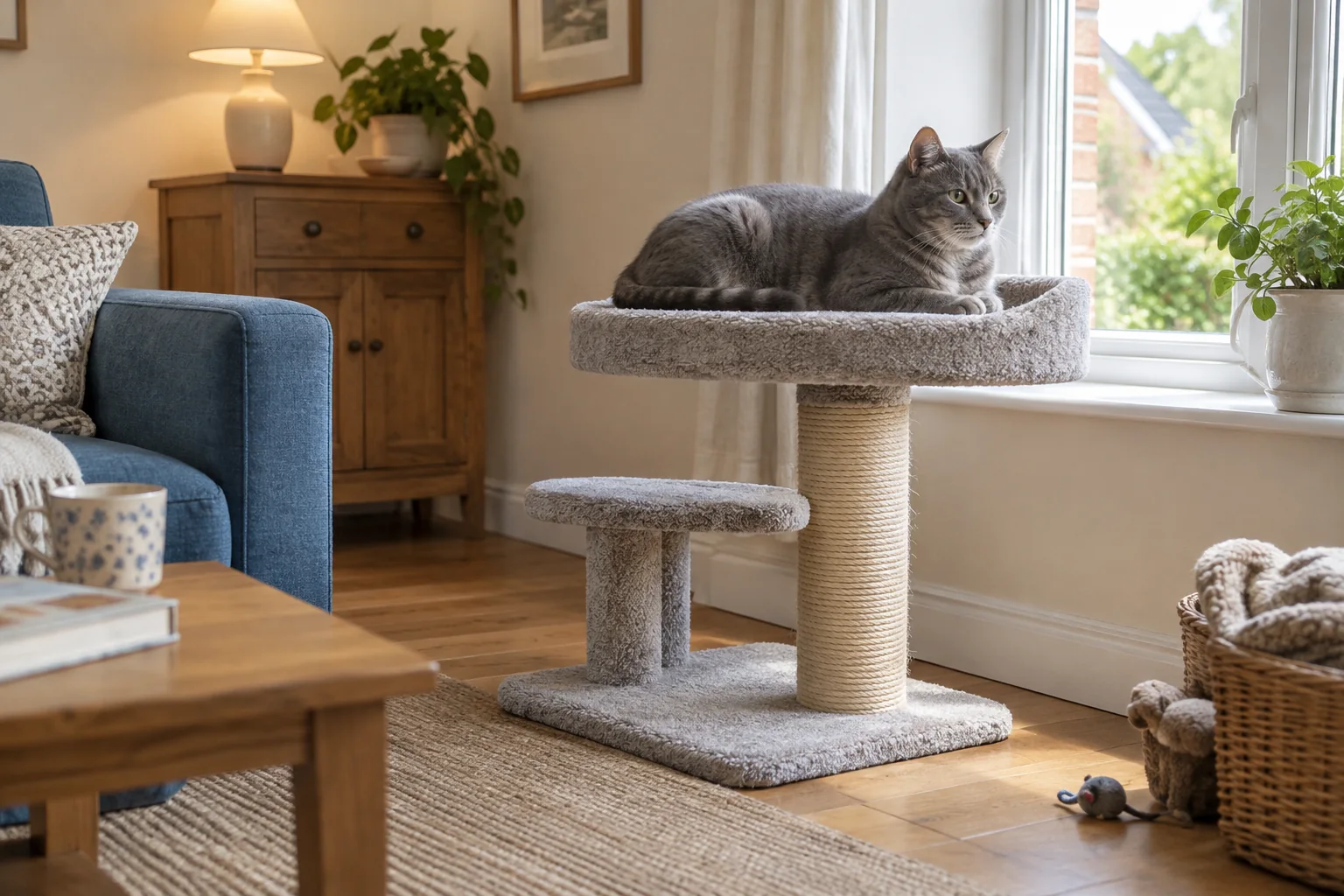
A good cat tree gives your cat somewhere useful to rest and climb without turning your room into an obstacle course. The tallest model is not automatically the best fit. Start with the cat's resting space, the way they move between levels and the furniture's complete outline.
For a smaller room
Mark out the proposed base on the floor, then check the outermost platform and bed dimensions. An overhanging perch may take more room than the base suggests. Leave access to the door, curtains and the route your cat will use to get on and off. A corner location is useful only if the furniture can be assembled and secured there as instructed.
Compare a compact tree with a separate post and reachable perch. Ask which arrangement does more for your cat in the available space. A low footprint is not a reason to skip a required wall restraint.
Catit Vesper High Base, black
Best for: A furniture-style tree with a hideaway
An MDF furniture-style tree with a cube hideaway, two platforms and cushioned resting areas. Choose it for a combination of climbing and enclosed rest, after allowing for its full outline and the route between levels.
What stands out
- Several distinct resting positions
- Manufacturer offers replacement parts
Keep in mind
- The 56 cm base still needs real floor space
- Upper platforms require climbing and jumping
- 56 × 56 × 121 cm overall
- Two-entry cube den
- Memory-foam cushions
For a larger cat
Look for the usable internal bed or platform measurement, not just the tree's height. Raised edges and cushions can reduce the resting area. A breed name in a listing is less useful than a clear dimension drawing and model-specific instructions.
A stated load figure also needs context: is it per platform, per hammock or for the whole tree? Do not treat it as a guarantee about jumping. If the manufacturer does not explain a limit, ask before buying around it.
Plan a route, not just a destination
Follow the steps from floor to top. Are the gaps practical for your cat now? An accessible lower resting spot can matter more than an impressive upper perch. For a cat finding movement difficult, Cats Protection's older-cat advice discusses making resources easier to reach. New reluctance to jump is a reason to contact your vet.
Amazon Basics hammock cat tree, beige
Best for: One compact hammock and scratching spot
A compact raised hammock supported by two jute-covered scratching posts. It is a simpler alternative to a tall tower when you mainly want one resting spot and a nearby scratching surface.
What stands out
- Combines resting and scratching
- Fewer levels to fit into a room
Keep in mind
- Check the usable hammock area for your cat
- A raised hammock is not a ground-level bed
- Two jute-covered posts
- Plush hammock
- Assembly required
Think about the second year
Check whether you can buy the correct replacement post or cushion and whether the fabric is removable. A replaceable post is only useful if its diameter, length and fixings match. Keep the assembly instructions and model code with your order details.
Cats Protection's indoor-cat guidance explains the value of opportunities to climb and scratch. A tree can provide both; a separate scratching surface may still be useful elsewhere in the home.
Choose the guide that matches the household
For a tight floor plan, compare trees for small homes by their complete outline. For a heavier or longer cat, use trees for large cats to focus on usable beds and stated limits. Those are different problems: a compact base does not establish a roomy perch.
Multiple-cat trees need separate resting places and usable routes, while low trees for older cats put reachable levels first. A window perch is a separate mounting decision and needs support for the exact window or wall arrangement.
Set it up for the room you actually use
Work through where to put a cat tree before assembly, then use the stability checks to review the base, fixings and required restraint. Keep the maker's instructions with the furniture rather than treating a wall strap as an optional accessory.
For upkeep, cleaning a cat tree separates upholstery, rigid panels and posts. If future repairs matter, compare trees with replaceable posts and check replacement-post sizes and threads before assuming a matching-looking part will fit.
Read the guides
Find the next useful guide
Start with fit and access, then compare the designs that solve your particular space problem.
Choosing, setup & care
Work through fit, everyday decisions and upkeep.
- Cat tree stability: assembly and placement checks Check cat-tree assembly, floor contact, restraint, routes and wear. Understand why a thick post or a heavy base does not establish a universal safe load.
- How to choose a cat tree Measure usable beds, plan the route between levels and compare assembly, materials and replacement parts before buying a cat tree.
- How to clean a cat tree Remove hair, check fabric labels and clean cat-tree surfaces without soaking structural boards or rope. Inspect joints, dry fully and plan supported replacement parts.
- Where to put a cat tree Find a stable, inviting cat tree position with usable climbing routes, safe window access and room for landing. Plan around doors, heaters and other cats.
Frequently asked questions
How do I choose between a cat tree and a window perch?
Start with the job and available support. A tree offers levels and sometimes scratching at a floor footprint; a window perch offers a resting location with its own mounting requirements. Check usable space, access and the exact manufacturer-supported fixing arrangement before comparing appearance.
Can one tree suit a large cat in a small room?
Possibly, but check both constraints independently. The outer outline must fit the room, while each used platform needs suitable internal space and supported loading. A small base or a large-cat label does not establish both. Keep enough room to approach and leave.
Does every cat tree need a wall restraint?
Follow the instructions for the exact model and use any required anchoring. Overall weight or a broad-looking base is not a reason to omit it. If the instructed fixing cannot be used in your chosen position, select another position or a suitable different design.
What makes a tree more useful for several cats?
Separate resting areas and practical routes matter more than counting decorative platforms. Look at whether one cat can block another from reaching a bed or leaving the tree. Provide other resting options around the home rather than expecting one tower to meet every need.
Can I replace a worn post without replacing the tree?
Only when the structure remains sound and the replacement is supported for it. Confirm length, diameter, thread, fixing depth and end fittings against the exact model. New rope or a similar-looking post does not repair a damaged base or connection.


