
Buying guide · Litter & cleaning
Best low-entry litter trays
Compare two open litter trays with stated low entrances, including dimensions, approach routes, cleaning and the limits of low-sided designs.
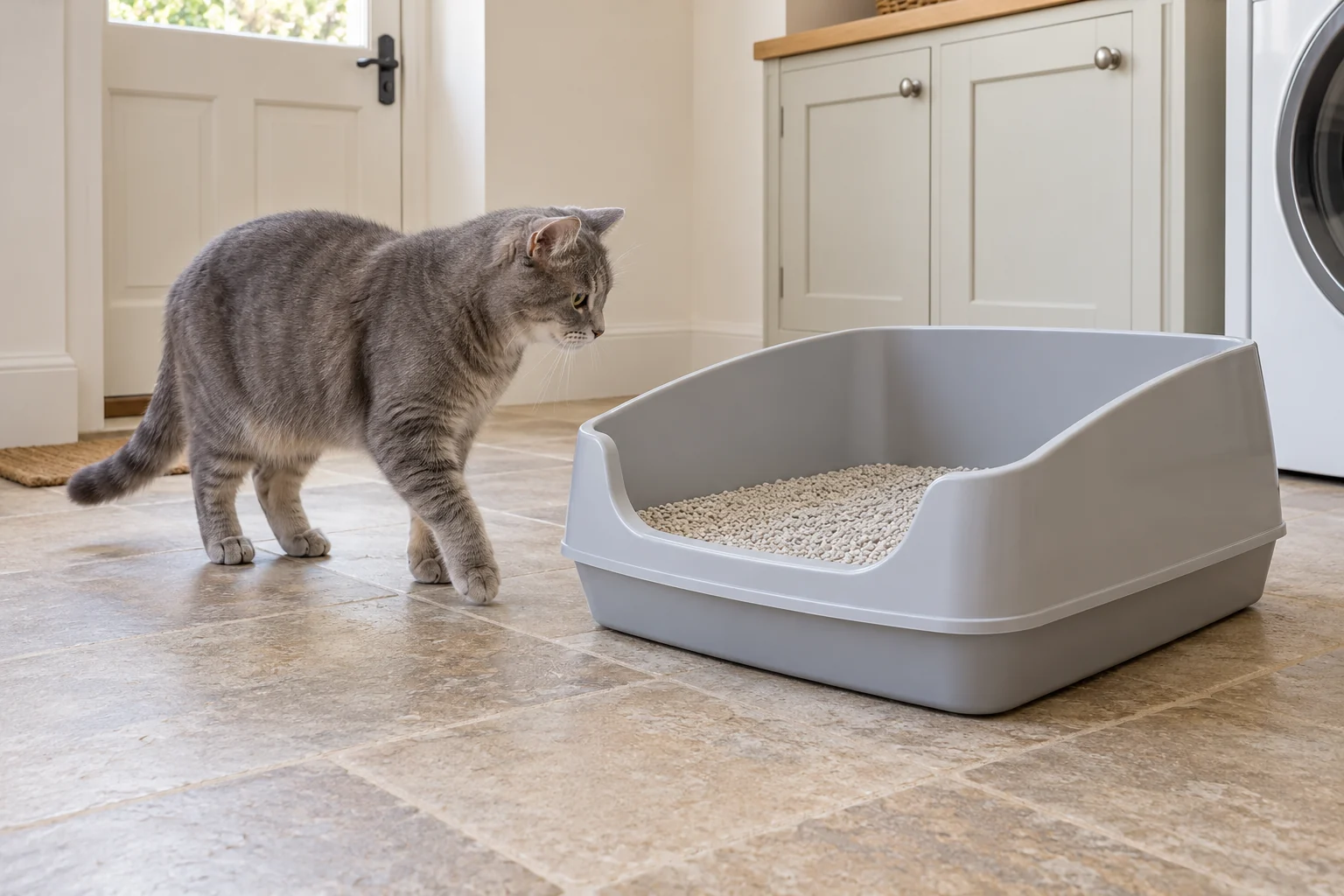
The short answer
Start with the job your cat needs it to do
Compare the KittyGoHere 2.0 for two 3-inch entrances, or the Vealind XL for a rectangular tray with a listed 7.5 cm corner entry. Both still have a threshold to step over. Match the usable tray space and approach to your cat; a small kitten tray is not automatically a suitable low-entry tray for an adult cat.
Compare the options
| Tray | Listed entrance | Outer dimensions | Main trade-off |
|---|---|---|---|
| KittyGoHere 2.0 Large | 3 in / about 7.6 cm | 22.5 × 18.5 × 6 in | Two low exits can let litter escape |
| Vealind XL | 7.5 cm corner entry | 60 × 40 × 15 cm | Corner approach and pedal affect access |
A low entrance and a small tray are different things
The best low-entry litter tray gives your cat a manageable step without removing the space needed to turn and position comfortably. Some shallow products are kitten trays: the wall may be low because the entire pan is small. Start with your adult cat's usable floor area, then compare the entrance separately.
A description such as senior-friendly is less useful than a drawing showing the floor-to-lip height at the actual opening. The highest rear wall and the entry can differ considerably. A tray advertised as 15 cm tall can have a much lower front, while another labelled easy access may still require a substantial step.
The two options here have stated entrance measurements in their selected Amazon UK listings. Neither is completely level with the floor. These are researched equipment comparisons, not clinical recommendations. If toileting or mobility changes, speak to your vet rather than assuming a different tray explains or resolves the problem.
KittyGoHere 2.0: two low approach routes
KittyGoHere 2.0 Easy Entry, large grey
Best for: Two low approach routes
An open tray with two lowered entrances, each listed at 3 inches, and higher surrounding walls. The second exit can be useful when planning the route through a quiet toileting area.
What stands out
- Entrance height is stated separately
- Open top makes the inside easy to inspect
Keep in mind
- Still a raised threshold rather than level entry
- Check inside space, import delivery and selected size
- 3 in / approx. 7.6 cm entry
- 22.5 × 18.5 × 6 in outer size
- Two entrances
The selected large KittyGoHere 2.0 has two lowered entrances listed at 3 inches, approximately 7.6 cm. Its overall size is 22.5 × 18.5 × 6 inches, approximately 57 × 47 × 15 cm. Those are outer dimensions; the usable floor will be smaller once the sloping sides and corners are accounted for.
Two entrances give you another positioning option, particularly where the cat benefits from being able to enter and leave in different directions. To make that feature useful, leave both routes accessible. Placing one opening against a cabinet would remove the practical advantage, and putting both entrances into a narrow corridor could still make the location awkward.
The low sections can also be a compromise for a cat that digs vigorously or urinates towards the sides. Higher surrounding walls cannot contain material at an open entrance. Choose around the cat's posture and cleaning needs, and plan a surrounding surface that can be cleaned without putting a difficult mat across the route.
This is a specialist US-made product listed on Amazon UK. Check the selected size, seller, dispatch location and delivery arrangement before ordering. Compare the stated opening and usable floor with your cat’s needs rather than treating a senior-friendly label as proof of fit.
Choose it for: a stated low threshold and a second exit. Main limitation: each opening remains a step, and more open sections mean less containment.
Vealind XL: a lower corner opening
Vealind XL low-entry litter tray
Best for: A rectangular tray with a lowered corner
An open tray listed at 60 × 40 × 15 cm with a 7.5 cm corner entrance and an exit pedal. It provides a larger rectangular outline without asking the cat to climb over the full side wall.
What stands out
- Separate entrance measurement
- Higher rear wall than the entrance
Keep in mind
- Outer dimensions do not give usable inside space
- Pedal and corner opening need to suit the cat’s approach
- 60 × 40 × 15 cm outer size
- 7.5 cm listed entrance
- Exit pedal
The Vealind XL listing gives 60 × 40 × 15 cm outer dimensions and a 7.5 cm entry at a corner. That is the important distinction from simply comparing its full side height. It provides an open rectangular arrangement for a cat that can use the corner approach comfortably.
There is an exit pedal beside the opening. Assess its texture and position as part of the route, rather than treating it only as a litter-control feature. A cat needs somewhere to place each paw while stepping in and turning; the corner layout can feel different from a broad centred front entrance even when the lip height is similar.
A larger pan still needs checking, scooping and full cleaning according to an appropriate routine. Fill to a suitable depth for the cat and litter, keeping the entry manageable. The amount the pan could physically hold is not a target to fill or a reason to postpone care.
Before purchasing, confirm the internal base measurements and entrance width if either is important to your cat's fit. The listing's 60 × 40 cm exterior rectangle does not establish how much flat standing space remains inside the tapered walls.
Choose it for: a rectangular open tray with a separately stated lower corner. Main limitation: the pedal and corner opening need to work with your cat's actual approach.
Measure the opening, floor and approach
Write down three measurements: entrance height, usable inside length and width, and clear approach space. When asking a seller for an entry height, specify from the floor outside to the top of the lip at the opening. A measurement taken from the litter surface inside answers a different question.
For internal space, a top rim measurement is not the same as the floor where the cat stands. Ask where the dimensions were taken and whether they include a removable rim. Curved corners and sloping walls can reduce the available area even in a tray marketed as extra large.
For the approach, mark where a cat can stand before entering and how they will turn to leave. Check nearby doors, laundry appliances and bins while they are in their ordinary positions. A lower entrance placed immediately against a wall or appliance may still create an awkward movement.
Cats Protection's tray-size discussion uses roughly one and a half times the cat's length from nose to tail base as a sizing guide. Use that as context for generous room, alongside the exact internal shape and your cat's posture. Do not measure a curled sleeping cat and assume the same outline is enough for toileting.
Keep litter depth and the lip in mind
A low entrance limits how deep litter can be piled near the opening before it escapes. Keep the familiar litter type and an appropriate depth for your cat while evaluating a new tray. Do not compensate for a poor-fitting tray by filling it unusually high or changing several features at once.
There is a trade-off between containment and the step required to enter. Higher walls elsewhere can help with displaced litter, but a hood, top-entry lid or surrounding cabinet can add access demands. This shortlist keeps the top open so the route and usable space are easier to assess.
If your cat normally stands near the edge, notice whether their whole body is comfortably inside. A product's weight limit or breed label does not establish that there is room for their ordinary toileting posture. For broader choices, the litter equipment hub covers open and hooded arrangements.
Choose the location before adding accessories
Set the tray in a quiet, accessible place away from food and water. Cats Protection's toileting guidance discusses location, cleanliness and providing one tray per cat plus an extra. Several trays touching in one corner do not offer the same separate choices as distributed locations.
Try a clear route first. If you add a mat, check that its edge does not lift and its texture does not discourage stepping. The tray should sit securely on the floor, and a raised platform underneath would increase the effective entrance height you were trying to reduce.
Keep another usable option during a gradual change where practical. Replacing the tray, litter, position and surrounding enclosure at once makes it difficult to tell what the cat finds acceptable. A new problem using a familiar tray deserves veterinary attention, including when a lower entrance appears to help.
Cleaning an open low-entry tray
Check how the pedal or any detachable section comes off before using it. A small join near the entrance can collect debris, so include that area when cleaning the full tray. Follow the maker's cleaning instructions, rinse as required and let the tray dry before putting it back into use.
Inspect the pan for rough edges, cracks or damaged joints. A low lip that has become sharp is not a useful accessibility feature. Do not improvise cutting or structural alterations to a purchased tray without appropriate manufacturer support; a purpose-designed lower entrance avoids creating unknown edges and weaknesses.
If usable floor area is the main constraint, compare the large open litter-tray guide. It separates larger outside outlines from actual inside space and entrance measurements.
Plan the cleaning routine around the usable tray. If scatter remains a problem, compare mats and scoops without adding a raised obstacle at the low entrance.
Sources and why the shortlist is short
Entrance and exterior dimensions come from the selected Amazon UK brand listings; internal fit needs confirming where no clear usable-floor drawing is supplied. Cats Protection supports the sizing and household-resource context. We have kept the choices to two documented low-entry designs instead of padding the list with ordinary high-sided or very small kitten trays.
Frequently asked questions
How low is a low-entry litter tray?
There is no universal shopping definition. The models here list thresholds of about 7.5–7.6 cm, but both still require a step. Compare that exact outside floor-to-lip measurement with what your cat can manage, and check entrance width and approach space as well.
Can I use a kitten tray for an older cat?
Only if it also has enough usable space for the adult cat to stand, turn and toilet normally. A low wall does not make a small pan an adequate adult tray. Compare internal floor measurements rather than the age label or the top rim dimensions.
Are low-entry trays suitable for cats that kick litter out?
They involve a containment trade-off. Higher rear and side walls may help, but litter can still leave through the low section. Watch the cat’s digging and toileting posture, and keep the entrance usable rather than blocking it with a steep mat or barrier.
Does an older cat always need a covered tray?
No. A cover is a separate preference and access decision, not a requirement of age. It can change the opening and turning space. Compare your cat’s established habits and follow welfare guidance; the two options in this guide are open designs.
Will a low-entry tray solve accidents beside the box?
It may change the physical access, but it cannot establish the reason for an accident. New toileting changes, discomfort or reduced movement need a vet’s advice. Tray position, cleanliness, litter, inside space and access to separate resources also need consideration.