
Buying guide · Play & enrichment
Best beginner cat puzzle feeders
Compare Catit Digger, Buggin’ Out and Trixie Fun Board. Learn how to introduce an easy dry-food puzzle without making rewards too difficult.
The short answer
Start with the job your cat needs it to do
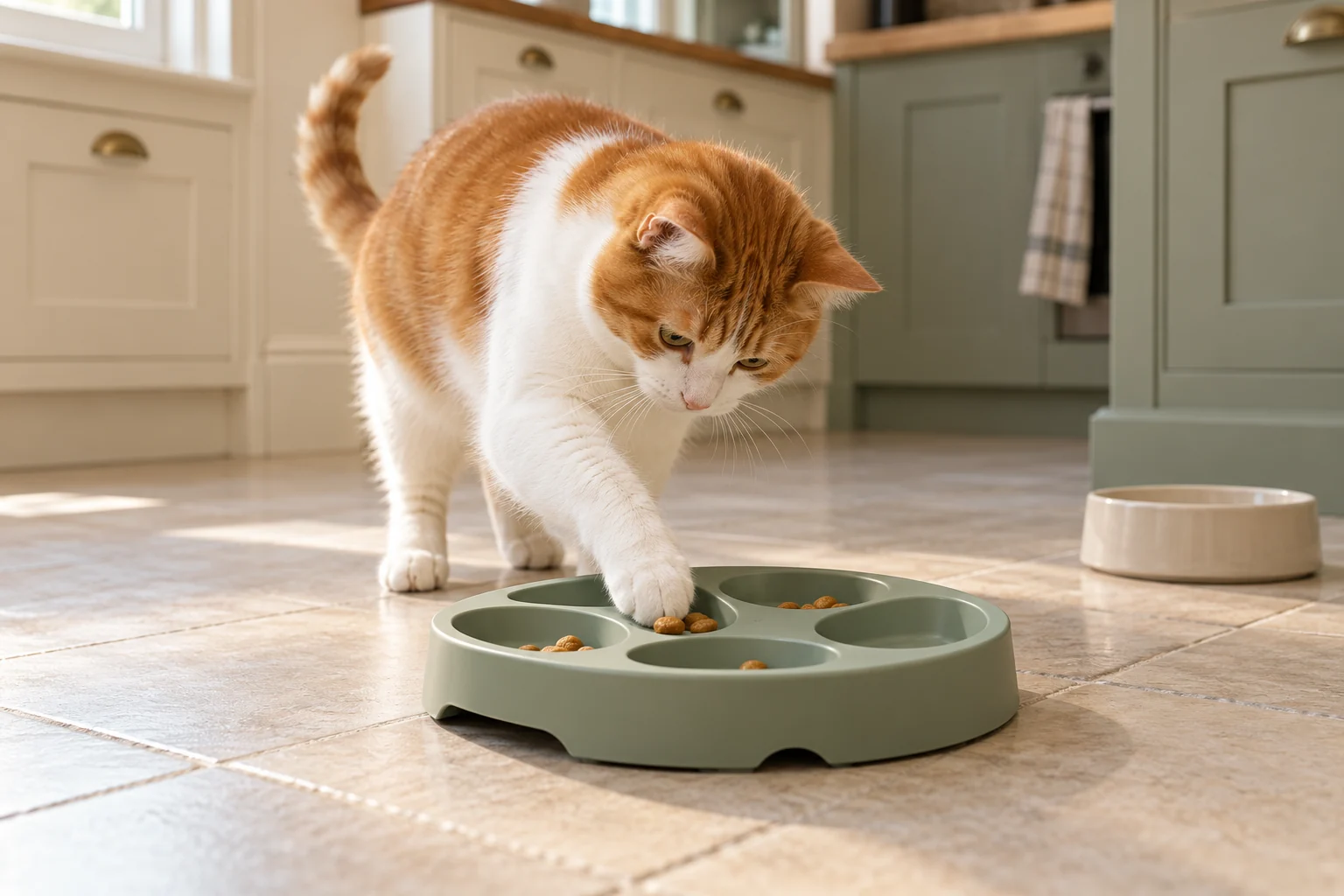
Start with the Catit Digger for a simple paw-retrieval activity. Buggin’ Out suits a flat presentation that can begin with covers open, while Trixie Fun Board offers several activity styles on one larger board. The easiest arrangement is the one your cat can succeed with now; introduce only a small amount of familiar dry food at first.
Compare the options
| Puzzle | Starting action | How it can change | Main limitation |
|---|---|---|---|
| Catit Digger | Paw food from an accessible short tube | Try different tube depths | Some cats prefer a flat surface |
| Buggin’ Out | Find rewards with covers open | Introduce a single moving cover | Closed setup can be too demanding initially |
| Trixie Fun Board | Use the easiest open module | Try another of five modules | Larger footprint and mixed difficulty |
Make the first puzzle easy to solve
The best beginner puzzle feeder lets a cat discover a reward without already knowing a new mechanism. A complicated board may offer many activities, but filling every covered compartment on the first attempt can make the whole thing harder to understand. Start with a few visible pieces of familiar dry food and a simple action.
Notice how your cat approaches food. A cat that naturally paws at objects may take to a tube, while one that nudges or noses a surface may find an open flat tray easier. Food size, mouth access, paw access and the surface underneath all affect the experience. A difficulty label is only a starting description.
These three choices have different retrieval actions and ways to simplify the first presentation. Begin with food plainly reachable, observe whether the action interests your cat and make the next step only slightly harder. Keep puzzle food within the usual feeding plan.
Catit Digger: a simple paw-retrieval choice
Catit Senses 2.0 Digger
Best for: A simple dry-food puzzle
Five removable tubes hold dry treats or kibble for your cat to retrieve with a paw. Begin with an easy-to-reach reward and watch whether the activity appeals before making it more challenging.
What stands out
- Different tubes allow a simple starting choice
- Separates for washing
Keep in mind
- Treats still count towards the normal feeding plan
- Not a timed feeder or a wet-food bowl
- Three short and two long tubes
- Removable tubes
- Dry treats or kibble
The Digger contains five removable tubes: three short and two longer ones. Its straightforward action is reaching a paw into a tube and bringing food out. Begin with the easiest accessible tube and a small visible reward, rather than placing all the food at the bottom of the deepest opening.
It is useful to be able to remove the tubes for washing and to inspect where crumbs collect around their bases. The layout also lets you see whether a cat is actually retrieving the food. Approaching or touching the puzzle is not the same as successfully eating from it.
For a cat that is reluctant to put a paw into a tube, a flat tray may be the better first choice. Do not make access harder merely because the product offers longer pieces. Keep an ordinary feeding arrangement available while you observe the new activity so the cat is not depending on an unfamiliar puzzle for the whole meal.
The Catit Senses Digger information supports the removable-tube design and dry-food use. Follow its cleaning directions, dry the pieces before refilling and make sure they are seated correctly when put back together.
Buggin’ Out: begin with the covers open
Nina Ottosson Buggin’ Out Puzzle & Play
Best for: A flat puzzle that can start uncovered
A flat dry-treat puzzle with sliding and swivelling covers. Start with the rewards uncovered; the moving pieces then allow a gradual change from simply finding food to working out how to reach it.
What stands out
- Can present exposed rewards first
- Moving parts stay attached
Keep in mind
- A fully closed setup is harder for a beginner
- Hand-wash and inspect food channels carefully
- Sliding and swivelling covers
- Dry treats or kibble
- Non-removable play pieces
Buggin' Out combines sliding and swivelling covers on a low board. Its useful beginner feature is that you can present accessible rewards before asking the cat to move a cover. An open first arrangement changes the task from solving a mechanism to simply noticing and collecting food.
Once your cat is comfortable, introduce one small change: partly cover a reward or use one moving piece. Watch how the cat responds and return to an easier setup if the activity is frustrating or the food remains inaccessible. More closed compartments do not automatically provide a better activity.
The moving play pieces stay attached. That reduces loose pieces to keep track of, but it does not remove the need for inspection or cleaning around the channels. Hand-wash as instructed, rinse away food residue and let everything dry before food is added again. Do not assume attached pieces make a product indestructible.
Compartment counts vary between retailer and family descriptions, so this guide does not use a count as a selling point. The important distinction is the flat presentation and the combination of movement types. The manufacturer's cat-game range identifies the Buggin' Out model separately from Melon Madness and Rainy Day.
Trixie Fun Board: different actions on one board
Trixie Cat Activity Fun Board
Best for: Trying several retrieval actions on one board
A 30 × 40 cm board with five different dry-food activities. Begin with the easiest accessible area rather than filling every module, then introduce a different action when your cat is comfortably finding the reward.
What stands out
- Several ways to present an easy reward
- Training guidance supplied
Keep in mind
- Some modules are harder than a first puzzle needs
- Needs more floor area than a single small puzzle
- 30 × 40 cm
- Five activity modules
- Dishwasher-safe board
The 30 × 40 cm Fun Board combines five activity modules and includes training guidance. Its advantage is variety: you can observe which type of retrieval action interests your cat without buying several separate boards. Its size also means finding a clear floor position where it can remain steady.
For a first attempt, use only the easiest accessible section. Some modules ask for more precise paw movement than others, so the whole board should not be treated as one uniform beginner level. Introduce another section when the cat is comfortably finding the rewards in the first one.
The selected Trixie listing specifies a dishwasher-safe board. Follow the actual model's washing directions and check removable or attached components against the instructions rather than copying the same method onto the other puzzles here. Inspect the food channels after washing, especially if pieces of kibble have softened in a corner.
The Trixie Fun Board packaging information identifies the strategy game and model. Use the supplied training guidance as part of the purchase, rather than relying only on pictures of a cat using the hardest section.
Match the food to the opening
Start with the cat's familiar dry kibble or a suitable dry treat that fits the selected puzzle. Check whether a piece can be reached and removed without getting wedged. A puzzle designed for dry food should not be filled with wet food merely because its plastic surface looks washable.
Any food used in play still counts within the cat's normal feeding plan. Set a small amount aside from the appropriate daily allowance rather than continually adding extra rewards each time the board is presented. If your cat has a prescribed diet or feeding requirements, follow the advice already provided by your vet.
Cats Protection's feeding guidance describes dry food as suitable for puzzle-feeding activities. That does not make a puzzle a diet plan or a substitute for checking the cat is eating normally. Keep the food choice familiar when introducing the equipment so two changes are not competing at once.
A practical first-session routine
- Put the puzzle on a stable, clear floor away from a busy doorway.
- Offer a few accessible pieces of familiar food with covers open or the easiest module available.
- Give the cat room to investigate and leave; avoid forcing paws into openings or holding the cat in place.
- Observe whether rewards are actually retrieved and eaten.
- Stop while the activity remains comfortable, clear the food and clean as directed.
The useful progress is successful voluntary use, not a particular session length or difficulty level. Some cats will find one simple activity rewarding for a long time. Others may prefer a different style of play altogether. Cats Protection's play advice offers context for providing varied activities safely.
More than one cat: watch access, not just interest
One puzzle in the middle of the room does not create independent feeding opportunities for several cats. Notice whether one cat waits, blocks the route or takes rewards from another. Separate presentations or positions may make the activity easier to assess.
Food puzzles also do not identify which cat is allowed to eat. If food stealing is the actual problem, compare feeding access equipment and the wet-food feeder guide's access alternative. A timed feeder and a puzzle answer different questions again: scheduling versus retrieving food.
Cleaning, wear and storage
Clear uneaten food after the activity as appropriate to its storage instructions. Check corners and channels for crumbs, and follow the different care directions for the tubes, moving-cover board and dishwasher-safe Fun Board. Wet washed parts need to dry before dry food is put back in.
Inspect for cracks, rough edges, worn moving parts and trapped debris. Store the puzzle somewhere clean between sessions. Putting a food puzzle away gives you a chance to check it before reuse; it also helps keep the floor available for other activities such as a tunnel or resting perch.
If your cat prefers to move the food container, compare cat treat balls. Keep the first rolling task easy and the food within the same feeding plan.
Sources and recommendation method
Catit, Trixie and the Buggin' Out manufacturer descriptions support the mechanisms and cleaning distinctions, with Cats Protection providing feeding and play context. We rank the starting arrangement and practical fit, not a claimed level of intelligence or a guaranteed training outcome.
If you are starting with everyday household materials, our small-budget indoor enrichment guide shows how an easy food search fits alongside play, hiding and scratching.
Plan the care as well as the activity: cleaning food puzzle toys covers removable cups, channels and complete drying.
For a rolling food activity, compare cat treat balls and begin with an opening that releases the actual food readily.
Frequently asked questions
What is the easiest cat puzzle feeder for a beginner?
Choose an arrangement with visible, easily reached food. A short accessible Digger tube, an open Buggin’ Out section or the easiest Fun Board module can each provide a starting point. The most useful option depends on whether your cat prefers pawing, nosing or simply finding food on a flat surface.
Can I put a whole meal in a new puzzle feeder?
Start with a small amount while you observe successful use, and keep the familiar feeding arrangement available. Check that your cat actually retrieves and eats the food before relying on a puzzle for more of a meal. Any reward food still belongs within the normal feeding allowance.
Can these puzzles hold wet cat food?
These recommendations are for dry kibble or suitable dry treats. Do not put wet food into a dry-food mechanism merely because the surface is washable. Check the exact product’s permitted food types and cleaning directions if you need a wet-food activity.
What if my cat ignores the puzzle?
Make the reward accessible, use familiar food and allow space to investigate without pressure. A different retrieval action or activity may suit better. Do not remove ordinary food to force use. A broader change in appetite or ability to eat should be discussed with your vet.
Can two cats share the same puzzle?
Observe the interaction rather than assuming they can. One cat may block access or collect the other’s rewards. Separate positions or sessions can give each cat a clearer opportunity. None of these puzzles recognises individual cats or protects a portion for a specific pet.