
Buying guide · Feeding
Best automatic cat feeders for dry food
Compare a battery hopper, an app-controlled feeder and a pre-portioned tray. Understand kibble fit, meal schedules, cleaning and access limits.
The short answer
Start with the job your cat needs it to do
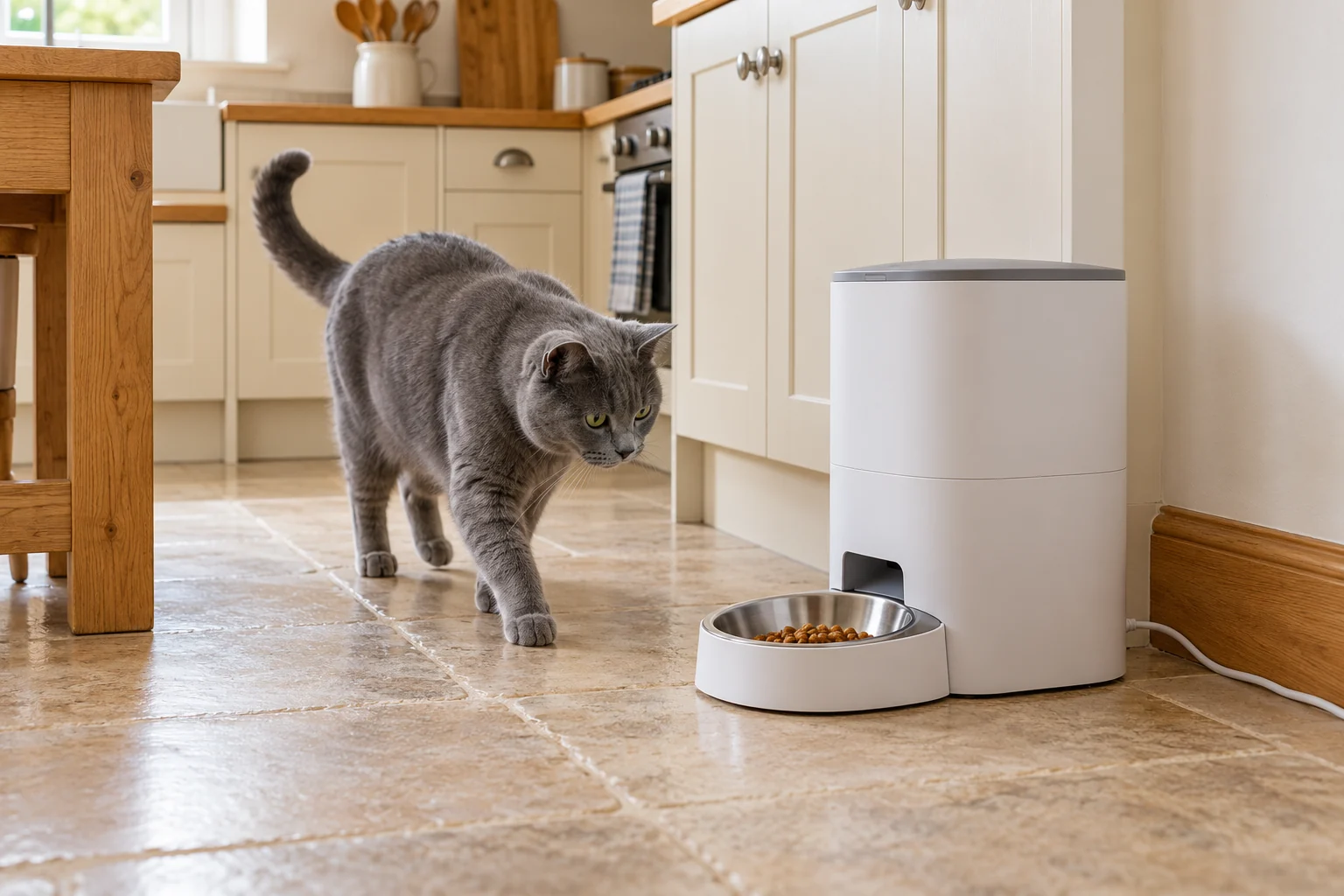
Choose the Cat Mate C3000 for a local battery-powered hopper with up to three timed meals a day. PETLIBRO Air WiFi offers app control and more scheduled meal slots in a compact 2-litre design. If you prefer weighing portions yourself, the Cat Mate C500 opens pre-filled compartments instead of dispensing from a hopper. None identifies which cat eats the available food.
Compare the options
| Model | How food becomes available | Controls | Main limit |
|---|---|---|---|
| Cat Mate C3000 | Dispenses dry food from a hopper | Local LCD; 4 × C batteries | Up to three timed meals daily |
| PETLIBRO Air WiFi 2L | Dispenses dry food from a hopper | App; 2.4 GHz Wi-Fi | Needs compatible setup and recharging |
| Cat Mate C500 | Opens pre-portioned compartments | Local digital timer; 3 × AA | One open portion plus four timed openings |
Decide whether you need dispensing or a later opening
Automatic dry-food feeders use two different approaches. A hopper meters food into a bowl, while a compartment feeder opens food you have already portioned. If you want to weigh each serving yourself, the second approach may be more useful than a larger reservoir or a more elaborate app.
Start with the number of future meals you need, your existing feeding plan and the food's shape. A reservoir measured in litres cannot be compared directly with one described in kilograms: the mass that fits depends on the kibble. Neither capacity is a recommendation for how much a cat should eat.
The three options below give you local hopper controls, connected hopper controls and a pre-portioned tray. Choose the dispensing method first, then check the actual serving and next programmed meal while you are present.
Cat Mate C3000: a local battery-powered hopper
Cat Mate C3000 dry-food feeder
Best for: A local schedule without Wi-Fi
A battery-powered hopper feeder with local LCD controls and up to three individually sized timed meals a day. It is a straightforward choice when you want dry-food dispensing without an app.
What stands out
- No network or app needed
- Removable bowl, hopper and feed parts
Keep in mind
- Kibble output needs checking with your actual food
- Three timed meal slots may limit your schedule
- Up to three timed meals daily
- Up to 3 kg dry-food capacity
- 4 × C batteries
The C3000 serves up to three individually sized timed meals a day and holds up to 3 kg of dry food. It uses local LCD controls and four C batteries, without needing Wi-Fi or an app. That makes it the straightforward starting point if a small number of repeatable scheduled meals is the main job.
The three timed slots are a real scheduling limit. Count the meals you need in advance instead of assuming the hopper can provide any number because it holds plenty of food. Closer Pets' C3000 support page confirms the three timed feeds and a maximum kibble size of 16 mm.
The dispensing system needs to be set up and primed as the instructions describe. Test it with the actual food, then weigh several delivered portions to understand the result. A nominal setting or the maker's approximate minimum gram figure should not become an assumption that all kibble shapes produce the same mass.
The UK product information identifies removable bowl, hopper, lid, nozzle and feed-screw parts for dishwasher cleaning. The motor and controls are different components. Keep them out of water and follow the exact disassembly instructions.
Choose it for: a local schedule with no network setup. Main limitation: three scheduled daily slots, plus the need to check output with your own kibble.
PETLIBRO Air WiFi: compact app-managed meals
PETLIBRO Air WiFi feeder, 2 litres
Best for: App-managed dry-food schedules
A compact rechargeable hopper feeder controlled through the PETLIBRO app. The selected Air WiFi listing supports up to ten scheduled meals and requires a 2.4 GHz network for its connected features.
What stands out
- Rechargeable cordless positioning
- App food and battery alerts
Keep in mind
- Requires an app and compatible Wi-Fi for setup
- Logs do not prove a particular cat ate
- 2-litre hopper
- 2.4 GHz Wi-Fi
- Up to ten scheduled meals daily
The selected Air WiFi feeder has a 2-litre hopper, rechargeable operation and app-managed scheduling for up to ten meals daily. Its UK listing specifies 2.4 GHz Wi-Fi; do not transfer the dual-band features of a Granary model onto the Air merely because both are PETLIBRO feeders.
Rechargeable operation can give you more choice of position without leaving a cable across a walking route. It also gives you a charging task to plan. The advertised battery duration depends on conditions and use, so this guide does not promise a fixed number of days between charges.
Low-food and battery alerts are useful prompts to check the equipment, not proof that a particular cat has eaten. An app record may describe a scheduled event or dispensing action. Watch the bowl and the cat's actual use, and keep a practical care arrangement for faults, changes in appetite or unexpected interruptions.
Before setup, confirm the supplied UK power package, compatible network and the app requirements for the exact model. The manufacturer's Air WiFi support identifies PLAF108 separately from other feeder families. Follow its permitted cleaning, kibble and charging directions rather than generalising from a camera feeder's manual.
Choose it for: more schedule slots and connected controls in a compact hopper. Main limitation: setup, charging and app connectivity add responsibilities alongside the physical food path.
Cat Mate C500: weigh the portions yourself
Cat Mate C500 five-meal feeder
Best for: Several timed servings
A rotating tray with one compartment open initially and four scheduled openings. A sensible starting point when you want several pre-portioned meals without an app.
What stands out
- More scheduled openings than the C200
- Removable dishwasher-safe lid and tray
Keep in mind
- Ice packs require preparation
- All cats can reach the open compartment
- Four timed openings
- Two supplied ice packs
- 3 × AA batteries
The C500 is a tray alternative, not a hopper. You fill the compartments with the portions you intend to make available, and the tray rotates at scheduled times. Its five compartments include one initially open portion and up to four future openings. This can suit a planned daily gap when you want direct control over the food placed in each section.
Because it does not meter loose kibble through a dispensing chute, you are comparing a different routine. Preparation takes place while filling the tray. There is also a broader tray and lid assembly to lift out and wash. Check where it will sit and whether the cat can approach the exposed section comfortably.
It uses three AA batteries and local digital controls. The removable bowl and lid have their own washing directions; the powered base must be treated separately. The supplied ice packs are relevant to its wider wet-food use, but are not the reason to choose it for ordinary dry-food portions.
Read our dedicated C500, C200 and access-control comparison if you also need wet meals or to distinguish timing from selective access. The C500 can make a compartment available, but it cannot reserve that food for the intended cat.
Choose it for: pre-weighed dry servings and a limited sequence of future openings. Main limitation: the tray must be prepared, and one compartment is available from the outset.
Check kibble fit before comparing portion numbers
Measure the largest pieces of the food you actually use and read the exact model's supported range. Shape and consistency matter as well as nominal diameter. Do not put wet food, sticky mixtures or unsuitable pieces through a dry-food hopper because they fit through the top opening.
Use the product's setup procedure and run observed trials while you are at home. Weigh repeated outputs with your normal kibble and check the bowl at the scheduled times. A unit's portion number is an equipment setting, not a universal number of grams or a dietary instruction.
Keep the established feeding plan, including veterinary guidance where applicable. Cats Protection's feeding advice provides general context for food types and routines. A feeder does not decide a suitable diet, and a large hopper should not be filled as a target intake.
Plan for power and network interruptions
Separate the events you need to understand: batteries running low, a rechargeable unit needing charging, Wi-Fi disconnecting and the wider internet connection failing. Ask the exact manual what is stored locally and which app functions need a connection. Do not assume every model continues every feature in the same way offline.
During introduction, check the schedule under ordinary household conditions while you can intervene. Confirm the time and meal settings after any reset or battery change as the manual requires. A backup arrangement should include a person who can check the cat and equipment, not simply another electronic alert.
The C3000 avoids network setup but still relies on batteries and a clear dispensing mechanism. The Air adds connected features but still needs food, charging and physical checks. The C500 removes hopper metering from the job but introduces the need to prepare every compartment.
Multiple cats and daily care
A single bowl of dispensed food is available to whichever pet reaches it. Two nearby bowls do not automatically create separate portions either. Watch whether one cat blocks another, finishes both meals or approaches from behind. If selective access is the main requirement, compare that function separately through the feeding hub.
Reservoir capacity should never be presented as the time a cat can be left without care. A feeder cannot check appetite, illness, water, litter or an unexpected household problem. Keep the ordinary care arrangement and use scheduled equipment as one part of it.
For cleaning, remove old crumbs and inspect the chute, feed screw or tray corners according to the model directions. Dry washed food-contact parts completely before adding dry food. Do not top up indefinitely without checking the remaining food, its storage directions and the state of the reservoir.
If avoiding a phone, router or account is the deciding requirement, our feeders without Wi-Fi guide compares local setup, controls and batteries across timed trays, a hopper and selective access.
During setup, follow introducing an automatic feeder and build in model-specific cleaning. A large hopper does not remove either task.
Sources and comparison limits
Sources include the selected Amazon UK listings, Closer Pets' C3000 product and support information, the C500 documentation and PETLIBRO Air support. The comparison distinguishes dispensing mechanisms, supported schedules and care requirements. Current prices, stock and battery-duration promises are not used to rank these different mechanisms.
Before relying on a schedule, follow the automatic-feeder introduction routine and plan the cleaning and restart checks.
Before relying on a setting, weigh repeated feeder portions. If delivery fails, follow the missed-meal checks.
Frequently asked questions
Is a hopper feeder better than a rotating tray for dry food?
A hopper dispenses food from a reservoir, while a rotating tray opens portions you fill beforehand. Choose a hopper for repeated metering and a tray when weighing each serving yourself is preferable. Compare the number of scheduled events, preparation and cleaning rather than assuming one mechanism is always better.
Do all automatic cat feeders need Wi-Fi?
No. The C3000 and C500 use local controls and batteries. The selected PETLIBRO Air WiFi uses an app and requires a compatible 2.4 GHz network for connected setup and features. Check the exact model rather than transferring requirements from another feeder in the same brand.
Does one portion setting equal a fixed number of grams?
Do not assume so. Kibble size, shape and density affect the mass delivered by a hopper. Follow the setup directions and weigh several outputs with the food you actually use. The established feeding plan should determine the target amount, rather than the hopper setting deciding the diet.
Can an automatic feeder tell me which cat ate?
These three cannot. A timed event or dispensing log does not identify the animal eating from the open bowl or compartment. If one pet steals another’s food, compare a selective-access mechanism and observe the complete feeding arrangement, including whether another cat can block the approach.
How long can I leave my cat with a full hopper?
A hopper’s capacity is not an unattended-care interval. The cat still needs appropriate human checks, water, litter care and attention to appetite or illness. Use an automatic feeder within a care arrangement and follow the product and food-storage instructions.