
Buying guide · Feeding
Best microchip cat feeders
Compare standard SureFeed and Connect microchip feeders by selective access, app features, Hub requirements and daily care. Understand what neither feeder can do.
The short answer
Access control first; app records only if useful
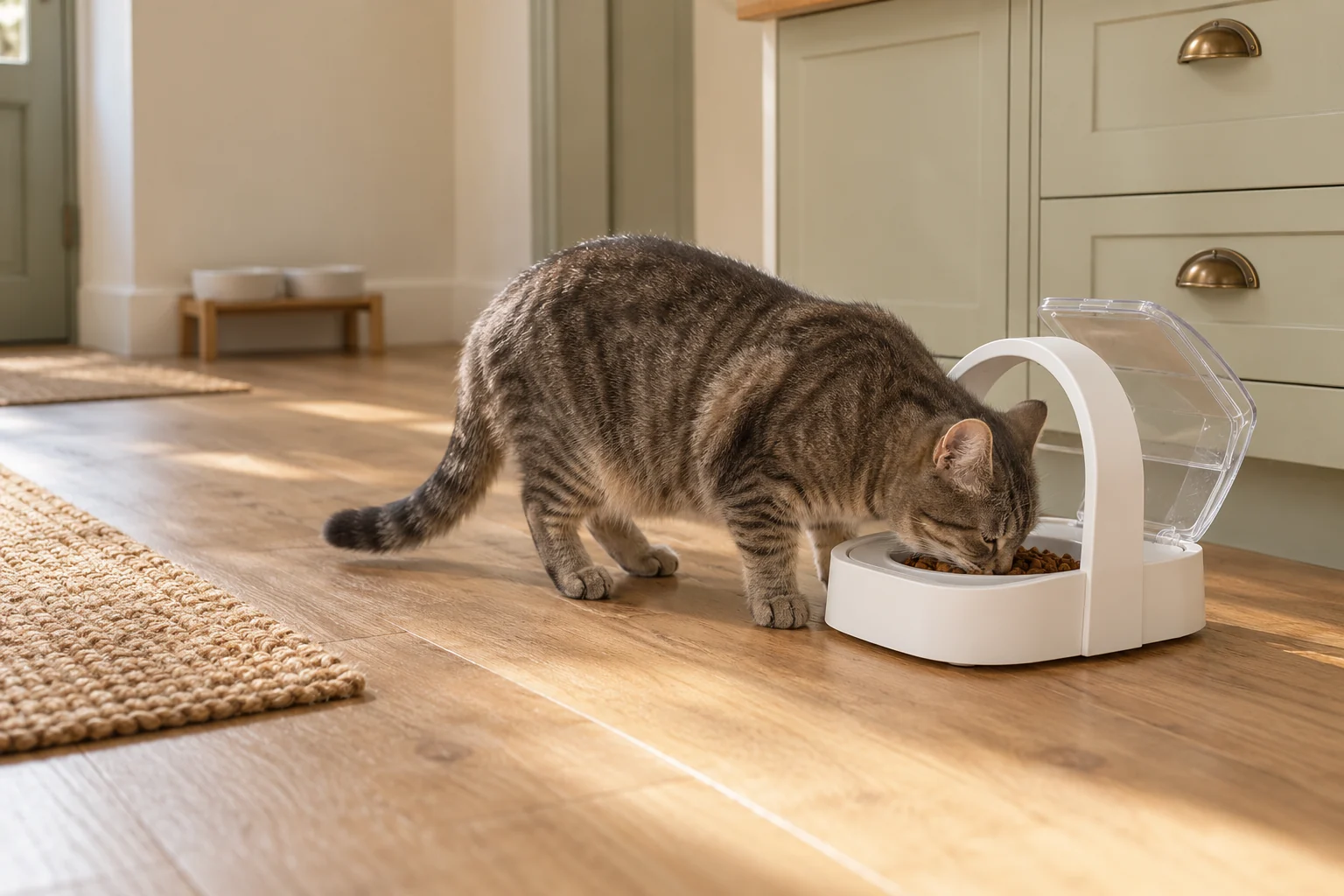
The standard SureFeed is the clearest starting point for selective food access without an app. Choose SureFeed Connect when weighing and feeding records are worth the extra Hub-and-app setup. Both recognise a registered microchip or compatible collar tag and uncover food you have already placed in the bowl. Neither dispenses scheduled meals or refrigerates food.
Compare the options
| Feature | Standard SureFeed | SureFeed Connect |
|---|---|---|
| Registered microchip / compatible tag access | Yes | Yes |
| Wet and dry food | Yes; not refrigerated | Yes; not refrigerated |
| Integrated weighing / app records | No | Yes, through Hub and app |
| Hub needed for app | No app connection | Yes; excluded from linked offer |
| Power | 4 × C cell batteries | 4 × C cell batteries |
| Best starting point | Straightforward selective access | Access plus feeding observations |
A microchip feeder solves a different problem from a timer. It is useful when the right food is already available but the wrong pet keeps eating it. The lid opens for a permitted animal rather than at a programmed mealtime.
That distinction makes shopping easier. If your main aim is breakfast at a set time, see our dry-food automatic feeder guide. If the problem is separate diets or one cat losing access to their meal, the two genuine microchip models below are more relevant.
Compare standard SureFeed for local selective access with SureFeed Connect for integrated weighing and app records. A tag-only dispenser or motion-opening bowl may control access differently, so establish which identification system the actual product uses before comparing extra features.
Choose selective access for the right task
Consider what happens at mealtime. If a quick eater finishes and moves to a slower cat’s bowl, selective access may help protect that second portion. If a prescribed diet must remain separate, it can support the arrangement your vet recommends. The feeder still needs an appropriate location and supervision while the cats learn.
If the cat needs a measured amount, you remain responsible for putting that amount into the bowl. Connect adds weighing support and records, but it does not refill the bowl from a hopper. The standard feeder does not gain scheduling through an accessory or an app upgrade.
A cat eating less, losing weight or behaving differently around food needs veterinary attention. A device may help you manage access or notice a pattern; it cannot establish why the change happened. Avoid adjusting a prescribed diet solely because of an app graph.
Best straightforward choice: standard SureFeed
SureFeed Microchip Pet Feeder
Best for: Individual access, rather than timing
The lid responds to a registered cat’s microchip or compatible tag. It belongs on your shortlist if another pet steals food, but it does not release meals at scheduled times.
What stands out
- Access tied to registered identities
- Gradual lid-training mode
Keep in mind
- Does not schedule meals
- Rear access may need an additional cover
- Wet or dry food
- 400ml bowl
- 4 × C batteries
The standard Microchip Pet Feeder is the simpler choice when access control is the main requirement. Register the cat’s microchip using the feeder’s controls, fill the bowl and introduce the lid movement gradually. There is no Hub or app to add to the routine.
Sure Petcare specifies a 400 ml bowl capacity and four C cell batteries. The capacity describes the bowl, not a recommended meal size. Select food and portions around your cat’s feeding plan. Batteries are a separate purchase, and the low-battery indicator needs to be part of your normal checks.
The feeder supports compatible Sure Petcare RFID collar tags as an alternative to an implanted chip. The linked model includes a tag, but a cat already using a compatible implanted chip does not need to wear one simply to use the feeder. If you use a tag, choose a suitable safe collar arrangement and check the maker’s guidance.
The limitation is deliberate: you do not get integrated food weighing or app-based feeding records. If you only need to stop casual bowl swapping, that may be a sensible trade-off. Paying for Connect has little value if you will not use its monitoring features.
Best for feeding records: SureFeed Connect
SureFeed Microchip Pet Feeder Connect
Best for: Microchip access with app records
Selective microchip access with integrated weighing and feeding-history features through the Sure Petcare app. This feeder-only listing does not include the required Hub.
What stands out
- Integrated food weighing and portion lights
- Feeding activity available in the app through a Hub
Keep in mind
- Hub and batteries add to the setup cost
- Does not dispense timed meals or refrigerate food
- 400 ml bowl capacity
- 4 × C cell batteries
- Hub required for app; not included
Connect adds integrated scales, portion-indicator lights and records through the Sure Petcare app. It is useful when knowing when a cat visits and how much food has been added or removed would help you understand the routine. It retains the selective-access purpose of the standard model.
The linked Amazon offer is the feeder-only model. The Hub is not included, and four C cell batteries are also required. The Hub links compatible Connect devices to the app through your home router. Check whether you already have a compatible Hub before buying another, and confirm your router and app setup against the current instructions.
When setting portions, use the food and amount agreed for your cat. The lights guide you while you add food; the feeder does not automatically pour that amount at a later time. The records also need interpretation: food removed from a bowl is useful information, but it is not a medical diagnosis or a complete nutritional assessment.
Choose Connect when those extra observations are worth maintaining another connected device. Choose the standard model when app-free selective access is the whole goal. Our feeders without Wi-Fi guide compares that simpler approach with genuinely timed equipment.
Distinguish microchips, collar tags and motion sensors
“RFID” is a broad technology description. It does not by itself tell you whether a feeder reads the identification microchip implanted in a cat. Some products respond only to the tag supplied by their own brand. That can be a valid design, but it is a different wearing and replacement requirement.
A motion-opening sealed bowl is different again. If the lid opens whenever an animal approaches, it does not identify which pet is allowed to eat. The word “automatic” therefore tells you very little about selective access.
Before ordering, confirm the complete product name, the exact model, supported identification method and supplied accessories. For implanted chips, use the Sure Petcare compatibility information. Do not assume a chip format or a tag from another brand will work because it looks similar.
Plan the feeding station around the cats
Give the permitted cat a calm approach with room to eat normally. Avoid squeezing the feeder between furniture where another cat can block the only exit. Keep it away from litter and do not put several protected meals into one congested corner if the cats are already competing.
A determined pet may try to approach alongside the registered cat or reach the food from an unprotected angle. Watch the actual interaction rather than assuming the first successful opening proves the arrangement is secure. The maker offers a rear-cover accessory for persistent access problems, but its suitability and fitting should be checked for the exact feeder.
Separate diets usually need separate food stations. Registering two cats to the same feeder gives both access to that bowl; it does not identify which portion belongs to which cat. The standard feeder’s memory for multiple identities is not a promise of individually controlled meals.
Introduce the lid in small stages
Set up the feeder with the cat nearby at a relaxed time. Follow the model’s training mode, allowing the cat to eat with minimal lid movement before increasing it. Do not rush straight to normal operation because the chip registration succeeded.
Keep familiar food and an easy alternative available while you establish reliable use. If the cat startles, backs away or refuses to approach, return to an easier stage rather than letting hunger force the issue. A slower introduction is particularly relevant when the cat already feels threatened near food.
Test normal access while you are home. Confirm that the permitted cat can open the lid, eat and leave, and that the other pet cannot casually take over. Repeat observations across several ordinary meals. For a prescribed feeding plan, agree any transition difficulties with your veterinary team.
Keep manual care in the routine
Check food condition, bowl cleanliness and battery indication daily. Remove leftover food according to the food’s handling guidance. The lid helps cover the bowl but does not cool it, sterilise it or make wet food suitable for indefinite storage.
Clean removable food-contact parts according to the exact instructions. Wipe the electronic body as directed rather than immersing the feeder. Keep the lid path free from dried food and inspect the sealing surfaces; forcing a sticky lid can create an unreliable feeding station.
For Connect, also check that the app records make sense after cleaning or refilling. Use the maker’s instructions for weighing setup and bowl changes. Do not assume all accessory half bowls are interchangeable between standard and Connect; the Connect product information distinguishes its accessories.
Compare the complete setup
Check the selected Amazon offer includes the model you intended. Standard SureFeed, Connect without Hub, Connect bundles, replacement bowls and the motion-opening Sealed Pet Bowl can appear close together in search results. An accessory photograph is not evidence that a feeder is included.
For standard SureFeed, plan for batteries, suitable placement and training time. For Connect, add the Hub if needed and confirm that the app features will be useful in your household. For either, consider whether one unit is enough for the number of diets you need to keep separate.
The best choice is the simplest setup that solves the actual feeding problem. Access control, scheduled meals and cold storage are different tasks; buying a more connected lid does not combine all three.
For the mechanism decision before shopping, compare timed and microchip feeders: a scheduled opening and permission to a bowl solve different tasks.
For spare inserts and guards, use SureFeed bowl and rear-cover compatibility to distinguish Standard split bowls from Connect halves.
Frequently asked questions
Will a microchip feeder work with my cat’s implanted chip?
These SureFeed models are designed to work with common identification microchips, and the maker provides a compatibility check. Confirm your cat’s specific chip before purchase. A feeder described only as RFID may require its own collar tag and may not read an implanted identification chip.
Does SureFeed Connect need a Hub?
The Hub is required to link Connect to the Sure Petcare app. The feeder-only Amazon listing in this guide excludes it. If you already own a compatible Sure Petcare Hub, check your setup; otherwise compare the complete cost of feeder, Hub and batteries before choosing Connect.
Can one microchip feeder serve several cats?
You can register more than one permitted pet, but they then share access to the food in that feeder. It does not allocate separate food or portions to each registered cat. If diets must stay separate, plan separate feeding arrangements and monitor whether each cat gets the intended food.
Will a microchip feeder stop every attempt to steal food?
It can restrict access at the lid, but placement and the behaviour of the pets still matter. Another animal may approach alongside the permitted cat or reach around an accessible side. Supervise introduction and discuss persistent access problems with the maker; do not treat the feeder as an absolute barrier.
Can I leave wet food in it all day because the lid seals?
A sealed lid is not refrigeration. Follow the food manufacturer’s storage and serving advice and your vet’s feeding plan where relevant. Room temperature, food type and hygiene still matter, and a closed lid does not create a universal safe holding time.