
Buying guide · Carriers
Best top-opening cat carriers
Compare Catit Cabrio and Ferplast Atlas 20 Deluxe Open for top access, usable space, closures, bedding and cleaning.
The short answer
Start with the job your cat needs it to do
Compare the Catit Cabrio for its broad-opening upper section and front access, or the Ferplast Atlas 20 Deluxe Open for a more conventional front-and-top arrangement with a detachable shell. Choose the one that fits your cat inside and can be closed, carried and cleaned correctly. Top access is useful, but it does not replace familiarisation at home.
Compare the options
| Carrier | Maker-listed outer size | Access | What to confirm |
|---|---|---|---|
| Catit Cabrio turquoise | 51 × 33 × 35 cm | Broad upper opening and front | Usable inside space and closure sequence |
| Atlas 20 Deluxe Open | 57.6 × 37.4 × 33 cm | Front door, top opening, detachable shell | Exact 20 Deluxe Open version and instructions |
Why choose a carrier with top access?
A top-opening carrier gives another way to reach the inside without depending entirely on the front doorway. That can be useful during a veterinary visit or when handling bedding. A removable upper shell can offer a different benefit again: access to the base while the cat remains in a familiar lower section, when appropriate to the situation.
Those features need to be considered alongside the whole structure. Check whether opening the top changes another connection, how every latch closes and whether the base stays supported during carrying. A wide opening is not an advantage if the shell is difficult to reassemble correctly in your ordinary routine.
Cats Protection's carrier guidance recommends a strong, secure, easy-clean carrier of an appropriate size. These two researched choices offer genuine top access. Compare their opening, closure and carrying arrangements with your cat’s size and the journey you need to make.
Catit Cabrio: a broad-opening upper section
Catit Cabrio carrier, turquoise
Best for: Wide access for everyday vet visits
A rigid carrier with a wide-opening upper section and front access, designed to make the inside easier to reach. It can remain open at home as a familiar resting space between visits.
What stands out
- Multiple access points
- A rigid shape that can be inspected before use
Keep in mind
- Outer dimensions do not establish inside fit
- Follow the exact closure and vehicle-securing instructions
- 51 × 33 × 35 cm outer size
- Top and front access
- Removable food and water tray
The Cabrio's broad upper access is the main reason to compare it with a conventional carrier. Catit lists 51 × 33 × 35 cm outside dimensions, and the selected Amazon option is turquoise. The front opening gives another route into the carrier, while the removable food and water tray can be accessed from outside.
Think through how you will open and close it on the floor at home. Allow clear space above the upper section and beside the front. A carrier that fits inside a cupboard may still need a different position to open comfortably during use. Read the closure sequence before a trip, and check that every connection is secured rather than relying on one visible lock.
The tray is an equipment feature, not a reason to put food or water in front of a cat contrary to the veterinary instructions for a visit. Plan the actual journey and any appointment preparation with your vet where needed. Keep bedding clear of vents and closures so an accessory does not change the way the shell fits.
The rigid structure can remain accessible between visits, with an appropriate clean liner, if that helps it become a familiar object in the room. It is different from a fabric carrier that folds into a small flat package, so include the storage footprint in the decision.
Check Catit's Cabrio information for the exact opening and vehicle-securing instructions. A marketed seat-belt feature only helps when used along the intended route; do not invent a loop through the handle.
Choose it for: broad access to the inside. Check first: whether its usable interior and the complete closing sequence suit your cat and routine.
Ferplast Atlas 20 Deluxe Open: a conventional top-access layout
Ferplast Atlas 20 Deluxe Open carrier
Best for: A conventional hard carrier with top access
A hard carrier with front and top openings, side clips and a removable cotton cushion. The top access and detachable shell are useful details to compare when planning how to load, clean and reassemble it.
What stands out
- Upper shell detaches for cleaning
- Washable cotton cushion included
Keep in mind
- Select the 20 Deluxe Open model carefully
- Check inside fit and the supplied instructions before travel
- 57.6 × 37.4 × 33 cm outer size
- Front and top openings
- Cotton cushion and bowl
The Atlas 20 Deluxe Open offers a front door, a top opening and a shell that separates using side clips. Ferplast's UK information gives 57.6 × 37.4 × 33 cm outside dimensions for the 20 Deluxe Open, with a model-specific maximum capacity of 8 kg. Neither figure establishes how comfortably an individual cat fits inside.
Model naming needs care here. Atlas 10, Atlas 20, Atlas Open and Atlas Deluxe Open are not interchangeable descriptions of one package. Confirm that the selected option is the 20 Deluxe Open, then compare its own drawing and instructions. Generic bullets on the Amazon page describe a larger carrier, so this guide uses the manufacturer's 20 Deluxe Open specifications.
The supplied cotton cushion and bowl are practical accessories to account for. A cushion takes up some internal height and floor space; it should remain clear of the door and ventilation. Wash its fabric as the maker directs and clean the separated shell without leaving residue in corners or clips.
After cleaning, practise checking the side clips, top and front door in a systematic order while the carrier is empty. A detachable top is only useful if you can put it back securely. Keep the instruction sheet and identify replacement parts by exact model instead of substituting a similar-looking clip.
Choose it for: a traditional hard-shell carrier with several access and cleaning routes. Main limitation: the selected size and package need checking carefully within the Atlas family.
Compare inside fit rather than outside length
Measure your cat's normal standing height and resting length without forcing a posture, and compare those needs with the usable carrier interior. Ask for inside dimensions if the listing supplies only an external rectangle. Handles, wall thickness, raised bases and curved roofs do not add space the cat can occupy.
Account for the liner you intend to use. Thick bedding may make a shallow interior feel substantially smaller, while a loose bulky blanket can bunch near the door. The cat should be able to adopt a comfortable position and turn as appropriate to the carrier's intended use; a weight limit by itself cannot answer that fit question.
For example, a cat below the Atlas's 8 kg maximum may still be too long for its floor, while a lighter cat may need more standing height than the outer dimensions suggest. A large breed name in a title is not a substitute for a dimension drawing. Start with actual measurements and ask the maker when the fit is unclear.
Top opening versus removable top
A hatch or hinged top allows access while much of the shell remains assembled. A removable upper half gives wider access to the base, but requires more reassembly before carrying. Check which action each product allows and whether its front door needs to be positioned in a particular way during reassembly.
Do not lift or move a loaded carrier with a structural part open. Follow the exact product instructions and seek help from the veterinary team if a cat is difficult to handle. Equipment access is not a reason to force a frightened cat through a route that is unsuitable in the moment.
For a planned visit, consider how the veterinary team normally uses carriers and whether the upper section can be removed conveniently in the consult room. Clear instructions and secure closures are more useful than the largest advertised number of openings.
Make the carrier familiar before the appointment
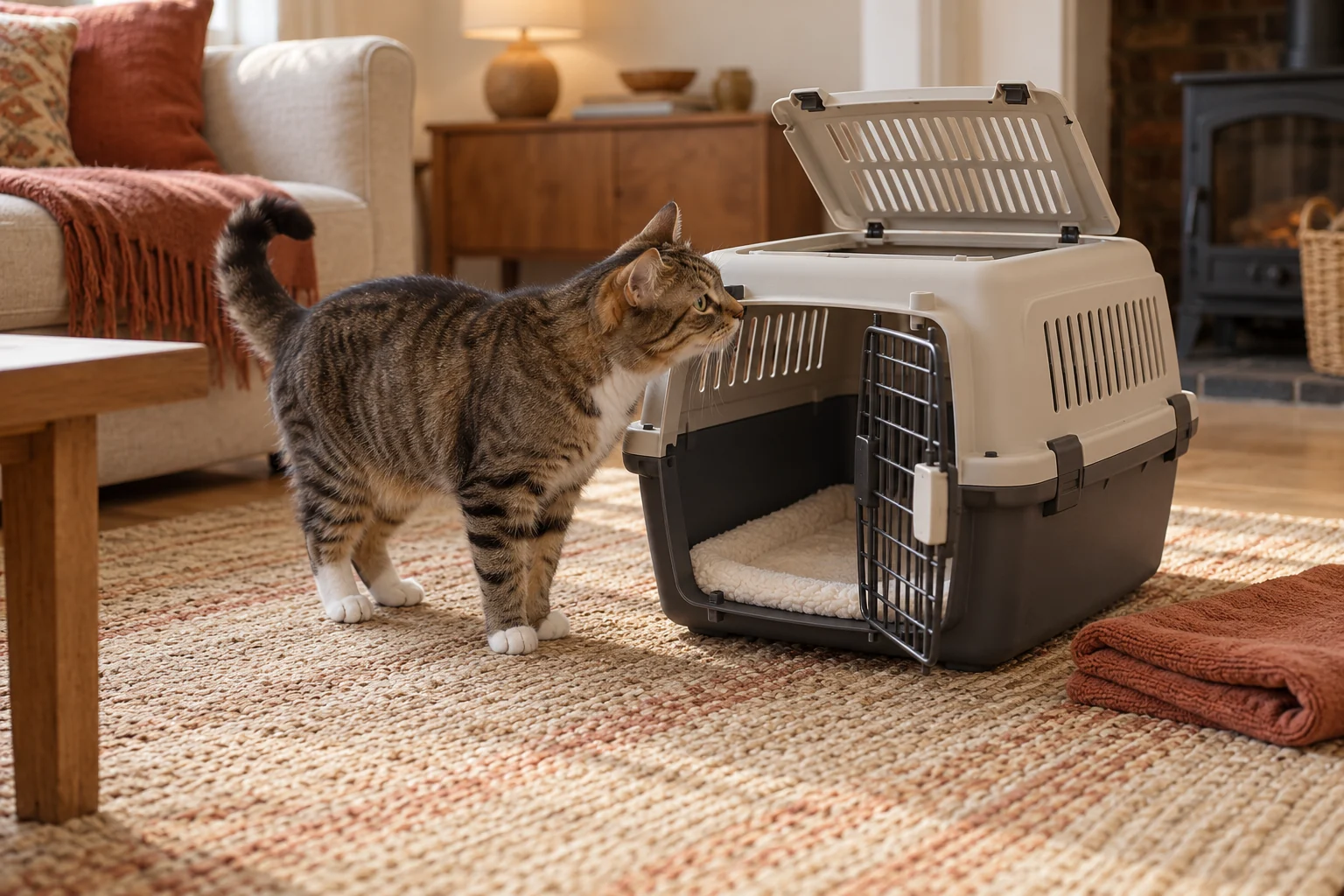
Where practical, keep the clean carrier accessible at home between trips. Cats Protection's guidance on you and your vet discusses letting it become part of the normal surroundings. Choose a quiet position where the cat can investigate and leave voluntarily.
Use bedding that fits and is permitted by the carrier instructions. Avoid creating a dangling strap, obstructing a vent or placing a loose item where it affects the door. Observe the approach and do not treat a single photograph of a cat beside the carrier as evidence that they are comfortable travelling in it.
Plan enough time to inspect the carrier before the journey, rather than discovering a missing latch while preparing to leave. Confirm the supported method of carrying and securing it in the vehicle. An airline-related description does not establish acceptance by a particular operator or flight; check current requirements separately if that is the intended use.
Cleaning and replacement parts
Separate washable fabric, bowls and the hard shell according to the maker's directions. Rinse permitted cleaners as required, dry the parts and inspect joints before the carrier is reassembled. Avoid assuming a disinfectant suitable for one material is appropriate for every plastic, metal or fabric component.
Keep the model code for any future replacement door or clip. A part that looks similar may have different hinge pins, tolerances or locking points. If the structure is cracked or a closure is damaged, seek the correct manufacturer-supported solution before using it with the cat.
The carrier hub covers the wider choice between hard and soft designs. If you want a washable resting surface for home as well, compare the care distinctions in our bed guide while checking carrier-specific fit separately.
If these top-opening models do not offer enough body room, compare the larger-carrier guide. Its front-entry options make usable interior space and handling bulk the starting point.
Sources and selection method
The shortlist uses Catit and Ferplast model information, the selected Amazon UK listings and Cats Protection's carrier guidance. The comparison focuses on opening design, fit and maintenance. We do not infer crash protection from a seat-belt feature or physical suitability from a maximum load alone.
Before comparing doors and hatches, measure your cat for a carrier and distinguish usable inside room from the outside footprint.
For the wider material decision, compare hard and soft carriers by closures, cleaning and the exact journey.
Before an appointment, use vet-visit carrier preparation and compare liners and absorbent pads by usable fit.
For long-term use, check replacement doors and clips by model, when to replace a carrier and the vehicle restraint guide.
Frequently asked questions
Is a top-opening carrier better for a vet visit?
It provides another route to the inside, which can be useful alongside front access. A removable top can offer a wider opening again. Choose around secure closures, usable space and the veterinary team’s handling needs; top access does not guarantee that every cat will be comfortable.
Are Atlas 20 Open and Atlas 20 Deluxe Open the same carrier?
Treat them as distinct named variants and check the selected package. This guide links the Atlas 20 Deluxe Open and uses Ferplast’s model-specific dimensions. Do not transfer a size, load limit or replacement part from a generic Atlas listing or another number in the family.
Does the maximum weight tell me whether my cat fits?
No. Weight capacity is one limit, while usable internal length, height, doorway and bedding determine physical room. A cat below a stated maximum can still be too long or tall for a particular interior. Ask for internal measurements when the listing only gives the outside.
Can I carry the carrier with the top open?
Do not move a loaded carrier with structural sections open. Assemble and close it fully using the exact maker instructions before carrying. Inspect every latch and connection, and use the supported carrying method. Get help from the veterinary team when handling is difficult.
Should I store the carrier away after every trip?
Where practical, keeping it accessible as a familiar clean object can help avoid it appearing only before journeys. It still needs a suitable position, unobstructed access and periodic inspection. A hard carrier’s storage footprint is therefore part of the purchase decision.