
Practical guide · Cat trees & climbing
Cat tree stability: assembly and placement checks
Check cat-tree assembly, floor contact, restraint, routes and wear. Understand why a thick post or a heavy base does not establish a universal safe load.
The short answer
Inspect the whole assembly before inviting use
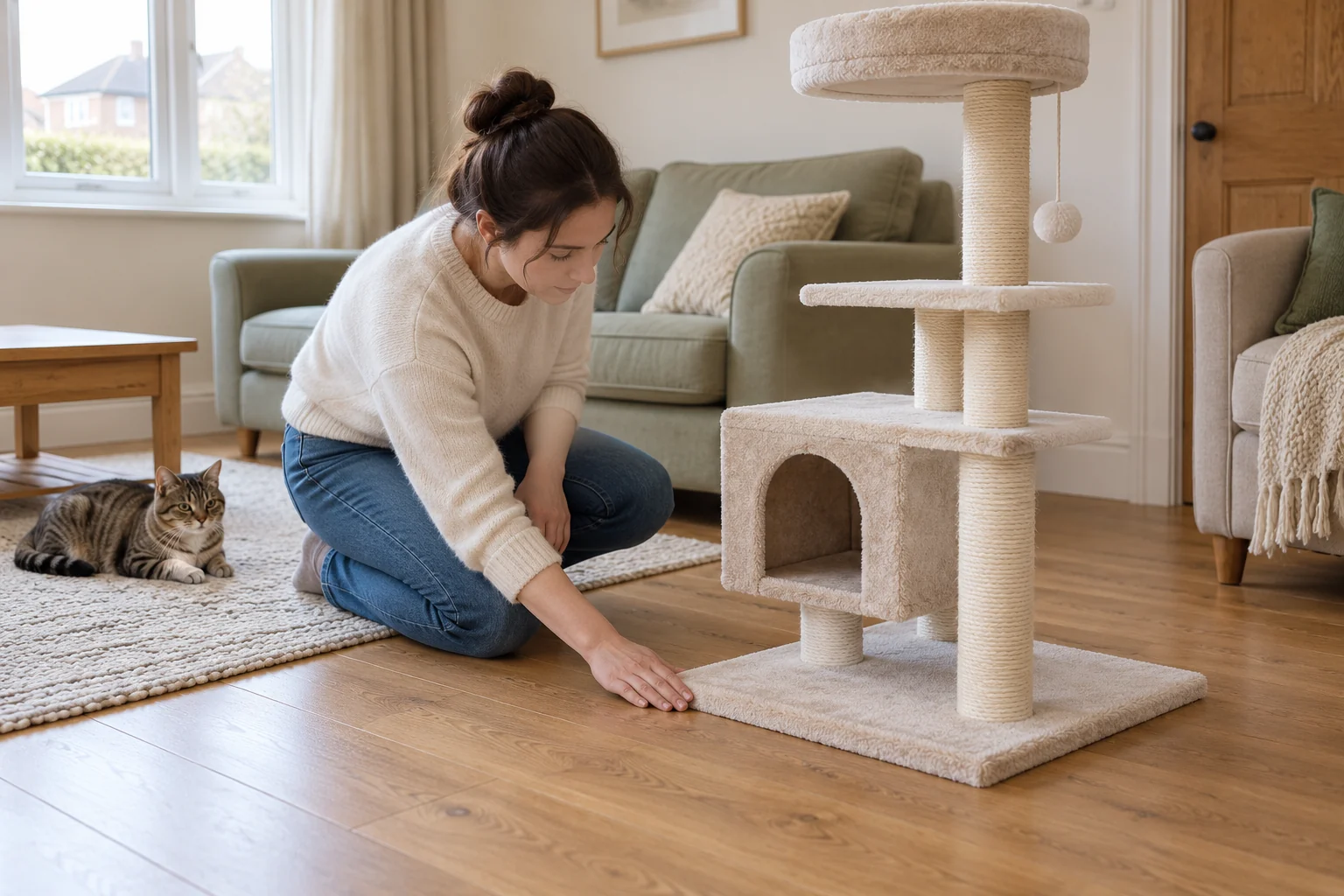
Before use, check the exact assembly instructions, complete floor contact, correct joints and any required restraint. Plan a clear route up and down, then inspect fixings and structural wear regularly. Overall weight, a thick post or one quoted load figure does not establish stability for every cat or placement. Stop use if a base, joint or supported platform is damaged.
A substantial-looking cat tree can still be assembled incorrectly or placed on an uneven surface. A broad base, thick column and generous bed are useful construction details, but they do not remove the need to inspect the complete arrangement.
This is an owner’s visual and assembly checklist, not a load-test procedure. Do not climb on furniture, push it towards tipping or use the cat as a test weight. The selection guide covers choosing a suitable structure; the placement guide helps plan its position.
Identify the exact model and revision
Find the label, order information and supplied instructions. Product families can include several heights and arrangements with similar names. A drawing for a shorter version or an older platform layout may not show the connections on your tree.
Lay out the parts list before assembly and check for missing hardware or damaged pieces. Keep children and pets away from loose fixings and unsupported components. If a structural panel arrives cracked or an insert is loose, resolve that before completing the assembly.
Keep the instructions for later inspections and replacement parts. A photograph of the label and the completed arrangement can help when asking the maker for advice. It is more useful than trying to identify a cream plush model from an old marketing photograph.
Follow the supported assembly sequence
Use the specified parts in their intended positions. Posts of similar appearance may have different lengths, fittings or roles in the structure. Swapping them to obtain a preferred bed height can alter platform support and connection engagement.
Follow the tightening sequence and tool guidance. Do not force a bolt that catches early or fails to sit correctly. Recheck alignment and the part number, and ask the maker if the connection remains uncertain. Additional glue, washers or a longer bolt are not automatic solutions.
Inspect the completed structure before inviting the cat onto it. Check that every required connection is present and that platforms face the intended direction. A decorative cover can conceal a fixing, so use the diagram rather than counting only what is visible afterwards.
Check the floor under the complete base
Choose a level supported area. A base partly on a thick rug and partly on hard flooring can rock, and a threshold or cable trapped beneath one edge can change contact. Clear the area before positioning the tree.
Look around the whole perimeter and confirm that the base sits as intended. Do not wedge random objects underneath to conceal a problem. If the floor is unsuitable, move to a better position or seek the maker’s supported installation advice.
Consider cleaning and daily use. A tree squeezed behind a chair may get bumped repeatedly, while one beside a door can be struck when the door opens. Stability is an ongoing arrangement in a working room, not just a successful first placement.
Fit required restraint properly
If the instructions require an anti-tip strap, bracket or other restraint, plan it before use. The fixing method must suit both the product and the wall. A wall’s surface appearance does not tell you what is behind it or which fixing is suitable.
Use the intended attachment points and seek competent help when the wall or installation is uncertain. Do not tie the tree to a curtain rail, radiator or lightweight item of furniture. Placing the tree near a wall does not itself provide the specified restraint.
If suitable installation is not possible in the intended room, reconsider the location or design. Avoid deciding that a strap is optional because the tree feels heavy while empty. Follow the exact instructions rather than a general impression.
A compact model with an anti-tip provision
The Feandrea compact ramp tree combines a cave, upper perch and ramp in a 48.5 cm square by 96 cm overall layout. Its supplied anti-tip arrangement is part of the installation decision. Check the selected version’s instructions and required fittings before assembling it in a tight corner.
Compact plush tower
Feandrea compact cat tree with ramp
A plush-covered 96 cm tree with a cave, raised perch and sisal scratching ramp. It offers several activities within a listed 48.5 cm square outline, provided the final platform positions and restraint fit your room.
Check: Plush-covered panels need their own cleaning routine
View on Amazon ↗The ramp does not establish that every cat can reach every level, and the compact footprint does not remove forces from jumping or turning. Use it as an example of checking the complete product rather than treating a short height as a safety rating.
A substantial single-post example
The TRIXIE XXL Klara has a 60 cm square base, a 20 cm diameter post and a 100 cm overall height. It illustrates how a simple structure can still need checks at the base, post connections and raised bed.
Single raised bed
TRIXIE XXL Klara cat tree, grey
A single elevated resting bed on a 20 cm diameter sisal post, with a 60 cm square base and 100 cm overall height. Check the usable bed interior separately; the base dimensions do not establish the sleeping area.
Check: Inner bed size needs confirming separately
View on Amazon ↗TRIXIE’s Klara information explicitly avoids a general kilogram capacity because usage, assembly, installation and condition affect the result. Do not convert the tree’s own weight, a component test or its large-cat description into a universal load claim.
Inspect routes and nearby hazards
Trace the cat’s route from the floor to each useful platform and back. Leave suitable landing space and avoid relying on a rolling chair or light side table as a step. A high bed should not leave the cat dependent on a single difficult jump down.
Check windows, blind cords, heaters, door swings and nearby breakable objects. The tree can change what the cat can reach. A position that was safe before an elevated platform arrived may need a new window or cable arrangement.
In a multi-cat home, watch whether another cat can block the route. Several beds above the same narrow lower platform do not necessarily provide independent access. Offer alternative resting places and avoid crowding the tree’s base with food, water or litter equipment.
Distinguish surface wear from structural damage
Some scratching wear is expected. Loose loops, exposed staples, damaged hammock attachments and lifting fabric edges still require attention, but they are different from a cracked panel, stripped insert or loose load-bearing joint.
Stop use of a damaged structural part and contact the maker about the correct replacement. Do not re-rope a column and assume its internal connection has been repaired. The replacement-post reference explains dimensions and fittings without treating similar-looking parts as interchangeable.
Follow the maker’s inspection schedule and recheck after moving or disassembling the tree. Look for a new tilt, base rocking or a changing connection during normal use. Do not wait for a complete failure before investigating a visible change.
Work through five checks before use
Cat tree assembly and placement checklist
0 of 5 checks complete.
Completing this list is a prompt to inspect, not a certification of structural performance. If a connection or installation remains uncertain, keep the cat off the tree and obtain appropriate help. A useful resting structure is one that can be assembled, positioned and maintained as its maker intended.
Frequently asked questions
How much should a cat tree wobble?
There is no universal acceptable movement measurement for every design. Check the maker’s assembly and installation guidance, and investigate rocking at the base or movement at a joint. Do not encourage the cat to jump onto a structure to test it. Stop use if you cannot establish that it is correctly assembled and sound.
Does a heavy base mean I can skip the anti-tip strap?
No. Use any restraint required by the exact product’s instructions. Weight alone does not account for height, projecting platforms, floor level or a moving cat. If you cannot fit a required restraint properly, obtain suitable help or choose a design you can install as intended.
Can I tighten every bolt as hard as possible?
No. Follow the supplied sequence and any tightening guidance, using suitable tools. Excess force can damage threads, inserts or panels. If a connection will not become secure in the intended way, stop and ask the manufacturer rather than compensating with more force.
Can I repair a cracked platform with glue?
Do not rely on an improvised repair to a load-bearing part. Keep the tree out of use and obtain the maker’s approved replacement or advice. Replacing a worn scratching covering is different from restoring a cracked platform, damaged base or stripped structural connection.
Should I recheck a tree after moving it?
Yes. Recheck assembly, floor contact, restraints, clearances and the route before the cat uses the new position. Movement can disturb joints or change how the base sits. Follow the manufacturer’s continuing inspection guidance as well as making these checks after relocation.