

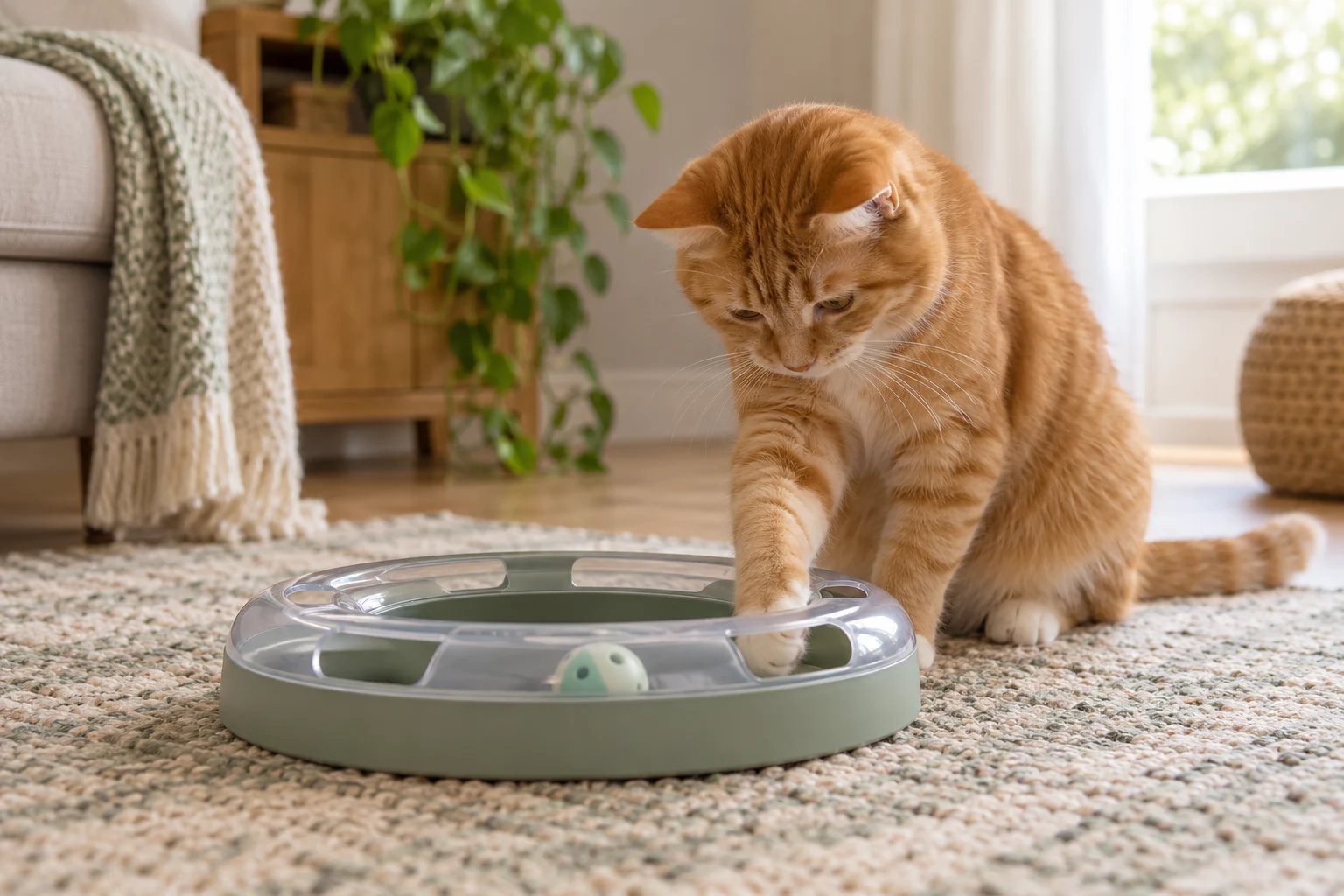
Begin with the kind of play your cat chooses: a moving target to chase, a tunnel to investigate or a simple puzzle to explore. You do not need to buy every type at once. Give one activity a fair introduction and watch what your cat does with it.
Play together
A teaser toy creates a different interaction from a ball left on the floor. Check attachments before each session and put strings and wand toys out of reach afterwards. Cats Protection's play guidance covers appropriate toys and safe play.
Look for a clear space where the cat can move without colliding with furniture. The route and surface matter when choosing whether a long wand or a small rolling toy is practical in your room.
Start puzzles simply
Before choosing a puzzle feeder, check the food it accepts, the opening dimensions and how it can be washed. Make the first attempt easy enough for the cat to discover the reward. A puzzle is useful only if the cat can reach what is inside.
Do not assume a more complicated design is better. Choose a model that offers a straightforward starting arrangement and observe whether the activity suits your cat. Any food used for play still belongs within the cat's normal feeding plan.
Catit Senses 2.0 Digger
Best for: A simple dry-food puzzle
Five removable tubes hold dry treats or kibble for your cat to retrieve with a paw. Begin with an easy-to-reach reward and watch whether the activity appeals before making it more challenging.
What stands out
- Different tubes allow a simple starting choice
- Separates for washing
Keep in mind
- Treats still count towards the normal feeding plan
- Not a timed feeder or a wet-food bowl
- Three short and two long tubes
- Removable tubes
- Dry treats or kibble
Tunnels, hiding places and choice
Compare a tunnel's internal diameter with its advertised overall length. Check whether it keeps its shape, whether a cat can leave easily and how you will clean it. A large play item can be less useful than a small hideaway placed somewhere the cat already spends time.
Offer room to leave an activity. With more than one cat, think about whether an exit or favourite spot can be blocked. Avoid placing everything in one busy corner.
Catit Vesper Tunnel, grey
Best for: Exploring and hiding between play sessions
A foldable fabric tunnel with a peekaboo opening and a removable round cushion. It gives a cat somewhere to explore and pause, and can be put away when you need the floor space back.
What stands out
- Offers a tunnel and a resting spot
- Folds down between uses
Keep in mind
- Check usable tunnel space, not just outer dimensions
- Inspect the hanging toy and fabric for wear
- 96 × 48 × 28 cm overall
- Foldable design
- Removable cushion
Keep the useful things interesting
Try presenting a few different activities at different times rather than filling the floor with every toy. Check wear before bringing an item back out. If a cat loses interest in play suddenly or seems unable to move as usual, discuss the change with your vet.
For another everyday activity that needs an appropriate surface, start with scratching posts and pads. A reachable perch can add a different way to use the room.
Choose an activity, rather than a bigger toy collection
For food-based activity, start with beginner puzzle feeders or compare treat balls by food opening and first-use difficulty. Keep rewards within the same daily feeding plan; difficulty is useful only when the cat can discover and reach the food.
For movement, play tracks offer a contained rolling route, kicker toys provide something to hold and kick, and tunnels offer a different way to investigate the room. Wands with replaceable attachments support shared play, with connector compatibility and supervised use part of the purchase decision.
Build a routine you can keep
The small-budget enrichment guide helps prioritise useful variety before spending more. Toy rotation keeps a manageable selection available while giving you an opportunity to inspect stored items before they return.
Read how to use a wand toy safely for movement, inspection and storage. For food-contact toys, cleaning puzzle feeders covers dismantling and drying rather than assuming every insert or mechanism shares the same wash instructions. Keep play locations clear enough for the cat to approach and leave; adding an activity should not block a route to food, water or resting space.
Read the guides
Find the next useful guide
Find a few activities your cat uses, then introduce, rotate and maintain them without crowding the home.
Choosing, setup & care
Work through fit, everyday decisions and upkeep.
- How to clean cat food puzzle toys Remove crumbs, wash food-contact areas and dry puzzle toys fully before reuse. Includes separate care for Catit Digger cups and the TRIXIE Fun Board.
- How to rotate cat toys Create a manageable toy rotation with supervised play, safe storage and easy cleaning. Match toys to your cat’s response rather than a rigid replacement calendar.
- How to use a cat wand toy safely Plan supervised wand play with safe floor movement, regular catches, equipment checks and secure storage. Adapt the game to your cat’s movement and confidence.
- Indoor cat enrichment on a small budget Build a varied indoor routine with safe boxes, food searches, short play sessions and resting choices. Prioritise a few useful purchases without clutter or fixed budgets.
Frequently asked questions
Which type of cat toy should I buy first?
Start with a movement or activity your cat already enjoys and introduce one straightforward option. A puzzle, rolling track, tunnel and kicker ask for different actions. Watch voluntary use before adding complexity or buying several versions of a toy the cat has not used.
Can puzzle-feeder food be extra to normal meals?
Count food used for puzzles and treat balls within the cat’s feeding plan. Check the food and opening supported by the toy and start with an easy arrangement. Ask your veterinary team about individual dietary needs rather than using the toy to decide a food allowance.
How many toys need to be out at once?
There is no useful universal number. Keep a manageable selection of different activities without blocking routes or crowding resources. Rotate intact stored items according to interest and inspect them before use. One suitable activity used voluntarily can be more helpful than a floor covered in toys.
Are replacement wand attachments universal?
No. Match the connector and attachment family supported by the wand maker. Similar-looking clips can close or load differently. Inspect the complete connection and toy before play, supervise the session and store strings and attachments out of reach afterwards.
Can all plastic puzzle toys go in the dishwasher?
Only use the cleaning method permitted for the exact toy and components. Plastic appearance does not establish heat tolerance or safe treatment of bonded pieces and mechanisms. Remove food residue, reach the accessible channels and let parts dry fully before refilling.


