
Practical guide · Cat beds & resting
Where to put a cat bed
Choose quiet, accessible sleeping places using the spots your cat already likes. Plan warmth, height, separate resources and a gradual move to new bedding.
The short answer
Follow the chosen sleeping spot, then improve it
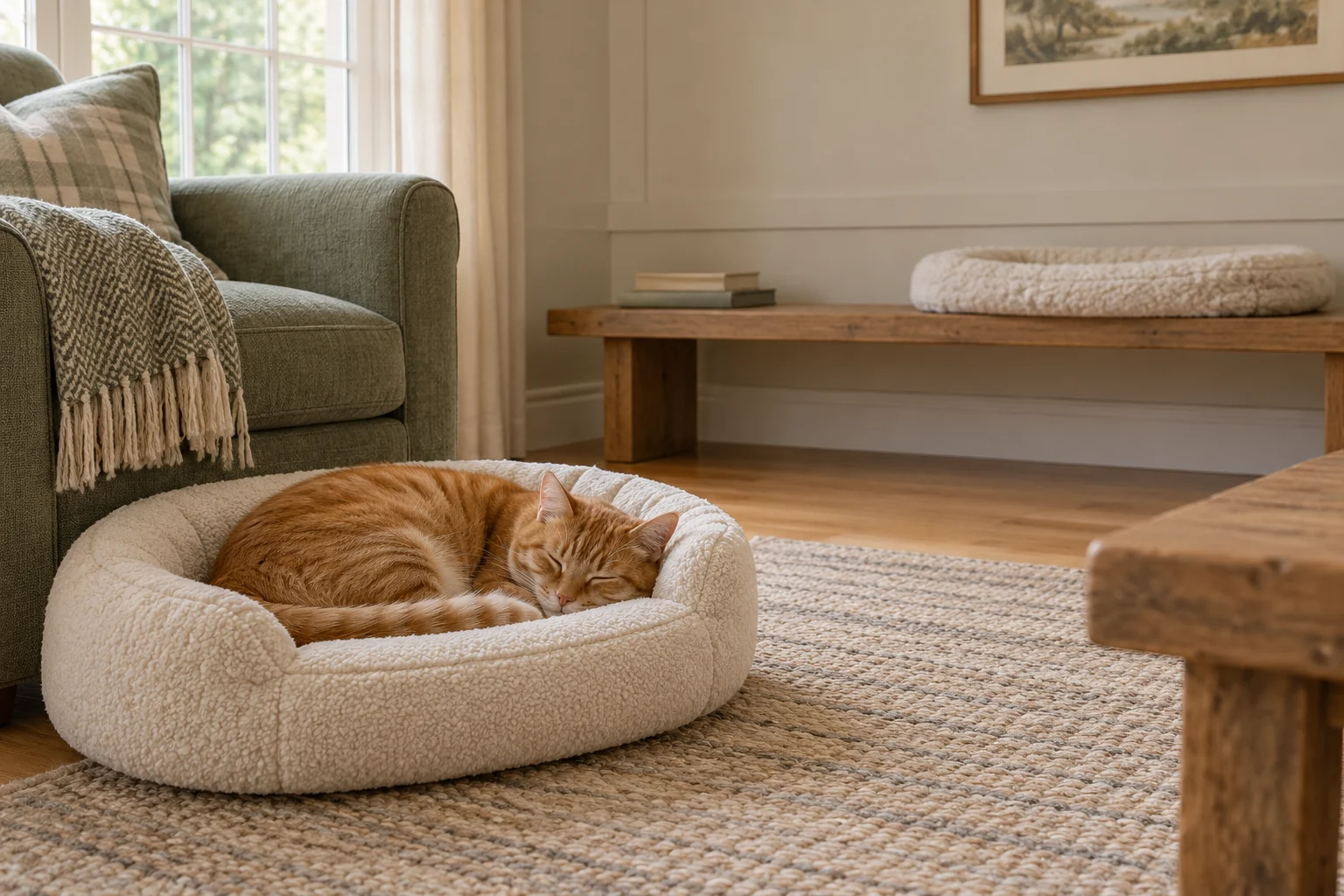
Begin near a place your cat already chooses to sleep: a quiet corner, a comfortable room with company at a distance, or an accessible elevated surface. Keep the bed away from noisy appliances, draughts, direct heat and litter or feeding stations. Offer more than one option and let the cat choose rather than repeatedly moving them into the bed.
A carefully chosen bed can remain empty if it is in the wrong place. The cat may prefer a plain cushion on a quiet chair because it offers a better view, a familiar scent or fewer interruptions. Location is part of the bed’s usefulness, not a finishing detail after the purchase.
Before buying another design, look at the places your cat uses at different times. This guide helps you turn those observations into a resting setup. For shape and size decisions, compare our washable beds, low-entry beds and beds for large cats.
Start with the existing sleeping habit
Notice where the cat settles in the morning, afternoon and evening. A sofa back may provide a view of the room; a bedroom corner may stay quiet; a rug may feel cooler than a plush cushion. Record the conditions as well as the place.
Do not assume a cat avoiding a new bed dislikes beds altogether. The bed may be in a corridor, beside a noisy appliance or too close to a pet that interrupts. Equally, a cat sleeping near people may still prefer enough distance that hands and feet do not pass over the bed.
Cats Protection’s advice on sleeping spots recommends several choices, accessible elevated places, comfortable temperature and freedom from disturbance. Use those principles alongside your cat’s own pattern rather than trying to find one perfect location for every nap.
Find quiet without isolating the cat
A quiet living-room corner can suit a cat that likes company while resting. Place the bed outside the route between the sofa, door and kitchen so people do not repeatedly step over it. Check the position during ordinary evening use, not just when the room is empty.
A bedroom can work if access remains predictable and the cat is not regularly disturbed. Do not choose a room whose door is usually closed if that would cut the cat off from the bed. Keep the route to other resources clear without putting the bed immediately beside them.
Avoid washing machines, vibrating appliances and places where a door slams near the sleeping cat. If you have children or visiting pets, create a simple household rule that a resting cat is left alone. A quiet position loses its value if the bed becomes a place for frequent attention.
Offer height only with safe access
An elevated place can provide distance from floor-level activity and a view of the room. Use a broad stable surface that fully supports the bed, with a route up and down suited to the cat. A cushion overhanging a narrow shelf is not a secure enlargement of that shelf.
Check grip on both layers: bed against furniture and furniture against the floor. Soft bedding can slide when a cat lands or pushes off. Avoid rolling chairs, folding furniture and surfaces that tip when weight reaches an edge. Keep the final landing clear too.
For an older cat or one with changing mobility, provide a comfortable lower option and discuss new difficulty jumping with your vet. A familiar high bed may become inaccessible even though the bed itself has not changed. A stable lower platform or floor-level mat can preserve choice while you investigate.
Check temperature through the day
Choose somewhere free from persistent draughts and direct heat. A sunny patch can be appealing at one time and uncomfortable later, so the cat should be able to move to another resting option. Do not wedge the bed between a hot radiator and a wall.
Keep bedding away from open fires, portable heaters, vents and electrical equipment that needs clearance. Follow the instructions for any heating product rather than placing a general fabric bed on top of it. This guide does not assume that a heated bed is needed.
Seasonal changes can alter a preferred location. A cooler open mat and a warmer soft bed may both have a place in the home. Offering a choice is more flexible than repeatedly relocating the only bed whenever the weather changes.
Keep sleeping separate from other resources
Give food, drinking water, toileting and sleeping their own usable places. There is no fixed distance that works in every home, but putting everything on one mat in the corner leaves little functional separation. Use the room layout to create distinct approaches.
Do not place the bed directly beside a litter entrance or where another cat must pass over it to reach food. A cat asleep there could inadvertently block a resource, and the resting cat may be disturbed each time someone needs access.
A scratching post near a favourite bed can be useful for stretching after waking. Keep enough space for the full movement without the post falling onto bedding or blocking the way out. Our scratching-post placement guide explains that arrangement in more detail.
A flat option for an established resting patch
Vetbed Original can provide a broad fleece surface on a suitable floor or fully supporting piece of furniture. The linked piece is roughly 102 × 76 cm, so check the whole area rather than folding it into an unstable pile to make it fit.
Flat washable fleece
Petlife Vetbed Original, grey 40 × 30 in
A flat washable fleece with the Original green backing. The selected listing is a generous 40 × 30 inch piece, useful when you want a continuous resting surface rather than a bed with raised sides.
Check: Original backing is not the Non-Slip range
View on Amazon ↗This Original version is not the Non-Slip range. Plan grip separately and test the arrangement before leaving it in use. Its flat shape can help when a cat dislikes stepping over a bolster, but it does not turn a poor location into a good one or provide the same cushioning as a thick mattress.
A soft-sided option for a smaller curled sleeper
The Scruffs Chester small bed offers a different shape for a cat that likes resting against a soft edge. Its 50 × 40 cm outside size includes the bolsters, so check the inner cushion against the cat’s sleeping posture.
Whole-bed washing
Scruffs Chester box bed, small chocolate
A one-piece small pet bed that the maker permits to be machine-washed as a whole at 30°C. It offers a conventional soft-sided resting space without having to remove a separate cover.
Check: Bolsters reduce the usable sleeping space
View on Amazon ↗This is a placement example for a suitable smaller sleeper, not a recommendation for every cat. A large stretched-out cat may need the larger-bed options instead. Place the bed on a stable surface with a comfortable entrance rather than assuming the lowered front is suitable for every mobility need.
Provide independent resting choices
Cats that sometimes sleep together should still have places to rest separately. Several beds in a tight row can be occupied or guarded from the same approach. Spread useful options through different areas where possible.
Watch who actually uses each place. If one cat leaves whenever another arrives, or waits near a bed without settling, the arrangement may need more separation. A larger shared bed is not always the answer; a second quiet position may provide more choice.
Include different heights and degrees of enclosure where they can be made safe. A floor hide, a broad low perch and a quiet open cushion can serve different preferences. Keep routes clear so no cat has to pass another’s sleeping spot at close range to leave.
Introduce the bed without making it a demand
Put the new bed near a chosen resting area and let the cat investigate. A familiar clean cloth can help when it fits safely, but avoid burying an entrance or adding unstable layers. Do not repeatedly place the cat inside or wake them to demonstrate the new bed.
If you need to change location, keep a familiar resting option available. Move gradually when practical and observe use before removing the old arrangement. A bed moved into a room with different noise, heat and traffic is a bigger change than the distance alone suggests.
Wash beds in rotation, following the exact care labels, so at least one familiar-scented resting option remains. Let thick filling dry completely. A newly washed bed with a strong laundry fragrance may be less inviting to the cat even when people find it pleasant.
Test the position during a normal day
Cat bed placement checklist
0 of 5 checks complete.
Check again with doors, curtains and household activity in their usual state. The right resting setup gives the cat several comfortable choices and lets them decide which one suits the moment.
Choose the format after the location: compare covered beds and caves for enclosure, or non-electric self-warming mats for a flat reflective resting surface.
Frequently asked questions
Should a cat bed go on the floor or up high?
Both can be useful. Many cats value an elevated resting place, but it must be stable, fully supported and accessible for that cat. Keep an easy lower option too, particularly if jumping is difficult. A height preference does not justify balancing a bed on a narrow or unstable surface.
Can I put a cat bed next to a radiator?
Avoid direct heat or any position that can become uncomfortably hot. Leave the cat a choice of resting places and follow the heater and bed instructions. A warm room with a safe separation is different from pressing bedding against a heater or covering a vent.
Should I put the bed beside the food bowl?
It is better to give sleeping, feeding, drinking and toileting areas their own space. There is no universal separation distance for every home; use distinct usable locations and a clear approach. A scratching outlet can be placed near a favourite bed for a stretch after waking.
Why does my cat sleep beside the new bed instead of in it?
The surrounding location may be right while the texture, temperature, smell or shape is not. Keep the bed available without forcing use and try a familiar cloth if it suits the design. Avoid buying another bed immediately; observe the preferred surface and resting posture first.
Can I move my cat’s bed to another room?
Make the new resting option available while retaining a familiar one, especially if the cat is settled in the old place. Move gradually where practical and check the new room stays accessible with doors in normal use. Do not repeatedly carry a sleeping cat to the new bed.