
Practical guide · Carriers & travel
How to prepare a cat carrier for a vet visit
Prepare the carrier, liner, spare bedding and appointment details before a vet visit. Check closures, ventilation and the journey while keeping handling calm.
The short answer
Prepare the carrier and appointment before the journey
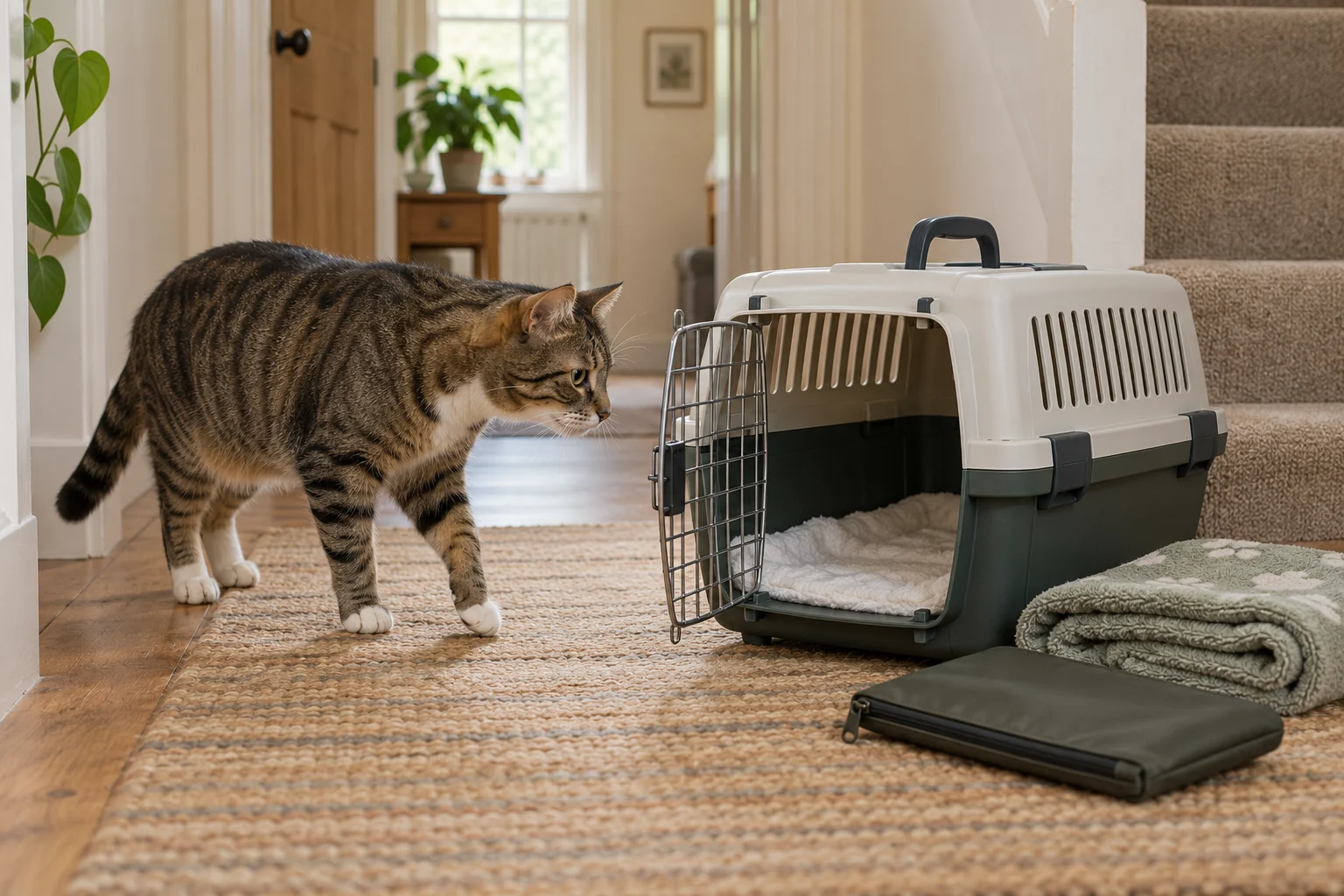
Check the appointment instructions, carrier closures, usable space and a thin fitted liner before the day of travel. Pack a spare liner and relevant notes, keep ventilation clear and use the carrier’s supported carrying and vehicle-securing method. Let the cat enter in a secure room and keep the carrier closed through the journey and waiting area. Follow the practice’s own fasting, medication and handling instructions.
Preparing a carrier before a vet visit removes several avoidable problems from an already unfamiliar day. A checked latch, a liner that stays flat and a note of the appointment instructions are usually more useful than adding lots of accessories at the last minute.
This guide covers the practical preparation and journey. For teaching comfortable voluntary entry over time, use introducing a cat carrier at home. Training is valuable, but an urgent appointment should not be delayed while a cat learns a new routine.
Confirm the visit instructions first
Check the practice location, arrival time and how to contact it on the day. An emergency service may be at a different address from the usual surgery. Note any request to wait outside, call on arrival or use a particular entrance.
Ask specifically about food, water and medication if a procedure is planned. Do not assume every appointment requires fasting, or copy instructions from a previous visit. Kittens and cats with particular health needs may require individual arrangements. If instructions are unclear, clarify them with the practice before changing the cat’s routine.
Prepare a short note of the reason for the visit, relevant changes, medicines and any requested samples or records. Keep the note outside the carrier so it can be handed over without opening the cat’s travel space.
Inspect the actual carrier before loading
Place it on the floor in a secure room. Check the door, top, base joins, clips, screws or zips as appropriate. Confirm every required component is present and closes fully. A handle that looks sound does not prove the base is securely attached.
Check usable room with the intended liner in place. Your cat should have appropriate space for a comfortable posture, turning and lying down. Do not rely on the carrier’s outer dimensions or a generic weight label alone. Use how to measure a cat for a carrier if fit is uncertain.
The Catit Cabrio is an example with top access and a rigid shell. Its particular closure and securing instructions still need to be followed; a top opening does not make the whole carrier escape-proof or crash-tested.
Wide-opening carrier
Catit Cabrio carrier, turquoise
A rigid carrier with a wide-opening upper section and front access, designed to make the inside easier to reach. It can remain open at home as a familiar resting space between visits.
Check: Outer dimensions do not establish inside fit
View on Amazon ↗Fit a thin familiar floor layer
Choose a clean liner that lies flat inside the actual base. Check the corners, door sweep and ventilation after fitting it. Avoid a thick folded blanket that consumes space, shifts under the cat or catches in the closure.
A familiar clean item can help retain an ordinary home smell, provided it is safe, fits and is not heavily perfumed. Do not add loose strings, frayed fabric or small objects. If the cat chews fabric, ask the practice about an appropriate alternative.
For possible accidents, a fitted washable absorbent pad is one option. The selected rocket & rex pads measure approximately 44.5 × 28 cm each. That size is not a stated match for every carrier, including the Cabrio: measure your own floor rather than treating the two product examples as a guaranteed kit.
A washable absorbent carrier-floor layer
rocket & rex reusable carrier pads, pack of two
Two washable multilayer pads with absorbent material and a waterproof backing. The listed 17.5 × 11 inch size needs matching to the actual carrier floor; it is not a universal fit.
Check: Do not cut through the sealed multilayer edge
View on Amazon ↗Pack a spare pad or thin liner in a separate clean bag, plus a bag for soiled material. The carrier liner comparison explains the difference between absorption, waterproof backing and draining fleece.
Keep the travel kit small and accessible
| Take separately | Why it helps | Keep in mind |
|---|---|---|
| Spare fitted liner | Allows a practical change if soiled | Change only in a secure suitable place |
| Appointment and medication notes | Reduces forgotten details | Follow the vet’s actual instructions |
| Light familiar cover if helpful | Gives a visual barrier | Leave ventilation clear |
| Bag for soiled bedding | Separates dirty items on the return | Keep away from the cat’s travel space |
Do not fill the carrier with bowls, toys and supplies. Loose objects can shift, and a bowl of water can spill over the liner. Ask the practice for journey-specific advice if travel is lengthy or your cat has particular needs.
Carry medication in its labelled packaging as requested. Do not give sedatives, human medication or another animal’s prescription to make loading easier. Discuss difficult journeys with the vet in advance.
Load in a secure room and check closures again
Allow time before departure and close escape routes before opening the carrier. Use the entry method your cat knows where possible. If handling is difficult or risks injury, ask the practice for an individual plan rather than escalating force.
Once the cat is inside, check all closures, including any opening you did not use. Keep fingers, fur and the liner clear of the latch. Lift gently with the carrier supported as instructed, including the base where appropriate, and avoid swinging it by the handle.
Use a separate suitable carrier for each cat unless the veterinary team has advised otherwise for the specific situation. Familiar cats can react differently when confined or distressed, and shared transport can make individual handling harder.
Plan the journey and waiting area
Follow the carrier and vehicle instructions for placement and securing. Do not improvise a restraint or assume a seat-belt opening establishes crash performance. Keep the carrier stable, ventilated and away from excessive heat, and avoid unnecessary movement or loud sound.
Keep it closed in the car park and waiting room. Ask about a quieter place to wait if dogs, noise or other cats are upsetting your cat. Tell the team if the carrier has a removable top so they can choose an appropriate examination approach.
A light towel may provide a useful visual screen, but it must not block ventilation or trap heat. Never leave the cat unattended in a parked vehicle while completing errands.
Prepare for the return and next visit
After coming home, open the carrier in a secure suitable room and give the cat space. Follow discharge instructions, particularly after sedation or a procedure. If a liner is soiled, bag it separately, clean the carrier using its own instructions and let everything dry before storage.
Keep the carrier accessible for familiarisation again when appropriate. A carrier that appears only immediately before an appointment can be harder to introduce calmly. Use carrier cleaning for the care routine.
Before leaving for the appointment
0 of 5 checks complete.
Preparation follows Cats Protection’s carrier guidance and advice on less stressful vet visits.
Frequently asked questions
Should I feed my cat before a vet appointment?
Follow the veterinary practice’s instructions for that appointment and your cat. Some procedures need a specific fasting plan, while other cats should not have food withheld without advice. Confirm food, water and medication arrangements in advance rather than applying a general rule.
What should I put inside the carrier?
Use a clean familiar thin liner that fits the actual floor without bunching, blocking the door or reducing headroom excessively. An appropriately fitted absorbent pad can help with accidents. Pack a separate spare and keep loose toys, bowls and heavy objects out of the travel space.
Can I cover the carrier with a towel?
A light familiar cover may help some cats, provided ventilation remains clear and the carrier does not overheat. Observe your cat’s response and the conditions. Keep access to the handle and closures clear, and do not treat a cover as a reason to leave the cat in a parked car.
Should I open the carrier in the waiting room?
Keep it securely closed until the veterinary team asks you to open it in an appropriate secure area. A frightened cat can escape quickly from an open carrier. Ask the practice about a quieter waiting arrangement if needed.
What if the visit is urgent and the carrier is not prepared?
Contact the vet and prioritise prompt safe transport. Do not delay urgent care to complete training, buy accessories or finish a washing routine. The practice can advise on the safest immediate approach for the cat and situation.