
Practical guide · Carriers & travel
When to replace a cat carrier
Check carrier damage, closures, size and cleaning before deciding to repair or replace. Distinguish a supported spare part from a cracked or unreliable structure.
The short answer
Start with the exact model and the job it needs to do
Replace according to condition and fit rather than a fixed age. Cracked load-bearing parts, unreliable closures, damaged receivers or insufficient usable room need action before travel. A supported spare is an option only when the surrounding carrier structure remains sound.
Replace a cat carrier when its structure, closure, fit or cleanability can no longer support its intended use reliably. There is no single age at which every carrier becomes unsafe, and a newer carrier can still need replacing after damage. Condition matters more than a calendar rule.
A supported spare may be sensible for an otherwise sound carrier with one replaceable component. A cracked receiver, distorted shell or repeatedly unreliable closure is a different decision. Do the inspection before the day of an appointment, while you have time to identify a proper replacement.
Separate cleaning, a supported repair and replacement
| What you find | First decision | Why it matters |
|---|---|---|
| Ordinary dirt on intact washable surfaces | Clean by the exact instructions, then inspect again | Dirt can hide damage but does not itself require a new carrier |
| One damaged removable part, sound surrounding structure | Ask the maker about the exact supported spare | A matched part may preserve a usable carrier |
| Cracked door surround, base, mounting point or load-bearing shell | Stop use and arrange replacement guidance | New hardware cannot restore damaged receiving material |
| Unreliable zipper, bent door or latch that releases unexpectedly | Stop use until a supported repair or replacement is complete | Apparent closure is not dependable containment |
| Cat no longer has appropriate room or access | Remeasure and choose a suitable carrier | Load rating alone does not establish usable body space |
| Damage prevents thorough cleaning or leaves sharp surfaces | Replace the affected supported part or carrier | A cosmetic cover does not remove the damaged surface |
Do not use a rushed journey as the first test of a repair. If an urgent vet visit is needed and the carrier is unreliable, contact the practice about a suitable immediate transport arrangement rather than improvising an open box or unsecure carrier.
Inspect a rigid carrier as a complete assembly
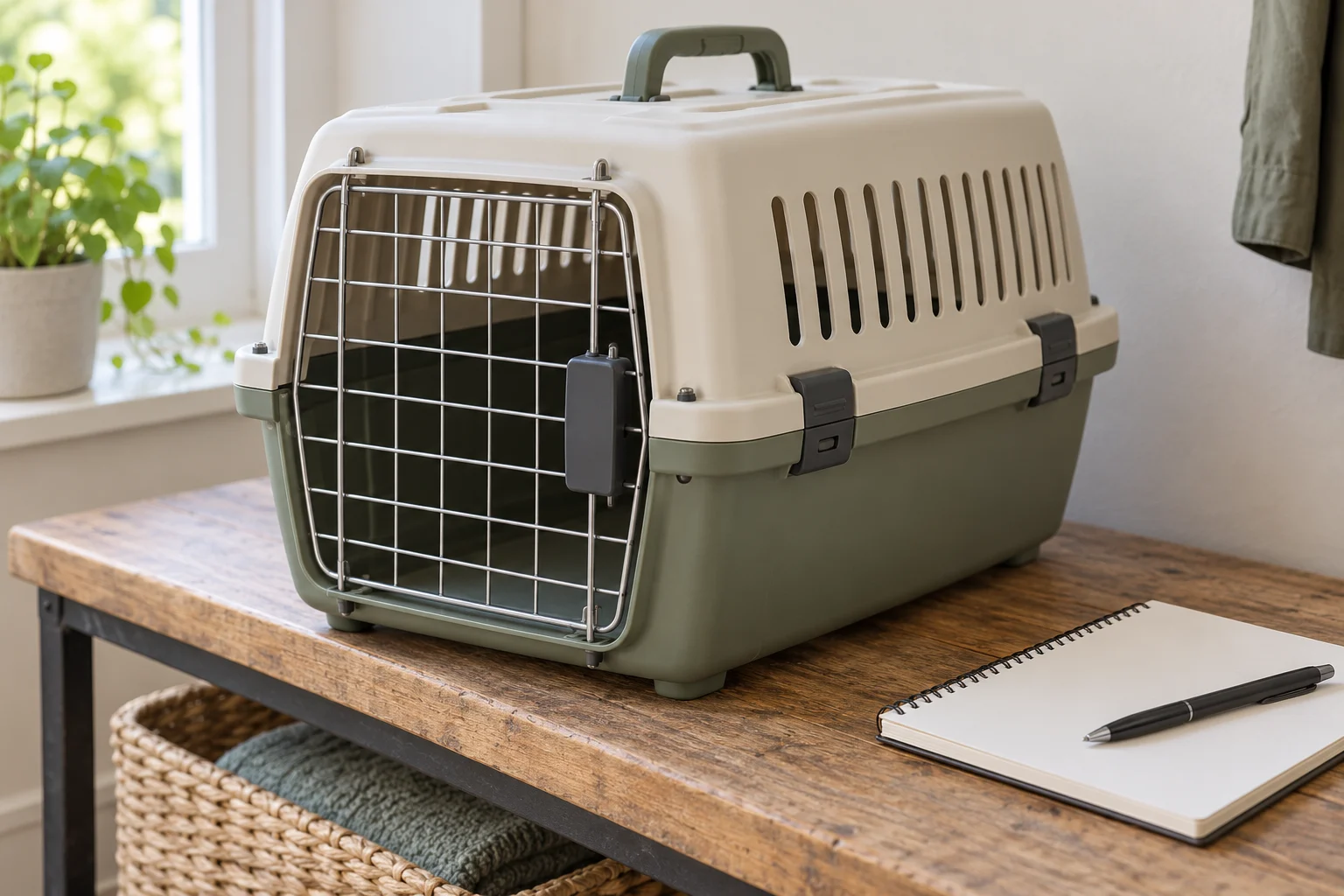
With the carrier empty and clean, look at the base, corners, shell joins, handle mounts, door surround and every latch receiver. Check for cracks, missing material, deformation, corrosion on metal parts and rough edges. Examine both sides of a join where accessible.
Close the door normally and check that its pins or retaining points sit fully in place. Each intended lock should engage without unusual force, and the door should not depend on lifting or twisting the shell to align. A carrier that only closes when held in a particular position needs attention.
The handle is part of the inspection, but it is not the only load-bearing element. Side clips and shell connections must all be present and correctly fitted. Support the base when handling the occupied carrier as appropriate to the instructions; do not assume a sound-looking handle proves the lower shell is securely attached.
Inspect soft carriers beyond the fabric colour
Look along the seams, mesh, zip teeth, sliders, floor insert, strap stitching and handle attachment. Frayed load-bearing stitching, torn mesh or a zip that separates after closing can compromise containment even when the carrier looks tidy from a distance.
Check that the floor remains flat and supported as designed. A sagging insert or bent frame can change both usable space and stability. Do not hide a damaged floor beneath thicker bedding or assume a new shoulder strap repairs weakened stitching where it attaches.
Cleaning instructions vary. Some inserts or covers are removable; others are not machine washable. If the permitted method cannot clean the damaged or deeply contaminated area adequately, ask the maker and vet about replacement rather than using a stronger chemical that may damage the material.
Recheck the cat’s room and entry route
A carrier’s maximum load is a ceiling, not a complete sizing guide. The cat also needs appropriate room for comfortable posture and a workable doorway. Growth, weight change, a bulky coat or changing mobility can make an old choice less suitable without any damage to the product.
Use how to measure a cat for a carrier to compare the actual internal space and entrance. Outside dimensions include walls, hinges and shaped corners; they do not describe a rectangular usable interior.
If loading has become difficult, consider the access design as well as size. Top access or a removable upper shell may help in some circumstances, but changing the box alone does not replace calm familiarisation. For a cat with pain or mobility changes, ask the vet about handling and transport needs.
Two replacement formats to compare
Wide-opening carrier
Catit Cabrio carrier, turquoise
A rigid carrier with a wide-opening upper section and front access, designed to make the inside easier to reach. It can remain open at home as a familiar resting space between visits.
Check: Outer dimensions do not establish inside fit
View on Amazon ↗The Catit Cabrio provides front access and a wide-opening upper arrangement. It is useful to compare where access and a documented vehicle belt route matter. Its size, weight and closure setup still need to suit the cat and person carrying it.
Do not buy it solely because it looks more substantial than the old carrier. Check the actual room, the vehicle setup and the ability to clean and refit all sections. A replacement that is too awkward to carry comfortably can create another practical problem.
Top-access option
Ferplast Atlas 20 Deluxe Open carrier
A hard carrier with front and top openings, side clips and a removable cotton cushion. The top access and detachable shell are useful details to compare when planning how to load, clean and reassemble it.
Check: Select the 20 Deluxe Open model carefully
View on Amazon ↗The Atlas 20 Deluxe Open offers a different front-and-top-opening format with a detachable shell. It may suit a cat for which that exact internal space and entrance work. Its listed load limit does not establish fit for every cat below it.
Whichever carrier you choose, read its own assembly and transport instructions. Door hardware and belt arrangements from the previous carrier should not be transferred by analogy. Replacement door and clip compatibility explains why similar family names do not guarantee shared parts.
Know the boundary of a supported repair
A repair is a reasonable option only when the manufacturer supports the exact part and the surrounding structure is intact. Keep the complete model and revision, obtain the appropriate instructions and refit all required pieces. Retain the confirmation for the next inspection.
Glue, tape, cable ties and unrelated clips are not established substitutes for the carrier’s designed load-bearing or closure parts. Do not rely on a cover to conceal cracked plastic, or on an extra strap to hold together a shell that no longer joins correctly.
After a supported replacement, check the empty carrier’s normal operation and inspect the whole assembly. This is a function check, not proof of crash performance. Never drop, shake or stress-test a carrier with the cat inside.
Carrier condition decision
0 of 5 checks complete.
Make the new carrier familiar before it is needed
Leave the safe, clean carrier open in an appropriate home location and allow voluntary investigation. Use suitable familiar bedding without blocking ventilation or closure. Do not save the first encounter for the moment you need to leave the house.
Follow introducing a carrier at home and prepare the next vet visit. Once the replacement is in use, label the old unreliable carrier clearly and keep it out of service so another person does not choose it accidentally.
Carrier choice and product references
Cats Protection’s carrier guidance supports secure construction, suitable room and practical access. Use the Catit Cabrio manual and Ferplast Atlas Deluxe 20 Open instructions for the individual product arrangements.
Frequently asked questions
Should every cat carrier be replaced after a set number of years?
There is no single interval that covers every material, design and use pattern. Inspect condition, closures, fit and the maker’s instructions. Damage can require replacement much sooner than a calendar reminder.
Is a small crack near a latch only cosmetic?
Treat damage around a latch receiver or other load-bearing point seriously. The closure relies on that structure. Stop use and seek replacement guidance rather than attaching a new clip to cracked material.
Can I replace just the door?
Sometimes, when the maker supports an exact replacement and the shell, receivers and other components are sound. Match the complete model, size and revision; a similar door outline is not enough.
Does being below the maximum load mean the carrier still fits?
No. Load rating does not establish internal posture room or doorway access. Recheck the cat’s actual dimensions and mobility against usable space rather than the outside box dimensions alone.
How should I check a repaired carrier?
Use the exact assembly instructions and inspect the empty carrier’s normal closure and all joins before use. Do not perform a drop, shake or overload test, especially with the cat inside. An ordinary function check is not a crash-safety certification.