
Buying guide · Cat carriers & travel
Best cat carriers for large cats
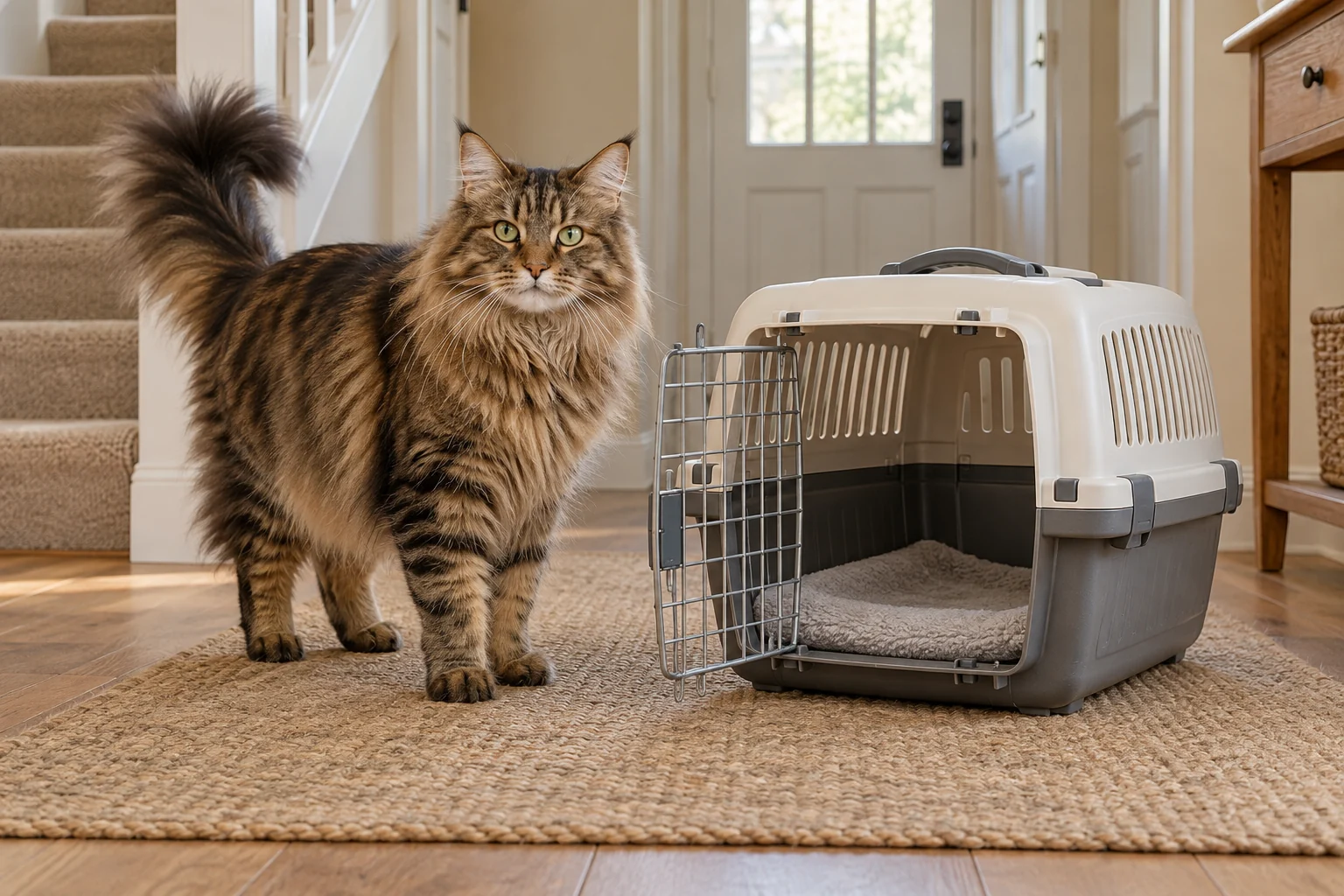
Compare two larger rigid carriers by body room, door access, load guidance and handling. Measure the cat and the journey, rather than relying on a breed label.
The short answer
Choose usable room you can also carry
Compare the Atlas 30 when its usable interior and doorway genuinely fit your cat, or the larger Atlas 40 Professional when the extra room is needed and its bulk is manageable. The published outer sizes and load limits answer different questions. Measure standing, turning and lying space, then check the vehicle, carrying route and exact assembly instructions.
Compare the options
| Carrier | Outer dimensions | Listed load | Main handling distinction |
|---|---|---|---|
| Atlas 30 | 60 × 40 × 38 cm | 15 kg | Smaller exterior; front entry |
| Atlas 40 Professional | 68 × 49 × 45.5 cm | 20 kg | Larger exterior; 3.72 kg empty |
Calculate the space the carrier occupies before comparing capacity
A higher load label does not describe the room needed in a hallway or car. Compare the outside rectangle separately from the cat’s fit inside and the supported method of securing the carrier.
| Carrier | Published outside length × width | Calculated rectangle | Separate fit requirement | Source |
|---|---|---|---|---|
| Atlas 30 | 60 × 40 cm | 0.24 m² | Door opening and usable interior remain separate measurements | [1] |
| Atlas 40 Professional | 68 × 49 cm | 0.3332 m² | Confirm vehicle position and handling as well as internal fit | [2] |
The Atlas 40 Professional rectangle is 38.8% larger than the Atlas 30 rectangle, although its listed length is only 8 cm greater. Its 9 cm extra width contributes to that change.
Do not turn this area difference into a claim about usable volume or the size of cat that fits. Use the measuring guide and exact carrier instructions alongside the outside planning figures.
Sources for this comparison
- Selected Atlas 30 listing — 60 × 40 cm selected exterior.
- Ferplast Atlas 40 Professional — 68 × 49 cm exterior; maker presents width and length in the opposite order.
Body room and load capacity are separate checks
A large cat carrier needs enough usable space for the cat, a secure way to enter and leave, and a size you can handle throughout the journey. A high kilogram number cannot answer all three. A cat may be comfortably below the published load limit while lacking enough height or length inside.
Start with the individual cat rather than a breed label. Long bodies, broad shoulders and ordinary lying positions can differ even between cats of the same breed. The carrier should allow normal standing, turning and resting as appropriate; its doorway also needs to accommodate the actual entry route.
These two Ferplast boxes offer different outer sizes and handling demands. Compare the documented specifications, confirm the exact model and use the manufacturer's instructions alongside appropriate veterinary and transport guidance.
Atlas 30: a larger front-entry box
Ferplast Atlas 30 carrier, black
Best for: A larger front-entry carrier
A front-entry rigid carrier with a 60 × 40 × 38 cm exterior and listed maximum load of 15 kg. Body room and doorway fit still need measuring.
What stands out
- Rigid removable upper shell
- Less exterior bulk than the Atlas 40
Keep in mind
- No top-opening hatch
- Outside dimensions are not usable interior space
- 60 × 40 × 38 cm outer size
- 15 kg listed maximum load
- Front metal-grid door
The selected black Atlas 30 is listed at 60 × 40 × 38 cm outside, with a maximum load of 15 kg. It has a rigid upper and lower shell, ventilation openings and a front metal-grid door. This is the smaller exterior of the two options here, which can matter as much to handling as the nominal capacity.
Its outer measurements are not a usable-interior drawing. Tapering sides, the roof shape, floor contours and any mat reduce or change the space available to the cat. Ask for the relevant inside dimensions if they decide the fit, including the entrance width and height.
There is no top hatch on this selected model. Removing the upper shell for cleaning or supported loading is a different operation from opening a dedicated top door. If top access is the main requirement, compare the top-opening carrier guide and then assess whether those models offer sufficient room.
The brand listing describes separating the shell using the side fastenings. Reassemble every fixing as directed and check the door and shell before use. A convenient cleaning arrangement should not be treated as permission to carry the box with incomplete closures.
Choose it for: a larger front-entry box when the measured interior fits. Main compromise: no top hatch and less outer height and width than the Atlas 40.
Atlas 40 Professional: more space with more bulk
Ferplast Atlas 40 Professional carrier
Best for: More room when the measured interior is needed
A larger rigid box with a 68 × 49 × 45.5 cm exterior. Ferplast lists 20 kg capacity and 3.72 kg empty weight; allow for its bulk as well as the cat.
What stands out
- Larger outer volume
- Four-point front-door fastening
Keep in mind
- Bulky for carrying and storage
- Transport rules and accessory kits need separate checks
- 68 × 49 × 45.5 cm outer size
- 20 kg maker-listed capacity
- 3.72 kg maker-listed empty weight
The Atlas 40 Professional measures 68 × 49 × 45.5 cm externally. Ferplast lists a 20 kg maximum capacity and a 3.72 kg empty carrier weight. It is marketed as a medium-dog carrier; compare it as a larger rigid-box option only when the cat's fit, secure setup and handling arrangement are appropriate.
The added width and height can be useful when a smaller box's interior is insufficient. They also make a noticeable difference in a hallway, on a car seat and when carrying through a doorway. Mark the full outside outline and check where it will sit before assuming that more volume is an uncomplicated improvement.
Ferplast's model specification describes a front door with four fixing points, lateral clips and additional closure components. Follow the exact supplied assembly instructions, including screws or ties where required. The capacity belongs to the properly assembled model, not an improvised arrangement.
The manufacturer also identifies optional accessories and transport-specific requirements, including a separate net kit. Do not infer airline or rail acceptance from the word Professional, a handle design or a reference to IATA. Obtain the operator's requirements for the actual journey and supplied equipment.
Choose it for: extra room that your measured cat actually needs. Main compromise: substantially greater bulk and empty weight, plus more setup details to follow.
Measure the cat and ask for interior dimensions
Take calm observations of how the cat stands and lies in a familiar space. Do not force it into a pose against a ruler. Record the body dimensions needed to compare with the maker's usable interior and doorway, allowing for the actual bedding you intend to use.
A thick cushion can reduce headroom and change the stability of the floor. A bulky blanket rolled near the sides reduces width. Account for those items without filling the box with loose objects. Check that the cat can use the intended space rather than occupying only a narrow patch beside accessories.
Cats Protection's carrier guidance recommends a secure, appropriate, easy-clean carrier. Use that broader context alongside exact model measurements. A photograph showing another animal inside is not a reliable scale drawing.
Check the doorway as well as the box
A roomy interior reached through a relatively small opening can still make loading awkward. Ask for clear entrance dimensions, including any projecting latch or inward curve. Consider how the cat will move through it and how the door closes once the cat is fully inside.
Front and top access answer different practical questions. A top-opening design can offer another loading route, while a removable roof is mainly a structural feature with its own assembly sequence. Do not confuse the two when comparing a product name or a picture with the shell separated.
Keep hands, fabric and the cat clear of closures. Confirm that the door is installed in the correct orientation and secured at every required point. If a fastening is damaged or uncertain, resolve it with the maker before use rather than adding an improvised household clip.
Plan the entire carrying route
Include the cat, empty carrier and permitted contents when considering what you need to lift. The empty weight of the larger box matters before the cat is added. Think about stairs, narrow doors, the distance to parking and the return journey with an occupied carrier.
A handle does not remove the need to follow the maker's carrying directions. Keep the carrier supported as instructed and avoid swinging or tilting it through tight spaces. If the route or total weight is impractical, seek appropriate help and reconsider the transport arrangement in advance.
Optional wheels are not the same as a guarantee that every surface or occupied-carrier movement is suitable. Check the exact accessory, installation and permitted use. Do not buy a large box around a wheel kit that is only intended for a different model.
Check the vehicle and transport requirements
Measure the place where the box will travel, the door opening used to load it and the space needed to secure it according to the carrier and vehicle guidance. A carrier that fits on the floor at home may not pass through a car door in its assembled position.
Do not treat a seat-belt slot or a rigid shell as independent proof of crash protection. No such testing has been carried out by us. Use the appropriate instructions and obtain transport advice where the setup is unclear.
For air, rail or ferry travel, ask the operator about the exact carrier and accessories. Rules can depend on the route and animal, and the operator's acceptance is a separate step from reading a manufacturer's general description. Avoid planning around universal airline-approved wording.
Make the carrier familiar before the trip
Where practical, keep a clean carrier available in a calm part of the home so the cat can investigate and leave voluntarily. Use a familiar permitted resting layer and keep the entry open only in a safe supported arrangement. Do not leave loose hardware or a half-assembled shell as a play area.
Introduce closures and movement gradually within appropriate guidance, rather than making the first encounter coincide with a rushed appointment. If the cat has particular travel or handling difficulties, discuss them with the vet before the journey. Equipment size alone cannot promise a stress-free trip.
Cleaning, inspection and storage
Remove permitted detachable components and follow the exact cleaning directions. Inspect fastenings, door pins, shell edges and ventilation openings while they are accessible. Let all parts dry fully and reassemble before storing or using the carrier.
Keep the model information with the box so replacement parts can be matched. A similar-looking door from another size may have different fixing positions. Store the carrier where it will not be crushed or damaged and allow time for a full check before the next outing.
Before travel, use vet-visit preparation and the model-specific car restraint guide. The larger size still needs a supported vehicle arrangement.
Sources and selection
The selected Amazon UK brand listing supplies the Atlas 30 dimensions and load guidance. Ferplast's Atlas 40 specification supplies its outer size, capacity, empty weight and setup requirements. These are conditional size comparisons for one cat, with no invented safety ratings or claims that either fits every large breed.
Frequently asked questions
What size carrier does a large cat need?
Choose enough usable interior for the cat to stand, turn and lie comfortably, following appropriate carrier guidance. Measure the individual and account for bedding, tapering walls and the doorway. A maximum load or Maine Coon label does not prove there is adequate body room.
Is a carrier’s weight limit the main measurement?
It is one necessary limit, not a substitute for dimensions. The cat can be below the load limit while the box is too low or narrow. Follow the maker’s exact capacity and assembly guidance, and separately check interior space and door clearance.
Can I use a larger dog-style carrier for a cat?
A larger rigid box may be a useful size comparison, but check its intended use, secure closures, opening spacing and actual fit for the individual cat. Extra volume also adds bulk and carrying weight. Do not choose an oversized crate solely because its capacity is higher.
Are these carriers approved for every airline?
No. Airline, route, aircraft and equipment rules need checking directly. Ferplast describes transport-specific requirements and an additional net kit for Atlas 40; a marketing reference to IATA is not universal boarding permission. Confirm the exact supplied setup before planning a flight.
Should I carry two cats in one large carrier?
This shortlist is about fitting one larger cat. A larger capacity does not establish that two cats can travel together comfortably or safely. Follow the maker’s instructions and appropriate veterinary or transport advice, including whether separate secure carriers are required.