
Practical guide · Carriers & travel
Hard versus soft cat carriers: which suits your journey?
Compare rigid plastic and structured fabric carriers by security, usable room, cleaning and journey requirements. Choose around your cat and the exact transport rules.
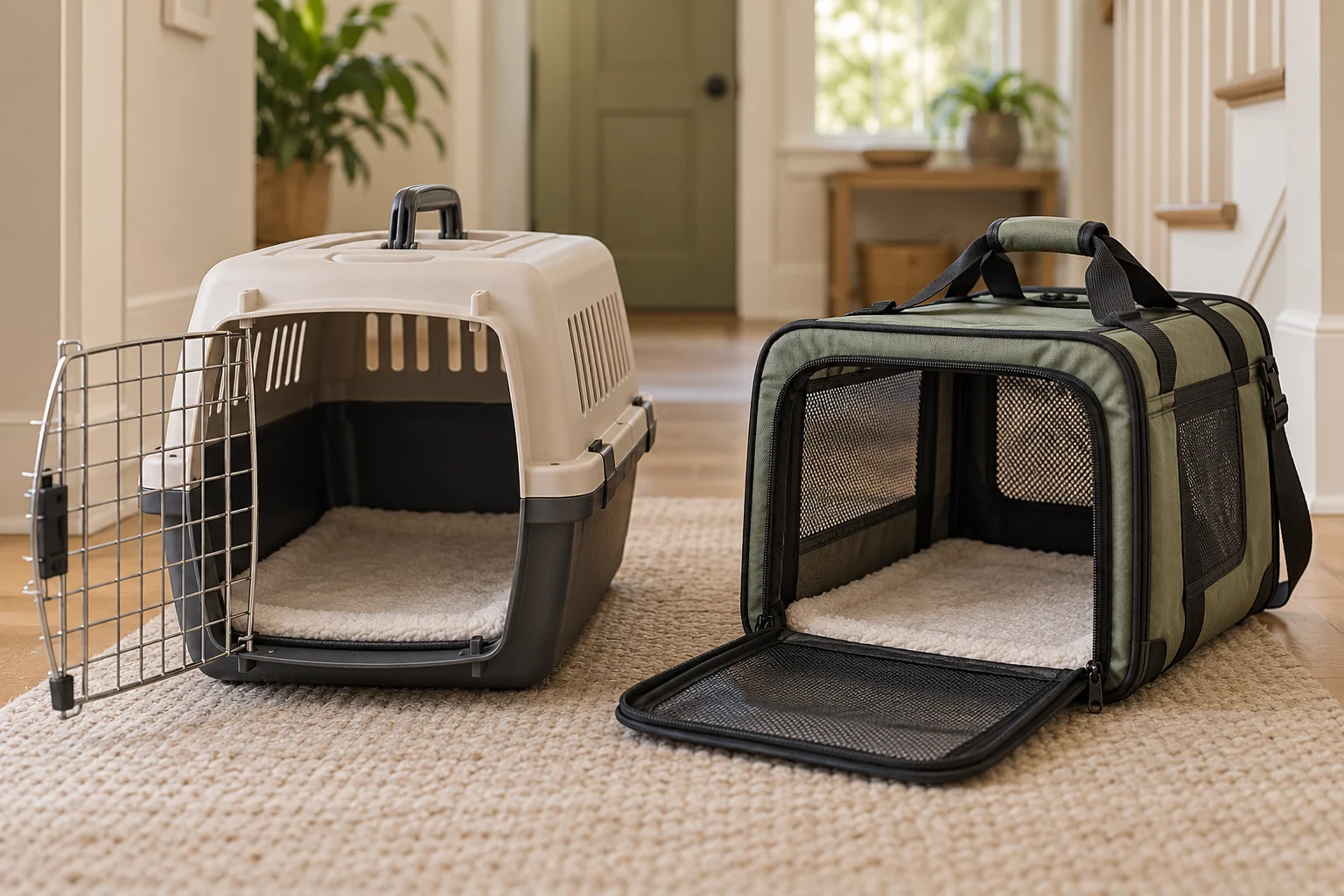
The short answer
Choose around the way your cat uses it
A strong secure rigid plastic carrier is the more straightforward starting point for routine cat travel, particularly where cleaning or a removable top matters. A structured fabric carrier can suit a cat and journey that genuinely fit its security, ventilation and operator requirements. Compare the actual inside space, closures and carrying method; soft sides, a shoulder strap or an airline-approved label do not establish transport safety.
Compare the options
| Example | Type and access | Useful distinction | Main check |
|---|---|---|---|
| Catit Cabrio | Rigid; top and front | Several access routes | Interior and exact closure sequence |
| Ferplast Atlas 30 | Rigid; front door | Larger outer outline | Inside fit; no top hatch |
| Sherpa Original Deluxe medium | Fabric; top and side zips | Mesh and removable liner | Fabric condition and exact journey rules |
Hard and soft cat carriers make different compromises. Rigid plastic offers a defined shell and a surface that is usually simpler to clean after an accident. Structured fabric can be lighter to carry and store, but mesh, seams and zips add different security and care checks.
Start with the cat and the journey, then choose a design. This comparison uses two rigid examples and one structured fabric example to explain the choices. It does not certify any product for a particular airline, car restraint or unusually determined escape attempt.
Why a rigid carrier is a sensible starting point
Cats Protection’s carrier guidance favours a strong secure carrier that is easy to clean, and discusses the value of top access or a removable top. Rigid plastic is a practical starting point for routine journeys and veterinary visits.
A defined shell keeps its shape, and soiled internal surfaces are easier to see and reach than layers of fabric and seams. That does not make every plastic carrier well designed. Check shell joints, latches, the door and handle connections as carefully as the material.
Consider the way the veterinary practice may need to examine or remove the cat. A removable top can allow a cat to remain on the lower half initially; a small top hatch is a different opening. Ask the practice about useful access if your cat finds handling difficult.
Rigid example with top access: Catit Cabrio
Catit Cabrio carrier, turquoise
Best for: Wide access for everyday vet visits
A rigid carrier with a wide-opening upper section and front access, designed to make the inside easier to reach. It can remain open at home as a familiar resting space between visits.
What stands out
- Multiple access points
- A rigid shape that can be inspected before use
Keep in mind
- Outer dimensions do not establish inside fit
- Follow the exact closure and vehicle-securing instructions
- 51 × 33 × 35 cm outer size
- Top and front access
- Removable food and water tray
The selected turquoise Cabrio lists outside dimensions of approximately 51 × 33 × 35 cm and offers top and front access. It illustrates why openings matter alongside the shell: more than one access route can make familiarisation and handling more practical.
Outside size is not inside fit. Check the usable floor, roof shape and the space left with the intended liner. A curved shell and fitted accessories can reduce room compared with a simple rectangular outline.
Follow the exact closure sequence for the version you receive. A well-seated door is only one part of a correctly assembled carrier. Check all shell joints, top catches and carrying points before use, then follow the maker’s vehicle-securing instructions separately.
Rigid example with a larger outline: Ferplast Atlas 30
Ferplast Atlas 30 carrier, black
Best for: A larger front-entry carrier
A front-entry rigid carrier with a 60 × 40 × 38 cm exterior and listed maximum load of 15 kg. Body room and doorway fit still need measuring.
What stands out
- Rigid removable upper shell
- Less exterior bulk than the Atlas 40
Keep in mind
- No top-opening hatch
- Outside dimensions are not usable interior space
- 60 × 40 × 38 cm outer size
- 15 kg listed maximum load
- Front metal-grid door
The Atlas 30 has listed outside dimensions of 60 × 40 × 38 cm and a 15 kg maximum load. Its metal-grid front door provides a different access arrangement from a carrier with a top hatch.
That larger outline can be useful for some cats, but the maximum load does not establish comfortable body space. Measure the actual interior and check the exact model’s permitted assembly. A cat can be below the weight limit and still lack adequate headroom or length.
This selected Atlas 30 does not have a top-opening hatch. If top access is the priority, compare top-opening carriers rather than assuming all Atlas models have the same door arrangement. Check removable-top handling only as permitted by the model instructions.
Structured fabric example: Sherpa Original Deluxe medium
Sherpa Original Deluxe carrier, medium charcoal
Best for: A structured fabric option for a suitable cat and journey
A structured fabric carrier with mesh ventilation, locking zips and top and side access. It has a removable machine-washable liner; the carrier body needs its own care instructions. Check usable room and the operator’s requirements rather than relying on an airline-approved label.
What stands out
- Mesh ventilation and two openings
- Can be carried by handles or shoulder strap
Keep in mind
- Fabric and mesh can be damaged by chewing or clawing
- Airline acceptance is specific to each journey; imported offer
- Medium charcoal version
- Locking zips; top and side entries
- Removable machine-washable liner
The selected medium charcoal Sherpa has mesh ventilation, locking zips and top and side entries. It includes a removable machine-washable liner, with the carrier body requiring its own care routine.
A shoulder strap and soft sides can be convenient, but assess the full structure under the intended load. The base must remain supported and the cat needs enough normal posture space without relying on squeezing the sides into a smaller outline.
The maker’s listing refers to under-seat travel. That does not establish acceptance on your particular route, and compressible framing is not permission to reduce the cat’s usable space below what it needs. Confirm all transport requirements before buying for a specific journey.
Fabric is a poor choice for a cat that repeatedly bites mesh, claws at seams or works at zip ends. Locking zips address one possible opening route; they do not make damaged fabric secure. The selected Amazon offer is an international version, so check package instructions and support.
Compare the practical trade-offs
| Decision | Rigid plastic | Structured fabric |
|---|---|---|
| Internal shape | Defined by the shell | Depends on frame, base and supported configuration |
| Security points | Door, shell joints, latches, handle | Zips, mesh, seams, frame, carrying points |
| After an accident | Usually more accessible wipeable surfaces | Liner, seams and body may need different cleaning |
| Access | Exact door, hatch and removable-top design | Exact zip openings and how they are secured |
| Storage | Often bulky; dismantle only as permitted | May fold, but confirm the exact design |
Do not equate a soft carrier’s flexibility with impact protection or a rigid shell with crash testing. This guide makes no crash-performance claim for the selected products. Follow the exact carrier and vehicle instructions for securing the load.
Measure the cat before choosing a size label
Use how to measure a cat for a carrier to record body size and compare usable room. The cat needs the normal postures appropriate to safe travel, within all manufacturer limits. A product called medium in one range may be a different size in another.
Measure with the actual liner in place. Thick bedding can reduce headroom, slide into a doorway or make the base uneven. Choose an appropriate thin secure liner rather than filling spare space with loose layers.
For a larger cat, compare large-cat carriers by internal dimensions and handling. A higher weight limit is only one part of that decision.
Check the exact journey separately from the purchase
A vet visit, a train journey and air travel have different practical requirements. Ask the relevant operator about the exact route and carrier before committing to a specialist purchase. Generic airline-approved wording does not cover every operator, cabin, aircraft or animal.
For car travel, use the carrier’s specified securing method and keep ventilation clear. Do not assume a shoulder strap is a seat-belt attachment or that every handle is designed to take restraint forces. Never open a carrier in an unsecured public space or moving vehicle to reassure the cat.
Keep ordinary familiarisation separate from transport day. The carrier introduction guide explains how to make investigation voluntary and familiar without turning each practice session into a journey.
Make the final choice reviewable
Check the carrier before the journey
0 of 5 checks complete.
Choose a rigid carrier when its access, cleaning and secure assembly suit the task. Consider structured fabric only when the cat’s behaviour, inside fit and journey requirements support that choice. Keep the carrier cleaning routine ready so the equipment returns dry, intact and correctly assembled after use.
For an existing carrier, check when replacement is needed before buying another format. For car journeys, use the exact restraint instructions rather than treating any carry handle as a belt point.
Frequently asked questions
Is a hard or soft carrier better for a vet visit?
A strong rigid plastic carrier is a sensible starting point and is supported by cat-welfare guidance. Easy cleaning, secure assembly and access through a top opening or removable top can be useful. Choose the exact design with your cat’s size and your veterinary practice’s needs in mind.
Are soft carriers escape proof?
No carrier should be treated as universally escape proof. Fabric, mesh, zip ends and stitching can be damaged or worked at, even when locking zips are supplied. Check every closure, the cat’s behaviour and the maker’s intended use. A determined chewer or clawer may need a different design.
Can a hard carrier be used for air travel?
That depends on the exact carrier, animal, route and operator’s current requirements. Cabin and hold travel are different tasks. Get confirmation for the precise journey rather than relying on a product’s generic airline-approved wording or a rule from another airline.
Does maximum load tell me whether my cat fits?
No. Load is one limit; comfortable internal length, height and width are separate. Padding and a removable liner also take up room. Check the cat can use the required normal postures within the intended configuration, while staying within every manufacturer limit.
Can I carry two cats in one larger carrier?
Do not assume a bigger carrier or unused weight allowance permits two cats. Individual secure carriers are the normal practical starting point. Follow veterinary advice and the exact product and transport requirements; sharing can create crowding, conflict and difficulty handling an emergency.