
Practical guide · Cat carriers & travel
How to introduce a cat carrier at home
Build a calm carrier routine from nearby bedding to voluntary entry, a closed door and a short lift. Learn when to slow down and how to avoid rushed practice.
The short answer
Progress from choice to closure, one stage at a time
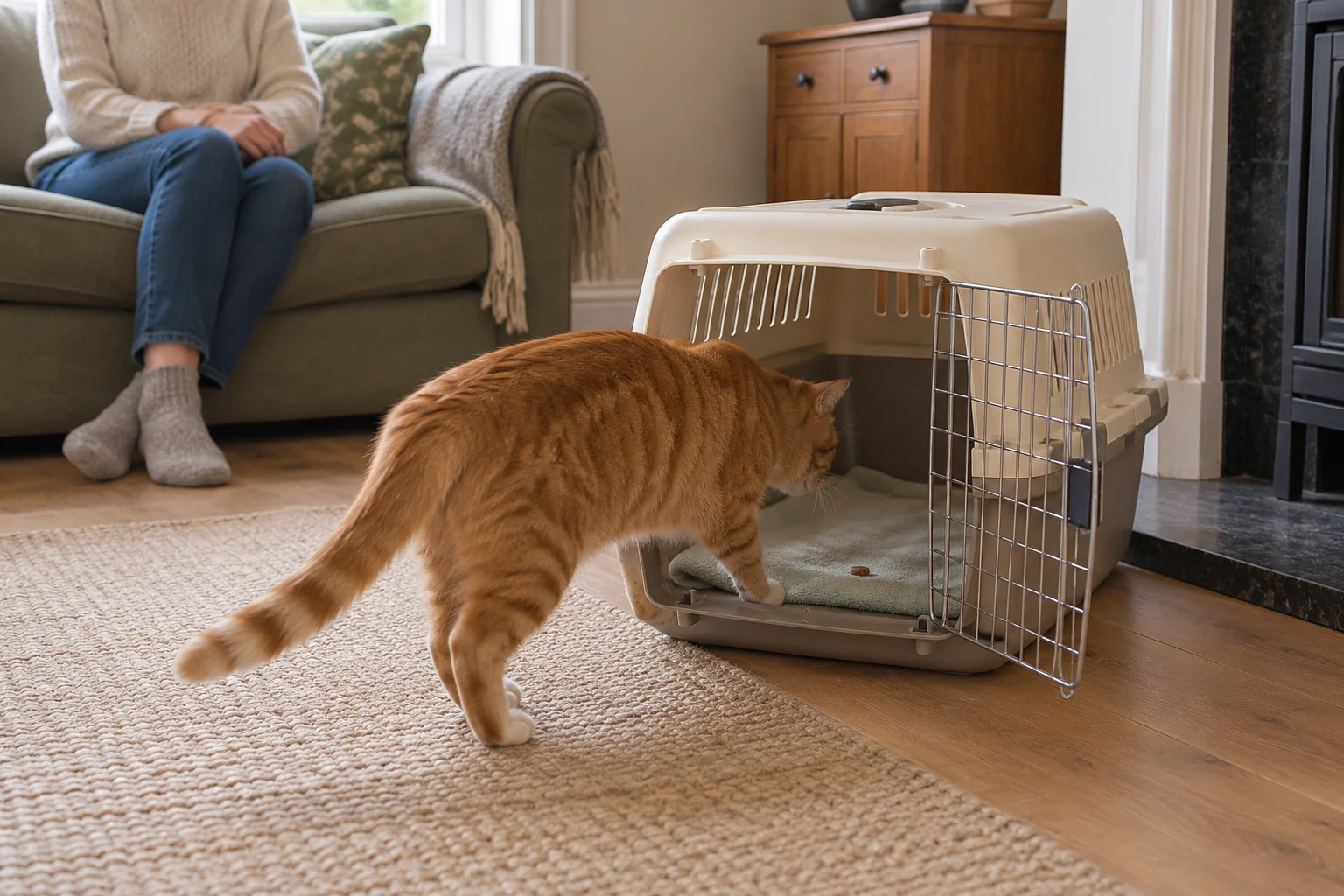
Leave a suitable carrier available in a quiet place, begin with familiar bedding nearby if needed, and reward voluntary investigation. Progress from relaxed entry to a briefly closed door, then a gentle level lift, only while the cat remains comfortable. There is no fixed number of days. If a stage creates fear, return to an easier one rather than using hunger or restraint to force progress.
A carrier that appears only before a journey can become a strong signal that something unsettling is about to happen. Keeping it available at home gives the cat a chance to explore it without every approach ending in a closed door or car ride.
This guide is a gradual familiarisation plan. It does not replace a fitting check: first make sure the cat has comfortable room to stand, turn and lie normally. Our carrier measuring guide separates usable interior space, openings and weight guidance.
Prepare the carrier and the room
Choose a quiet accessible position on a stable floor. Keep it outside the main walking route and away from appliances that start suddenly. Secure the door open according to the design so it cannot swing against the cat during an approach.
Use a thin suitable familiar towel or liner that lies flat without blocking vents or narrowing the entrance. Check the shell, door and fastenings before starting. A rattling latch or unstable base is an equipment problem to resolve, not something the cat should be expected to tolerate.
Cats Protection’s carrier guidance supports leaving the carrier out, introducing bedding gradually and progressing only while the cat remains comfortable. Make space for that process well ahead of an expected journey where possible.
Begin nearby if the carrier is already worrying
A cat that retreats at the sight of the carrier may need a starting point outside it. Place familiar bedding at a comfortable distance and allow normal use. Bring the carrier into position while the cat is elsewhere if seeing it arrive is a trigger.
Do not move the bedding closer every time the cat looks away. Give them opportunities to settle and choose the area. If they stop using the bedding when it moves, increase the distance again. Progress is more meaningful when the cat approaches voluntarily than when the room layout leaves no alternative.
Keep other pets from crowding the entrance. A cautious cat may abandon an approach if another cat waits nearby, even when the carrier itself is acceptable. A calm practice setting makes it easier to identify what needs changing.
Reward investigation without trapping
Once the cat is relaxed around the carrier, place a small suitable reward near the entrance. Later, offer it just inside, then farther in only as the cat becomes comfortable. Let them enter and leave freely; do not block the exit with your body or hand.
Use a normal feeding allowance rather than adding large quantities of treats. A cat on a prescribed diet may need different rewards or advice from the veterinary team. Avoid building a game in which the cat has to become very hungry before they will approach.
A cat sniffing the doorway or placing one paw inside is still gathering information. Keep sessions easy and allow breaks. Watch the whole body: retreating, crouching tightly or repeatedly refusing a previously easy stage means the next step should be smaller.
Build comfortable time inside
Move familiar bedding inside when that is an achievable change. Allow the cat to rest or collect a reward with the door open. Practise your ordinary presence nearby without reaching in each time they enter.
If the carrier has a removable upper section, follow its instructions for using the base as an introductory resting place. Reintroduce the roof as a separate change. Do not carry or move a partially assembled carrier with the cat inside.
The useful milestone is repeated comfortable use, not one successful entry. A cat that rushes in, takes food and bolts out may need more easy practice before door movement is added. Let the cat’s response determine the pace.
Introduce the door in small steps
Start with a slight controlled movement, then return the door to its open position. If the cat remains comfortable, progress towards a very brief closure and reopen it before distress develops. Keep hands clear of the cat’s body and the latch mechanism.
Do not jump from an open doorway to several minutes of confinement simply because the first movement was tolerated. Duration, noise and your position beside the carrier can each be a separate challenge. Change one at a time so an easier step is available.
If the cat scratches urgently, freezes in a tense posture or repeatedly tries to escape, stop the progression and return to a calmer stage. For a persistent problem, ask your vet about support rather than repeating an upsetting rehearsal.
Add a short level lift
Before lifting, fully assemble the carrier and secure every required latch. Check the handle and the maker’s carrying instructions. Support the carrier as directed, keeping it level and avoiding sudden swinging.
Begin with the smallest manageable movement, then set it down gently and allow a calm finish. Walking across a room is a later change, not part of the first lift. A carrier that tilts as you pick it up may need a different handling approach or model.
Do not take the carrier outside as a shortcut to “getting used to it”. Travel introduces additional sounds, movement and escape risks. Discuss the next stage with your vet where fear is substantial, and follow the transport instructions for the actual journey.
A removable-shell example
The Ferplast Atlas 30 is a front-opening rigid carrier with a removable upper shell. That arrangement can let you introduce the base and roof separately, while retaining a conventional front doorway for voluntary entry. Its larger outside dimensions still do not establish fit for an individual cat.
Larger front-entry box
Ferplast Atlas 30 carrier, black
A front-entry rigid carrier with a 60 × 40 × 38 cm exterior and listed maximum load of 15 kg. Body room and doorway fit still need measuring.
Check: No top-opening hatch
View on Amazon ↗Keep the shell fastenings and door parts together when the carrier is open for training. Before movement, restore the complete assembly and check each connection. A removable roof is a useful feature only when the everyday reassembly is reliable.
A different access arrangement
The Atlas 20 Deluxe Open provides top and front access in a smaller overall format. A top opening may help handling at other times, while the front entrance can remain part of voluntary training. Check both the usable inside room and the hatch clearance before buying.
Top-access option
Ferplast Atlas 20 Deluxe Open carrier
A hard carrier with front and top openings, side clips and a removable cotton cushion. The top access and detachable shell are useful details to compare when planning how to load, clean and reassemble it.
Check: Select the 20 Deluxe Open model carefully
View on Amazon ↗Neither access style guarantees a relaxed cat. If the existing carrier fits and works properly, begin with its introduction rather than assuming that a new door style is essential. The top-opening carrier comparison explains the different designs.
Handle setbacks without starting a struggle
After a difficult journey, return to a simple open-carrier routine when the cat is settled. Clean any soiling, rinse and dry properly, and replace a dirty liner with suitable familiar bedding. Our carrier cleaning guide separates routine care from infection-control advice.
Do not punish avoidance or repeatedly place the cat into the carrier to prove it is harmless. Reduce the difficulty and review the location. A new reluctance to step or turn may also involve discomfort, so mention changes in movement to your vet.
Keep a short progress record
| Stage | A useful observation | If it is difficult |
|---|---|---|
| Nearby bedding | Cat rests normally near the carrier | Increase distance or reduce disturbance |
| Voluntary entry | Cat can enter and leave without rushing | Keep rewards close to the entrance |
| Door movement | Cat remains comfortable with a small movement | Return to fully open practice |
| Brief closure | Cat can remain settled and leave calmly afterwards | Shorten the stage and seek help if needed |
| Level lift | Cat tolerates a gentle movement without panic | Recheck handling and return to stationary practice |
Keep the carrier available between journeys once it is accepted. A comfortable familiar place at home is a stronger foundation than a rushed rehearsal immediately before departure.
Frequently asked questions
How long does carrier training take?
It varies with the cat, the carrier and previous experiences. Some cats investigate quickly; others need a much slower introduction. Use relaxed repeated behaviour as the sign to progress, rather than aiming to finish within a set week. Ask your vet for help if travel is urgent or fear remains severe.
Should I close the door as soon as my cat goes inside?
No. First build comfortable voluntary entry and resting with the door safely open. Closing it immediately after the first approach can make that approach less appealing next time. Introduce brief door movement and closure as later stages, returning to an easier step if the cat becomes worried.
Can I use meals or treats during the introduction?
Small suitable rewards can help, preferably drawn from the normal daily allowance. Do not withhold necessary food to make the cat enter. Keep prescribed diets and feeding restrictions in mind, and choose a non-food reward or veterinary advice where food is not appropriate.
Does a top-opening carrier make training unnecessary?
No. A top opening changes access, but the cat still needs a comfortable association with the carrier and its movement. A removable upper shell can also help some introductions. Use the actual model’s instructions, and reassemble every required fastening before any lift or journey.
What if I need to visit the vet before training is complete?
Contact the practice for a handling and travel plan, especially if the cat is very fearful. Do not postpone necessary care to complete a training schedule or improvise forceful techniques. Continue gradual practice after the immediate journey when the cat is settled again.