
Practical guide · Water fountains & bowls
Noisy cat water fountain: checks before replacing it
Work through water level, assembly, pump care and surface vibration before replacing a noisy cat fountain. Includes standard PIXI checks and clear stopping points.
The short answer
Check the cause before buying a replacement
First check for damage, abnormal leakage or wet electrical connections, then provide a separate fresh water bowl. For a sound unit, work through the exact model’s water level, assembly, pump-cleaning and surface-contact checks with power disconnected before handling parts. A noisy pump is not automatically a failed pump, but persistent grinding, damage or repeated faults needs manufacturer support rather than improvised repair.
A cat fountain that begins humming, rattling or gurgling can sound like it needs replacing immediately. Sometimes the cause is a low water level or a removable part that is not seated correctly. Other noises point to wear or damage that deserves a different response.
Work through the checks in a consistent order and change one thing at a time. Keep fresh water in an accessible separate bowl while the fountain is being inspected. The cat should not have to wait for a repair to drink.
Check whether the unit should be used at all
Stop using a fountain with damaged cables, a cracked electrical housing, abnormal leakage, an unusual burning smell or repeated electrical faults. Do not open sealed electrical parts, splice a cable or substitute an unapproved power supply to see whether the noise changes.
Disconnect normally with dry hands where the plug and socket are dry and safe to reach. If an electrical connection is wet, follow the maker’s electrical safety instructions; do not handle a wet plug. Seek appropriate help to isolate the supply safely where needed.
Those are stopping points, not a checklist to work past. The remaining checks are for an otherwise sound unit and permitted user-serviceable parts. Keep the model name and any fault description ready when contacting the maker.
Describe the sound before dismantling
Note whether it is a steady hum, intermittent gurgle, plastic rattle, splash or harsher grinding sound. Record when it occurs: after refilling, as the level falls, after cleaning or continuously. A short recording can help support staff understand the fault.
Check the water flow without putting fingers near moving parts. A sound combined with weak or irregular flow suggests a different starting point from a steady flow with a vibrating casing. A quiet motor with loud splashing may be a water-path or assembly question.
Avoid repeatedly switching a struggling unit on just to collect more evidence. One observation is enough to begin the disconnected inspection. Do not run the pump outside water to make its sound easier to hear.
Check the permitted water level
Use the minimum and maximum information for the actual fountain. A large-looking reservoir can contain too little water at the pump, and a low-water light is not a reason to leave the device unchecked. Refill and monitor as the maker instructs.
Do not assume every fountain stops itself before dry running. A feature on one PIXI version, battery model or smart fountain does not transfer to another device with a similar shape. Check the model’s own manual.
If the level falls unusually quickly, inspect for spills and leaks while also observing the cat’s drinking pattern. Discuss a new change in thirst or general health with your vet rather than attributing it automatically to a successful fountain purchase.
Check the water path and seating
Disconnect power before removing or fitting parts. Compare the assembled order with the diagram: pump mounting, tubing, drinking top, spout and filter orientation can each affect flow or vibration. Keep seals and clips where the manufacturer puts them.
Look for a top that is not fully seated or a cable trapped where a panel should close. Clear loose hair or debris from accessible channels by the supported cleaning method. Avoid forcing clips, trimming a filter or pushing an unmatched tube into a connector.
Check the unit on a stable level surface with its full base supported. Keep it clear of a cupboard side or skirting board that could amplify vibration. Do not use a loose folded cloth to compensate for a rocking body.
Inspect the serviceable pump parts
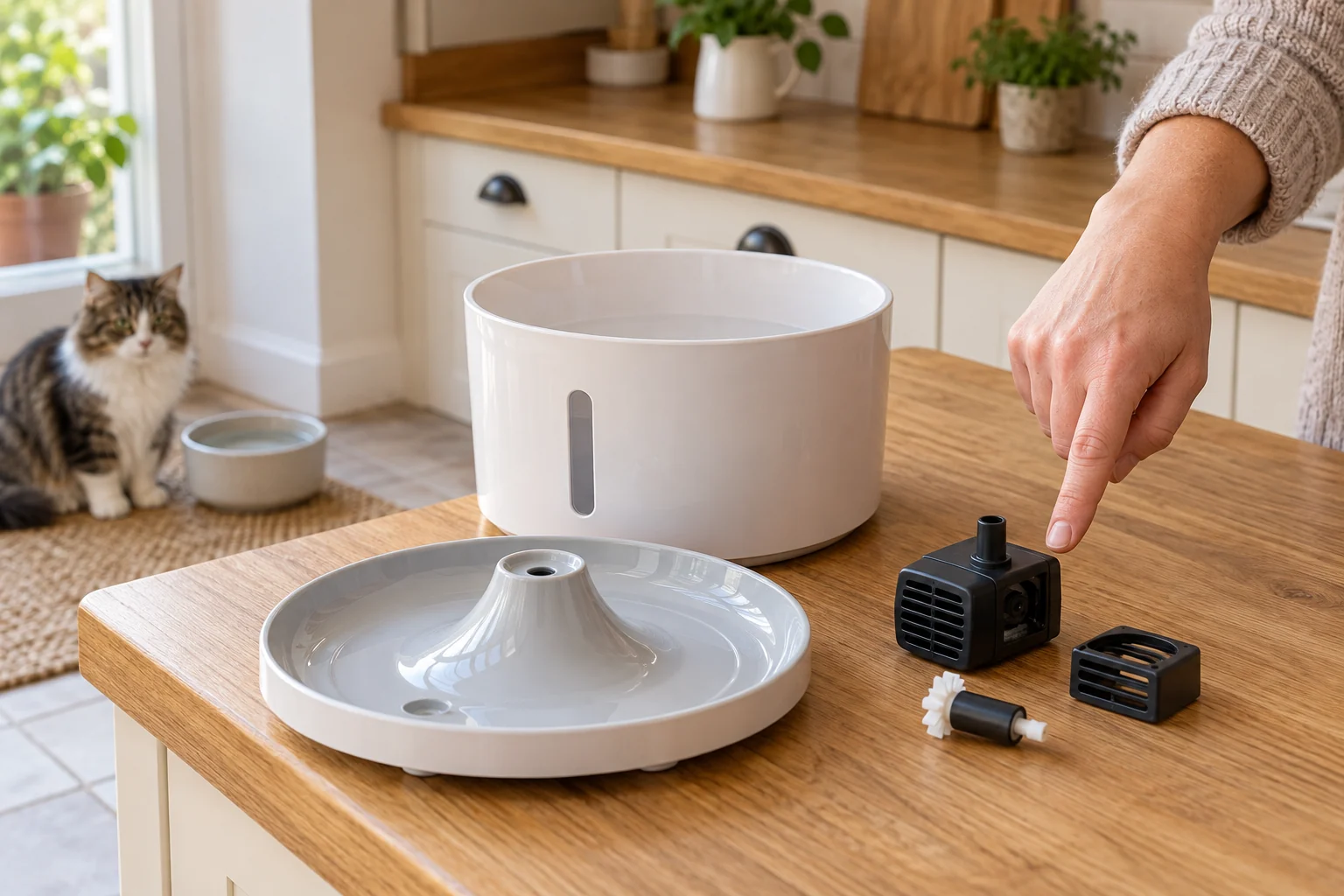
Where the manual permits it, remove the pump’s service cover and impeller cap, then lift out the impeller carefully. Keep small parts together and record their orientation. Remove hair and deposits by the exact cleaning method rather than scraping a rotor with a sharp tool.
A clean reservoir does not mean the pump chamber is clean. Material around the impeller can remain hidden behind an apparently clear inlet. Likewise, a fresh filter cannot remove debris already wrapped around a rotor.
Do not force a part that is not designed to open. If the shaft, housing or impeller appears damaged, ask for the model-specific replacement arrangement. Sealed electrical construction and serviceable water-path parts are different things.
A standard PIXI example
Visible water level
Catit PIXI drinking fountain, white
The standard white PIXI fountain has an illuminated water-level window and uses the PIXI filter family. It is worth comparing if you want an easy visual reminder to check the water, alongside a routine for washing the reservoir and pump.
Check: Needs power, pump cleaning and replacement filters
View on Amazon ↗For standard PIXI models 43715–43720, the manufacturer manual links noise with checks on water level, correct pump attachment and pump cleaning. Its pump mounts to the top assembly; do not assume it should be pressed onto the reservoir floor like another design.
Follow the illustrated removal and reassembly method, keeping power disconnected during handling. The manual requires the pump to be fully submerged during operation. Use those exact instructions alongside the broader sequence here, and do not extend them to PIXI Mini, Smart or UV-C versions without checking their manuals.
When the filter needs attention
For PIXI fountains
Catit PIXI genuine filters, 6 pack
The six-pack PIXI filter format, part 43722. Match it to the PIXI fountain family; a Flower or Mini Flower filter is a separate choice.
Check: Not a full-size Flower or Mini filter
View on Amazon ↗The linked pack contains genuine PIXI filters, not Flower or Mini Flower cartridges. Confirm the exact family in the Catit filter compatibility reference before ordering.
Check whether a filter is obstructed, saturated or fitted incorrectly. Follow its rinsing and replacement instructions; do not wash carbon media with detergent or stretch a replacement interval simply to make the motor sound quieter. A new filter is a consumable change, not a universal pump repair.
Use the symptom to choose the next check
| What you notice | Starting check | Avoid assuming |
|---|---|---|
| Gurgling as the reservoir drops | Correct fill level and permitted operation | Every model has reliable automatic shut-off |
| Rattle after cleaning | Seating, clips and exact assembly order | A new pump is needed immediately |
| Hum amplified by a cupboard | Level support and clearance | A soft absorbent pad is always appropriate |
| Weak flow with debris present | Filter path and serviceable pump cleaning | Washing only the visible bowl is enough |
| Persistent grinding or visible damage | Stop use and seek exact-model support | A generic rotor or power adaptor will fit |
Use the table to organise observations, not to diagnose a fault with certainty. Different models can produce similar symptoms for different reasons.
Retest once the unit is correctly assembled
Refill and reconnect only after the parts are correctly fitted and electrical connections are dry. Observe normal flow and sound on the intended surface. Check the reservoir and floor for leaks before leaving the unit in use.
If the noise persists, share the model, observations and maintenance steps with the maker. Ask whether a supported pump, rotor or other part is available and whether warranty support applies. Compare the repair with a complete replacement without discarding a sound unit unnecessarily.
Finish with a clear stopping decision
Fountain noise investigation checklist
0 of 5 checks complete.
For the complete washing sequence, use how to clean a cat water fountain. If the upkeep is no longer practical, compare a fountain and water bowl by the cat’s drinking choices and your daily routine.
If the filter or foam needs replacing, identify the exact family using Catit, Cat Mate or Drinkwell compatibility. A new cartridge is not a substitute for clearing a dirty water path.
Frequently asked questions
Why has my cat fountain suddenly become noisy?
Possible causes include a low water level, debris around a serviceable impeller, incorrect seating or vibration against a nearby surface. Start with the exact model instructions and inspect with power disconnected. Damage, abnormal leakage, unusual heat or electrical problems are reasons to stop using the unit and seek appropriate support.
Can I run the pump outside water to hear the fault?
Do not run a fountain pump dry unless the exact maker explicitly instructs a particular procedure. The standard PIXI manual requires the pump to be fully immersed during operation. Inspect and clean it disconnected, then test only after correct assembly and filling.
Will a new filter stop the noise?
Only where a saturated, obstructed or incorrectly fitted filter is part of the problem. A filter does not fix a damaged impeller, worn pump or resonating surface. Match the exact filter family and inspect the water path before buying parts.
Should I put a towel under a vibrating fountain?
Do not improvise a support that absorbs leaks, blocks vents, lets the fountain tilt or hides moisture. Use a stable level surface and only supports compatible with the maker’s instructions. Check that the unit is clear of skirting boards, cupboards and loose nearby objects.
When should I replace the complete fountain?
Consider replacement when the reservoir, cable, body or other essential parts are damaged, or when a supported repair cannot restore normal use. A correct replacement pump may be enough for an otherwise sound unit. Check warranty and manufacturer guidance before purchasing, and keep a separate fresh water source available.