
Practical guide · Feeding
How to clean an automatic cat feeder
Separate washable food-contact parts from the powered base, clean residue and dry before reassembly. Includes exact C500 care and a supervised restart checklist.
The short answer
Wash the food-contact parts and protect the mechanism
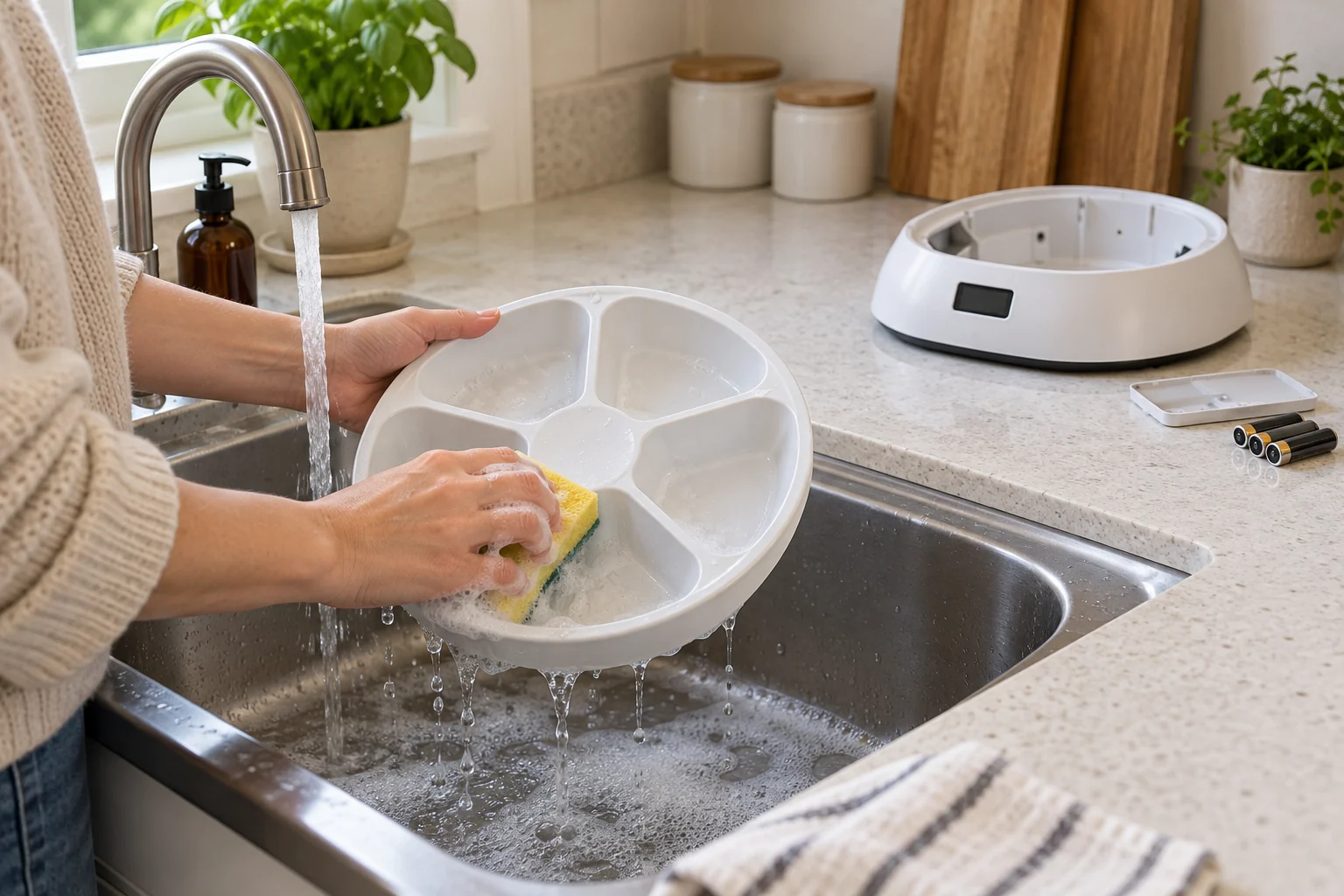
Serve the cat by another reliable arrangement, then switch off and disconnect the feeder as its manual requires. Separate permitted washable bowls, lids and inserts from the powered base, remove food residue and dry fully before reassembly. For the C500, the lid and bowl may go in the dishwasher, while the base is wiped with a damp cloth and must not be immersed. Other models need their own instructions.
Cleaning an automatic feeder involves two different jobs: washing food-contact parts and protecting the mechanism that operates them. Confusing those jobs can leave residue behind a fresh bowl or put water into a base that was never designed to be washed.
Start with the exact model instructions and a reliable alternative meal for the cat. Keep the food type and normal daily amount accounted for while the feeder is out of use. Do not rush drying to meet the next programmed opening.
Identify every part before adding water
List the bowl, removable inserts, carousel, hopper, lid, seals, ice packs and powered base as applicable. Find the care scope for each one. A metal bowl can have different instructions from its supporting tray, and a clear hopper can connect to a mechanism that must remain dry.
Take a photograph of the normal assembly if the manual permits user disassembly. Keep small fittings and seals together. Do not open a sealed motor or electrical housing to clean a surface that is not designed for user access.
If residue or a spill has reached an area you cannot safely clean, ask the manufacturer how to proceed. A damp cloth around the outside is not a remedy for liquid inside an electrical compartment.
Pause the schedule and make a fallback meal
Check when the next meal is due before taking the feeder apart. Provide the normal food through another suitable arrangement, keeping track of the total amount. Make sure another household member does not also serve a replacement meal without knowing.
Switch off, unplug or remove batteries only as the exact instructions require for cleaning. Keep power connections dry. Record the actual clock and programmed times because some settings can change when power is interrupted.
Empty remaining food and deal with it according to its storage guidance. Food that has already been exposed in a feeder should not automatically be mixed back into a fresh package. Keep waste, cleaning tools and clean food-contact parts separate.
Remove food residue before washing
Clear loose kibble, crumbs and accessible deposits without pushing them deeper into an outlet or drive. Remove permitted food-contact parts and wash them by the stated method, reaching the corners and underside as well as the visible eating surface.
Use only cleaning products and temperatures compatible with the component. Avoid abrasive tools that can roughen a plastic bowl or damage seals. Rinse as instructed so food-contact surfaces do not retain cleaning residue.
A clean-looking top surface can hide residue beneath an insert or around a carousel hub. Inspect where parts overlap and where the lid sits close to food. Do not overfill compartments when the feeder returns to use, because food can foul the mechanism again.
Exact care example: Cat Mate C500
For several meals
Cat Mate C500 five-meal feeder
A rotating tray with one compartment open initially and four scheduled openings. A sensible starting point when you want several pre-portioned meals without an app.
Check: Ice packs require preparation
View on Amazon ↗The C500 instructions allow the lid and food bowl to be washed in a dishwasher. They say the base can be wiped with a damp cloth and must not be immersed in water.
That permission applies to those named parts, not the complete assembled machine or every Cat Mate model. Keep the base away from the sink or washing area while the removable food-contact pieces are cleaned, and follow the supplied version’s instructions for all other components.
After washing, check that the bowl seats correctly on the drive and aligns as the manual describes. Confirm the actual clock, next scheduled opening and lid clearance before offering a supervised meal.
Clean underneath removable steel inserts
Removable steel inserts for a C500 feeder
Cat Mate C500 bowl with five steel inserts
A C500-specific replacement bowl arrangement with five removable stainless steel inserts. The selected Amazon offer describes a replacement bowl with inserts; check the package includes the matching carousel rather than treating these as C100/C200 bowls.
Check: Not the 402 insert set for C100/C200
View on Amazon ↗The C500-specific 464 arrangement has five separate steel inserts associated with a matching carousel. The manufacturer’s insert information permits hand washing and dishwasher cleaning of the inserts.
Remove them as intended and clean both the metal pieces and the supporting food tray by their respective care methods. Inspect below the insert rims and around the edges where food can spread. A clean insert should not return to a dirty or damp tray.
Check that the package and arrangement match the feeder before replacing any worn component. Our Cat Mate bowl and ice-pack compatibility reference separates 464 from the two-piece 402 set and the plastic bowl families.
Treat dry-food hoppers as a separate design
A hopper can contain dry food above a dispensing mechanism, with crumbs accumulating at the outlet and around moving parts. Remove and wash the hopper only where the exact model permits it. A transparent container is not necessarily a single washable assembly.
Keep protected drive and electrical areas dry, and do not pour cleaning water through the outlet as a shortcut. Use the maker’s supported access and tools for removing debris. Do not force a brush past an auger or other mechanism that is not intended to be opened.
Dry all permitted washable components completely before refilling. Check seams, corners and the underside where moisture can remain. Keep new food in its appropriate storage arrangement until the feeder is actually ready to use.
Separate care by component
| Component | Cleaning question | Before reuse |
|---|---|---|
| Bowl or carousel | Is hand washing or dishwasher use permitted? | Clean, dry and correctly seated |
| Steel insert | Does the exact set permit the chosen method? | Clean underside and supporting tray |
| Hopper | Is it removable and washable separately? | Corners and outlet fully dry |
| Powered base | What external wiping is allowed? | Dry connections and normal function |
| Ice pack | What surface-cleaning and freezing method applies? | Seal intact, no leakage or damage |
Keep those instructions with the feeder model. Cleaning permission for one component should not migrate to a different part because they were supplied in the same box.
Inspect ice packs and seals
Remove sealed ice packs as the manual allows and inspect for damage, bulging or leakage. Use the supplied care and freezing method. Do not immerse or dishwash a pack merely because the food bowl can be cleaned that way.
Do not repair a leaking pack with tape or leave it beneath food. Replace it with the exact supported part when required. Cooling remains dependent on the room, loading and food; a freshly cleaned feeder does not establish a safe wet-food holding period.
Check any removable seals for correct location, damage and residue. Avoid stretching or substituting them without approval. An incorrectly fitted seal can change how a lid closes or how a food-contact part sits.
Dry and reassemble without shortcuts
Let each washed piece dry fully by the permitted method before it returns to the base. Keep damp food-contact parts away from dry-food storage and protected mechanisms. Do not use an unsupported heat source to speed the process.
Reassemble with the correct inserts, carousel, lid and fittings. Keep the cat away during handling and any permitted test cycle. Check for a lid catching an insert, a bowl sitting high or an outlet obstructed by a misplaced part.
Observe the first meal after cleaning
Recheck the clock and programmed times, including the next actual occurrence. For a hopper, observe a permitted delivery and measure the amount if the setup requires it. For a carousel, confirm the correct compartment becomes accessible.
Watch the intended cat eat. A new scent, changed bowl or unfamiliar operating sound can affect acceptance, so return to the feeder introduction routine if needed. Keep a reliable fallback meal arrangement while a problem is resolved.
Complete the restart checklist
Automatic-feeder cleaning and restart checklist
0 of 5 checks complete.
Clean the support surface as well as the device. If spills reach the floor, feeding mats for cat bowls compares usable area and cleaning access; make sure any feeder sits level and its moving parts remain unobstructed.
Frequently asked questions
Can I put an automatic feeder in the dishwasher?
Only the exact parts the manufacturer permits. The C500 manual allows the lid and food bowl to be washed in a dishwasher; the powered base must not be immersed. A removable hopper, steel insert or another model’s lid may have different care instructions, so check each component separately.
How often should I clean an automatic cat feeder?
Follow the model and food instructions, and clean promptly when there is soiling or residue. Wet-food contact parts and dry-food hoppers present different tasks. Do not assume a closed lid, steel bowl or large hopper removes the need for routine washing and inspection.
Can I wash a dry-food hopper and refill it immediately?
Only if the hopper is washable and has dried fully, including corners, seams and the outlet. Water trapped among dry food can compromise the storage arrangement. Do not refill a damp component or add food around a protected mechanism that must remain dry.
Are stainless steel inserts easier to maintain?
Separate removable inserts can make washing individual food-contact pieces convenient, but the tray below, lid, edges and surrounding mechanism still need attention. Check the exact insert system and clean beneath it. Steel is not a reason to leave food residue or assume the whole feeder is dishwasher safe.
What should I check after reassembly?
Check bowl fit, alignment, lid clearance, power, actual clock and next scheduled meal. For a hopper, verify a permitted test delivery and its measured amount. Observe the intended cat eating before relying on the feeder again, especially if batteries were removed or parts changed.