
Practical guide · Feeding
How to check automatic cat feeder portion sizes
Weigh repeated dry-food servings, distinguish feeder units from grams and check the total daily allowance. Includes a worked example and a repeatable recording method.
The short answer
Weigh what the feeder delivers, then add the daily total
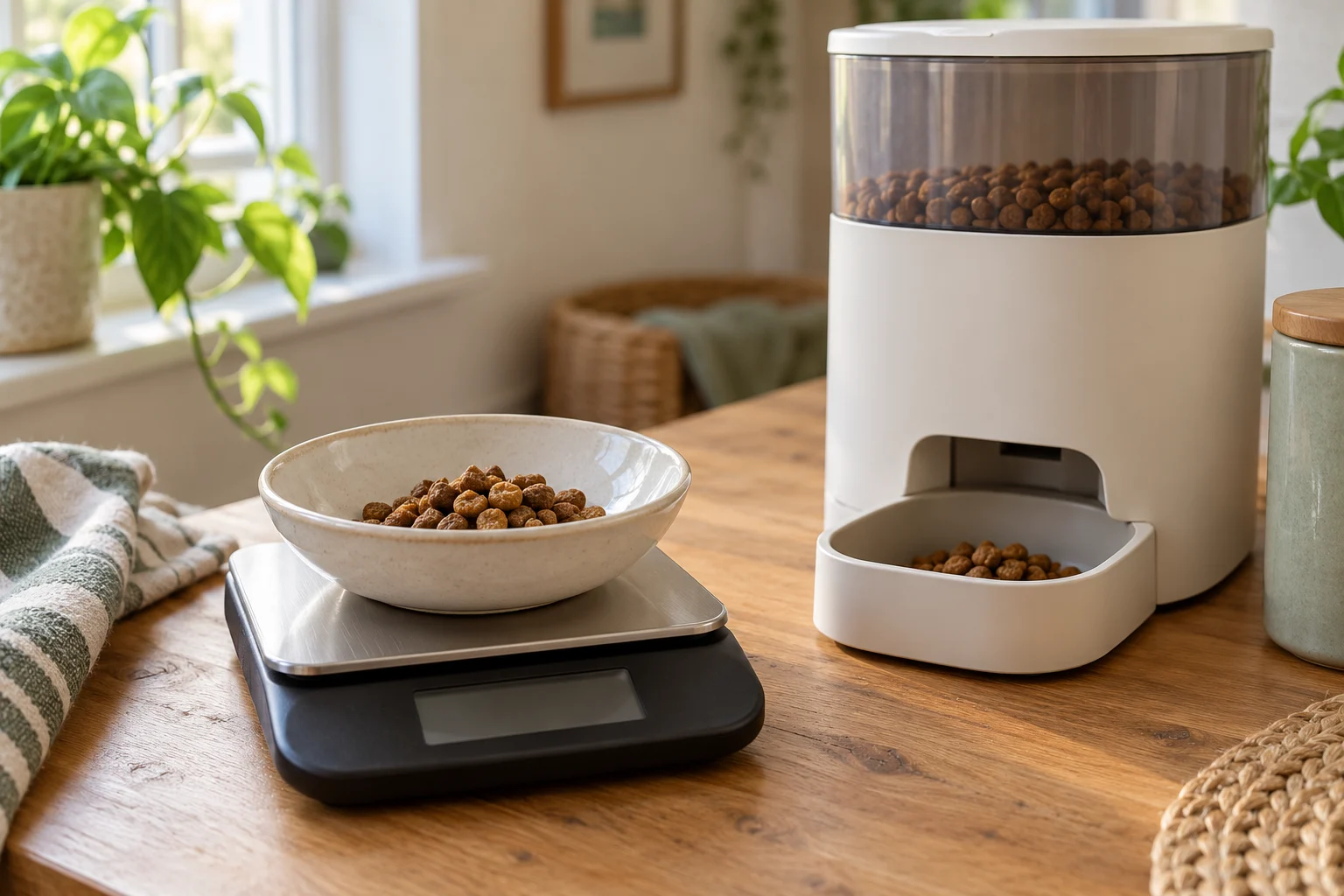
Use the cat’s established feeding plan as the target, then weigh repeated servings of the actual dry food on a tared gram scale. Feeder units are not universal grams. Prime the mechanism as instructed, compare several equal programmed servings and check the resulting daily total. Keep all test food out of unplanned extra meals and verify a real scheduled delivery before relying on it.
An automatic feeder can repeat a setting accurately while still serving the wrong amount for your cat. The display may show units or portions, but those numbers describe a mechanism setting rather than a standard measure of food.
This guide checks what lands in the bowl. It does not decide how much your cat should eat: use the food instructions and any individual veterinary feeding plan for that target. Keep treats, puzzle food and hand-fed extras within the same overall plan.
Start with a daily allowance and meal plan
Write down the food name, the intended daily amount and the number of meals the feeder will provide. Distinguish the complete day’s food from the amount assigned to this machine. If breakfast is served separately, the hopper should not automatically receive the entire daily allowance as well.
Use the same basis as your feeding plan. Dry and wet foods are not interchangeable gram for gram, and a change of recipe can change the energy in the same weight. Ask the vet when a prescribed diet, growth, weight change or illness makes the allowance uncertain.
For a purely arithmetic example, a plan allocating 60 g to three equal feeder meals means a target of 20 g per meal. Those numbers illustrate the calculation; they are not a recommended allowance for an individual cat.
Set up a useful weighing method
Use a level, stable surface and a clean dry dish. Place the empty dish on the scale, select grams and tare to zero before adding food. Check that the dish does not touch the worktop, wall or another object and that the display remains visible.
An ordinary suitable kitchen scale may already do the job. Choose resolution appropriate to the portion: a coarse display cannot reveal small differences in a very small serving. This is not a method for measuring medicines or making veterinary dosing decisions.
The Salter Disc is an example with a gram-weighing mode and tare function. Its liquid-measuring option is not the mode to use for kibble. Follow its operating instructions and keep the electronic body dry.
Weighing dry-food servings
Salter Disc 1036 digital kitchen scale
A tared receiving bowl and a gram display make it easier to compare repeated feeder servings. Use an existing suitable kitchen scale first; this is an ordinary food scale, not a medical dosing instrument.
Check: Select grams rather than the liquid-volume mode
View on Amazon ↗Prepare the feeder before recording servings
Check that the feeder is clean, dry, correctly reassembled and filled with suitable dry food. Follow the exact maker’s priming instructions before recording a measurement. An empty feed screw or chute can make the first delivery different from later ones.
Collect all priming and test food into clean containers. Do not let the cat eat each test delivery in addition to its planned meal. If food has touched a dirty surface or become damp, discard it appropriately instead of returning it to the hopper.
Use the method described for the actual model. A manual test button may deliver one unit while a scheduled meal delivers several, so establish what the button represents. Finish by observing a real programmed meal, rather than assuming every control runs the same sequence.
Understand the C3000 example
The Cat Mate C3000 is a dry-food hopper feeder with up to three individually sized daily meals. Its manual gives approximately 30 g for three feed units, depending on the food. That is explicitly approximate: it is not evidence that every unit of every kibble weighs 10 g.
Local battery controls
Cat Mate C3000 dry-food feeder
A battery-powered hopper feeder with local LCD controls and up to three individually sized timed meals a day. It is a straightforward choice when you want dry-food dispensing without an app.
Check: Kibble output needs checking with your actual food
View on Amazon ↗The C3000 also limits suitable dry-food size to a maximum of 16 mm. A food that seems to fall through once is not automatically suitable if it is outside the stated requirements. Check both compatibility and repeat delivery before changing the setting.
If the feeder offers only whole units, the exact target may fall between settings. Do not compensate by making unexplained changes to other meals. Record the limitation and choose an appropriate feeding arrangement with the person responsible for the cat’s diet.
Record several equal deliveries
After priming, collect at least five servings at the same intended meal setting. Tare the empty receiving dish for each separate weighing. Alternatively, use a clearly recorded cumulative method, but do not confuse the total on the scale with the weight of the latest serving.
| Illustrative serving | Recorded weight | Note |
|---|---|---|
| 1 | 19 g | Same food and programmed setting |
| 2 | 20 g | Dish tared again |
| 3 | 21 g | Dish tared again |
| 4 | 20 g | Dish tared again |
| 5 | 20 g | Dish tared again |
These are invented arithmetic readings, not results from a product test. Their total is 100 g; 100 ÷ 5 gives a 20 g average. The smallest reading is 19 g and the largest 21 g. Three meals averaging 20 g would provide 60 g through the feeder in a day.
Keep the individual readings as well as the average. A zero delivery followed by an oversized one can produce a plausible mean while leaving a cat without the expected meal. The example’s range is not a universal acceptable tolerance; judge suitability against the actual feeding requirements.
Adjust one setting, then check again
If the average differs from the intended amount, change the supported portion setting and repeat the collection. Record the new setting beside the weights so an old note does not get reused accidentally. Do not alter several meals, food type and mechanism setup at once.
If servings are inconsistent, investigate food compatibility, assembly, fill level and blockage before treating the problem as simple calibration. Use missed-meal checks for empty or interrupted deliveries, and stop relying on a feeder that has not been shown to work normally.
After the arithmetic, check the ordinary feeding event: correct clock, enabled meal, bowl accessible and intended cat actually able to eat. A measured amount delivered into an inaccessible bowl is still a failed feeding arrangement.
Keep a small record you can repeat
Save the feeder model, food, meal settings and readings together. Recheck after changing food, relevant disassembly, a portion adjustment or any unexplained delivery change. Do not assume a previous note remains valid simply because the brand name on the food bag is unchanged.
With a rotating tray such as the C500, weigh each portion before filling its compartment. The machine controls access time, not the food weight. Use the separate C500 programming guide for that setup.
Before relying on the measured setting
0 of 5 checks complete.
Model details follow the C3000 manufacturer instructions. For choosing a machine, see dry-food automatic feeders.
Frequently asked questions
How many grams are in one automatic feeder portion?
There is no universal conversion. The feeder mechanism and the kibble’s size, shape and density affect the delivered weight. Treat a manufacturer’s approximate unit conversion as a starting point, then weigh the actual food in your own feeder.
How many servings should I weigh?
A useful home check is at least five repeated servings at the same setting after the maker’s priming procedure. Record each weight, the average and the range. This is a practical consistency check, not a calibration certificate or a universal acceptable-error standard.
Can I use millilitres on my kitchen scale?
Select grams for weighing dry food. A liquid-volume mode does not convert kibble into a reliable food weight. Tare the empty receiving dish and confirm the unit before every set of readings.
Do I need to repeat the check when changing food?
Yes. Recheck when kibble type, size or shape changes, and after relevant cleaning, reassembly or setting changes. Confirm that the new food is within the feeder’s stated limits. A matching number of units can deliver a different weight with another food.
Does this method apply to a Cat Mate C500?
The C500 opens pre-filled compartments rather than dispensing hopper units. Weigh each portion before placing it into the tray, then check the schedule and correct compartment order. A C3000-style units-to-grams calculation is not how the C500 measures food.