
Practical guide · Litter & cleaning
Where to put litter trays in a small home
Plan full-size litter trays in a small flat or house using quiet access, separate locations and realistic cleaning space. Avoid shrinking the tray to fit furniture.
The short answer
Plan around a full-size tray and reliable access
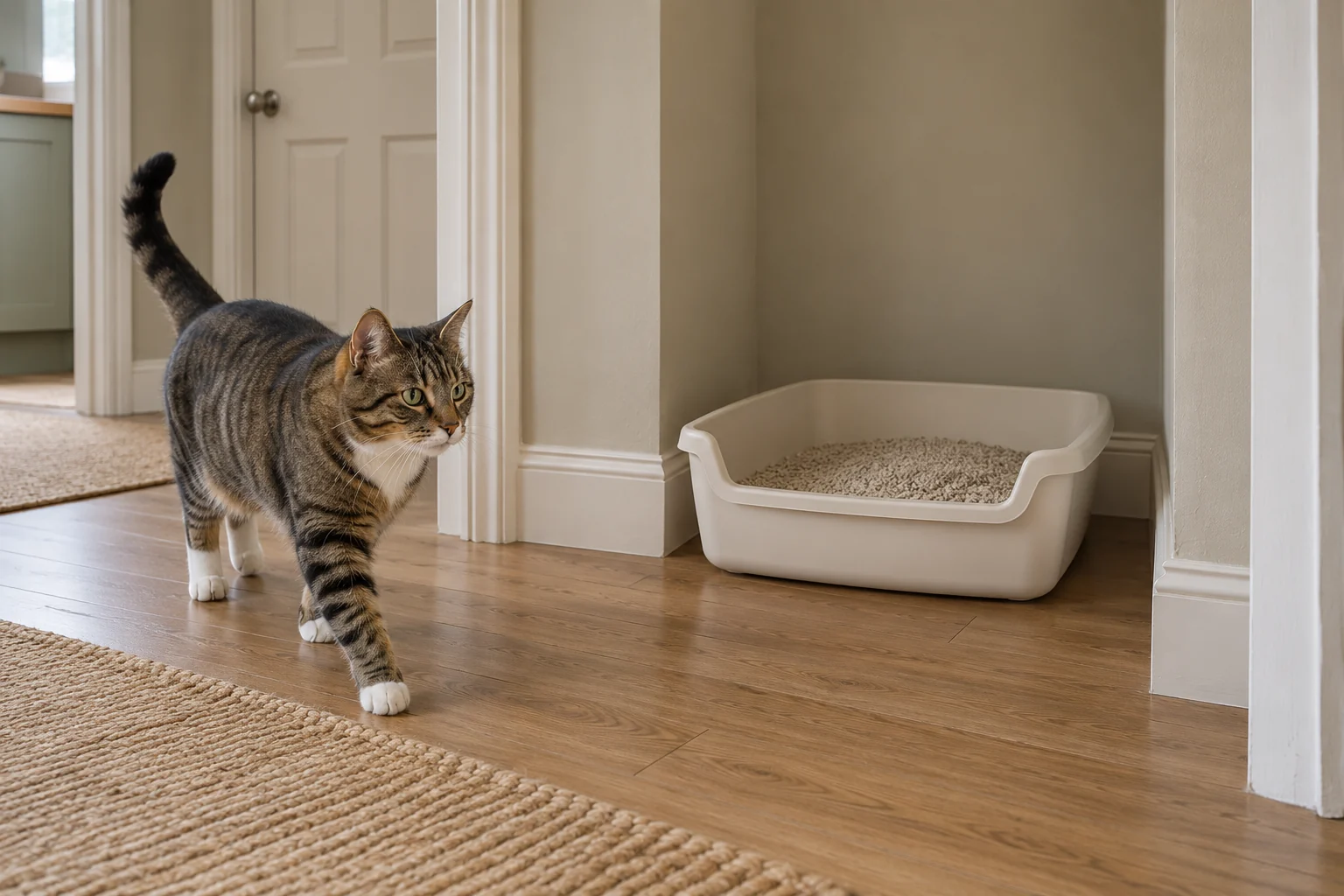
Choose quiet, consistently accessible positions away from food, water, beds and sudden appliance noise. Keep enough space for a correctly sized tray and a clear approach; do not shrink the tray simply to fit a cupboard. Spread trays between useful locations, using one per cat plus an extra as a starting point, and keep familiar options while changing the layout.
In a small home, the tempting solution is often the narrowest tray in the most hidden gap. That can solve a furniture problem while creating a toileting problem. The cat still needs enough room to turn, an easy entrance and a position that remains usable during normal household activity.
Start with the cat’s tray size, then plan the room around it. Our litter tray sizing guide explains body length and usable floor area. This page focuses on finding workable locations without reducing the tray to fit a decorative cabinet.
Map everyday activity before choosing a corner
Walk through the home at the times it is busiest. Note door swings, washing-machine cycles, shower use, visitors and the route between rooms. A position that looks peaceful in an empty flat may become a regular shortcut when people are home.
Mark food, drinking water and resting places separately. Cats Protection’s toileting guidance recommends quiet accessible locations away from those resources, doorways, corridors, cat flaps and noisy appliances. Use distinct usable places rather than putting every resource along one short wall.
Consider access when doors are closed as well as open. A tray in a bathroom or spare room is not reliably available if someone regularly shuts the cat out. Think about visitors and overnight routines, not only the layout while you are supervising.
Reserve the right tray footprint
Measure the full outside footprint for the room, then confirm the usable inside area for the cat. A rolled rim or sloping wall can make the floor smaller than the headline size. Leave space for the cat to approach the actual entrance without squeezing between furniture.
Do not use a kitten tray permanently because it fits beside the toilet. A larger adult cat still needs comfortable turning and digging room. If the first position cannot take a suitable tray, compare another location before choosing a smaller one.
Include your own cleaning space. You need to scoop, lift the tray and remove any rim or hood. A tray that can only be reached by moving several heavy objects is difficult to maintain, even if the cat can reach it easily.
Compare possible locations realistically
| Location | What may help | What can make it unsuitable |
|---|---|---|
| Quiet room corner | Clear approach with limited passing traffic | Narrow dead end or another pet blocking the exit |
| Bathroom | Washable surroundings and practical cleaning access | Closed door, repeated disturbance or damp crowded floor |
| Utility space | Separation from living activities | Sudden washing-machine noise or equipment blocking access |
| Bedroom edge | Potentially quieter through the day | Tray beside the bed, shut door or insufficient separation |
| Open-plan room | More than one possible route | Tray pressed into food, water or busy household traffic |
No room name guarantees a good position. Evaluate the actual noise, access and resource layout. A suitable open corner can be better than a specialised enclosure placed in a busy passage.
Plan separate usable options
One tray per cat plus an extra is a useful starting point. Spread them between locations so one blocked approach or closed door does not remove every option. Several trays touching in a row do not offer the same independence.
In a home over more than one floor, consider usable options on each relevant level, especially when movement is difficult. In a small flat, separation may mean different areas with distinct approaches rather than different floors. Keep routes understandable and unobstructed.
If space seems impossible, seek individual advice from a veterinary team or qualified behaviourist rather than assuming that fewer tiny trays will solve it. Equipment count and tray size address different needs, and both depend on how the cats share the home.
An open tray with a defined footprint
The Savic Aseo has an outside size of 56 × 39 × 27.5 cm, with higher rear sides and a lower front approach. It is a useful example for drawing a full footprint on the floor, but it is not automatically large enough for every adult cat.
Open tray option
Savic Aseo open litter tray, Bluestone
An open tray with raised sides and back, and a lower front approach. It offers a different layout from a hooded box, but the front still needs to be measured against the way your cat steps into a tray.
Check: Outer size is not the usable tray area
View on Amazon ↗Mark the entrance direction as well as the rectangle. Placing the lower front against furniture defeats the access feature. Check the usable floor against your cat’s size and leave enough clearance to remove the rim and clean the back corners.
A lower entrance for an easier approach
The Vealind XL offers a 60 × 40 × 15 cm outside outline with a 7.5 cm corner entrance. The corner opening changes how the cat approaches, so plan that route rather than treating it as an ordinary long-side opening.
Lower corner entry
Vealind XL low-entry litter tray
An open tray listed at 60 × 40 × 15 cm with a 7.5 cm corner entrance and an exit pedal. It provides a larger rectangular outline without asking the cat to climb over the full side wall.
Check: Outer dimensions do not give usable inside space
View on Amazon ↗A lower step can be useful when access is difficult, but it does not explain a new reluctance to toilet or move. Speak with your vet about such changes. The low-entry tray guide compares other approaches, while large open trays focuses on generous floor space.
Assess furniture enclosures from the inside
Measure the inside space with the tray, litter and any hood installed. Check headroom, turning space, doorway width and whether the cat can leave without passing another pet at close range. The cupboard’s outside dimensions are not the tray’s usable dimensions.
Keep cleaning access and ventilation realistic. A door that opens for people may still leave the tray difficult to lift or scoop. Odour hidden from the room can remain inside the cat’s toileting space, so enclosure should not be used to postpone cleaning.
Do not alter structural furniture, leave sharp cut-outs or create a trapping gap to make a tray fit. If the arrangement restricts a comfortable route, use a different location. Our covered versus open comparison explains the separate question of adding a hood to the tray itself.
Keep the approach clear
Leave room around the entrance for the cat’s body, not just its paws. A bin, laundry basket or projecting cabinet handle can make the approach awkward. Check that a nearby door cannot strike the tray or close the route while the cat is inside.
A litter-catching mat can help with household cleaning if it lies flat and is comfortable to cross. A thick or curled mat directly across a low entrance can create another obstacle. Do not let a large mat turn a narrow room into a trip route for people either.
Avoid putting a scratching post, food station or favourite bed against the entrance. Keeping resources distinct gives the cat more choice and reduces interruptions when different activities happen at once.
Offer a new position without removing certainty
Where space allows, add the new option while leaving the familiar tray available. Keep the litter material and cleaning routine similar so location is the main change. Moving the tray, changing the litter and fitting a new hood at once makes a refusal hard to interpret.
Observe ordinary use without hovering. A cat that enters and leaves comfortably is more useful information than one carried to the new location. Do not punish accidents or repeatedly place the cat into the tray.
For new toileting problems, contact your vet and review the household setup alongside that advice. A location improvement may help an access problem, but it cannot rule out discomfort or illness.
Test the layout as the home is normally used
Small-home litter layout checklist
0 of 5 checks complete.
Repeat the walk-through with a laundry basket in place and household doors in their usual positions. A workable arrangement serves the cat throughout the day, not only when the room has been cleared for a photograph.
Once access and tray size work, compare easy-clean litter mats and scoops without introducing a texture or obstruction your cat avoids.
Frequently asked questions
Where can a litter tray go in a small flat?
A quiet accessible part of a room can work if the cat has space to approach and leave and the tray is separate from feeding, drinking and sleeping areas. Review door use, noise and cleaning access. An unused corner is not automatically suitable if it becomes a narrow dead end or a busy route.
Can I put the litter tray in the bathroom?
Sometimes, provided the room remains accessible, the floor and tray are suitable and showers, doors or people do not repeatedly interrupt use. Do not make it the only option if the door is often shut. Strong cleaning products and damp storage also need managing away from the tray.
Is one large litter tray enough for two cats?
A larger tray does not replace separate toileting locations. The common starting point is one per cat plus an extra, spread around the home. One cat can block a single large tray, and several trays in a tight row can be unavailable together.
Can I hide the tray inside furniture?
Only if the full arrangement gives enough usable room, ventilation, cleaning access and a comfortable route in and out. Do not assume a cupboard marketed for litter solves those questions. A narrow single entrance or restricted inside height can make an otherwise suitable tray difficult to use.
How should I move a tray to a better place?
Where practical, offer a suitable tray in the new position while keeping the familiar one available. Keep litter and cleaning standards consistent and observe voluntary use. New toileting changes should be discussed with your vet rather than repeatedly relocating equipment as the only response.