
Practical guide · Litter & cleaning
Covered versus open litter trays
Compare covered and open litter trays by usable space, visibility, access and cleaning. Offer a fair choice without assuming every cat wants a hood.
The short answer
Choose usable space and access before a hood
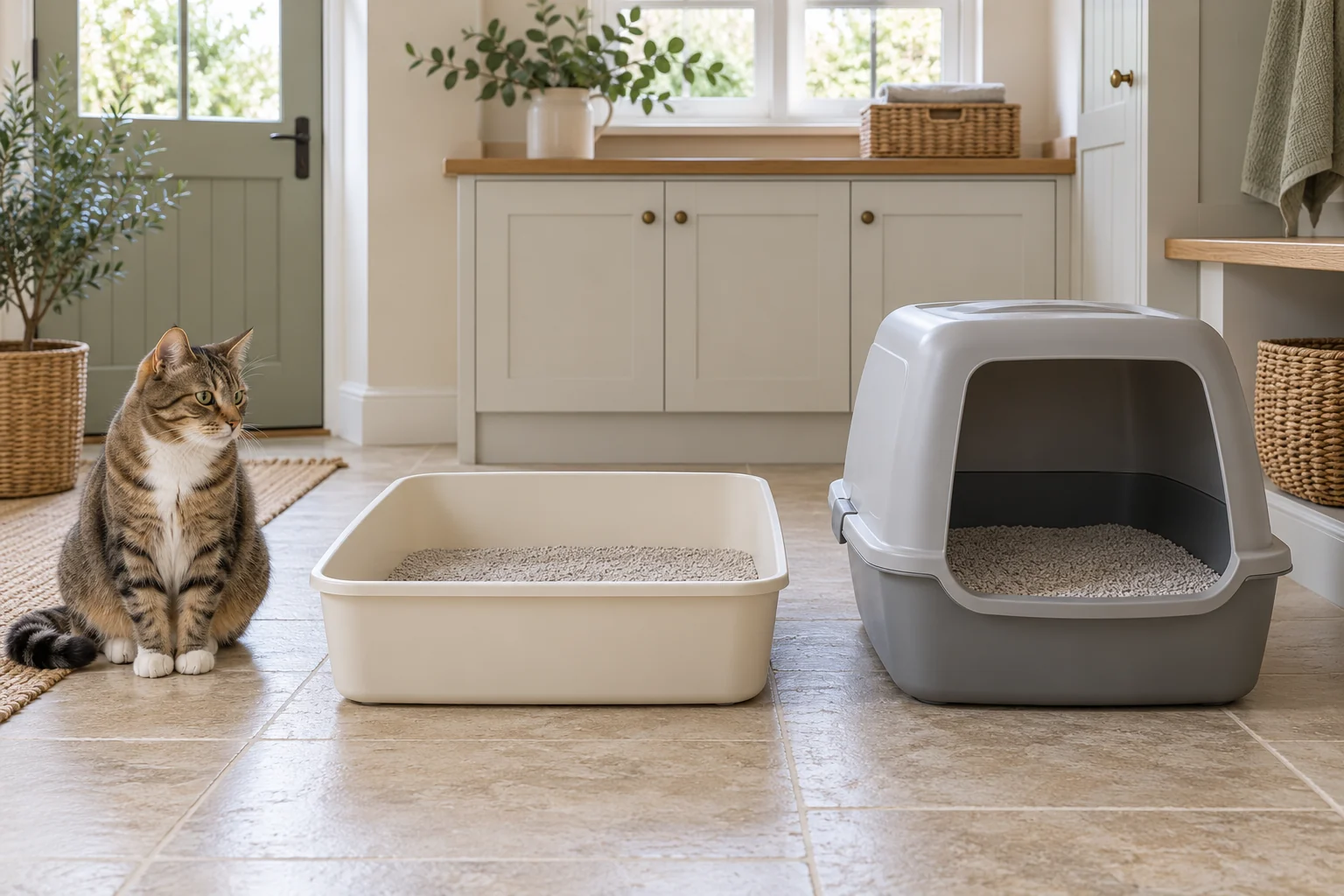
An open tray is a useful starting point because you can see the usable space, monitor cleanliness and avoid an enclosed entrance. A covered tray may suit a cat that already uses one comfortably, provided it is roomy, well maintained and easy to enter. Offer a fair choice rather than assuming a hood provides the privacy every cat wants.
Compare the options
| Question | Open tray | Covered tray |
|---|---|---|
| Can I see cleanliness quickly? | Usually easy to inspect | May need the hood lifting |
| What space needs measuring? | Inside floor and rim | Inside floor, entrance and roof |
| What affects the exit? | Walls and surrounding layout | Entrance, possible flap and surrounding layout |
| Does it replace cleaning? | No | No; trapped odour still matters |
| Useful starting point | Clear access and visible space | A cat comfortable with an adequately roomy enclosure |
The covered-versus-open decision often begins with what looks tidiest in the room. A hood hides the litter, while an open tray makes everything visible. For the cat, the more important differences are room to move, the entrance, the view of the surroundings and how clean the inside remains.
Neither style compensates for a tray that is too small or difficult to reach. Start with litter tray sizing, then use this guide to compare the enclosure. If entry is the immediate problem, our low-entry tray shortlist addresses that separately.
Compare the cat’s experience inside
An open tray provides an unobstructed top and usually a wider view of the room. A hood adds a roof and side enclosure, often leaving one front entrance. Some cats use that arrangement happily; others appear reluctant to enter or turn inside it.
International Cat Care’s tray guidance explains that a covered tray can retain odour and make some cats feel vulnerable, especially when there is only one exit in a shared home. It also notes that larger cats can struggle with restricted positioning and digging room.
That does not mean a familiar covered tray must be removed immediately. Observe the individual cat and offer a suitable alternative if you want to compare. Comfortable voluntary use, enough space and consistent maintenance are more useful than choosing a style on a blanket rule.
Measure usable floor and roof clearance
The outside hood length is not the same as the inside standing floor. Curved walls, hinges, a projecting entrance and the litter itself all affect usable space. Check the length and width at the base, then consider the roof clearance where the cat’s head and back will be.
For an open tray, a rolled rim can still reduce access or catch the cat’s body while turning. “Open” does not automatically mean spacious. A large rectangular floor is often easier to assess than a shaped tray whose longest outside dimension runs diagonally.
Use your cat’s nose-to-tail-base length as the starting point for the length calculation, then watch the full movement: entry, turning, digging, toileting and leaving. A cat that stands on the rim or repeatedly turns awkwardly may need more room, but no single posture establishes the cause by itself.
Look closely at the entrance and flap
Measure the clear opening with the tray assembled. A hood may have a generous outside width while the entrance is narrow. A flap also introduces movement and another surface the cat must pass under or push against.
Where the maker allows it, removing the flap can make a hooded tray easier to investigate. Do not remove structural pieces or modify sharp plastic edges. If the roof itself is the problem, a model with a removable hood may let you offer an open version while keeping the same base and litter.
Entrance height matters for both styles. A high-sided open tray can be harder to enter than a covered tray with a lower front, or the reverse. For cats with reduced mobility, keep the approach clear and avoid placing a bulky tracking mat directly across the step.
Treat odour as a cleaning issue first
A hood can reduce what people see and contain some smell, but the cat still enters that air space. A carbon filter is an accessory, not a substitute for removing waste and washing the tray. Do not choose a tight enclosure simply to delay scooping.
Set a routine that lets you inspect the whole tray, including corners, seams and the underside of the hood. Replace litter and wash according to the litter’s requirements and the cat’s use. Avoid strongly perfumed products intended to cover smell; they can make the tray less appealing.
Open trays make a quick visual inspection easier. Covered trays can be maintained just as deliberately if the hood lifts readily and you have space to remove it. Choose a design you can clean properly every time, rather than one whose hidden corners are difficult to reach.
Separate litter scatter from enclosure preference
A cat digging vigorously may throw litter over a low wall. A higher rear wall or a broad rim can help some setups, but a hood is not the only possible response. Check the amount and type of litter, the cat’s movement and the location before changing several things together.
High-sided open trays retain visibility while changing containment. A lower front remains useful for entry, although some litter can still leave there. A mat outside can catch particles if it lies flat and does not obstruct access.
Urine outside the tray is a different observation from scattered dry litter. Watch the position and discuss new changes with your vet. Do not assume that adding a roof fixes an underlying problem, particularly if the cat is straining or appears uncomfortable.
A covered option to assess: Catit Jumbo
The Catit Jumbo hooded tray offers a removable cover and carbon-filter arrangement. It is a relevant candidate when your cat already uses an enclosed tray and you want a model that opens for maintenance. Check the current exact version’s floor size, clear entrance and hood removal before choosing it.
Covered tray option
Catit AiRSiFT Jumbo hooded litter tray
A covered tray with a lifting hood section and removable top for cleaning access. Consider it if your cat already accepts a covered tray, rather than choosing a lid solely to make the room look tidier.
Check: Check usable inside space and doorway dimensions
View on Amazon ↗The word “jumbo” is not an internal measurement. Do not compare that label directly with an open tray’s listed length and assume the two provide the same room. If you plan to remove the flap or hood, confirm which changes the supplied instructions permit.
An open option to assess: TRIXIE Primo XXL
The Primo XXL is a large open design with a removable rim and a listed outside size of 71 × 56 × 25 cm. It provides an alternative shape for a cat needing a more open top and a broad footprint, but the base and entrance still require checking.
Larger open pan
TRIXIE Primo XXL open litter tray
An open tray with a removable rim and a large 71 × 56 cm outer outline. The selected 40175 is the open version, distinct from a hooded Primo XXL Top.
Check: Usable floor is smaller than the rim outline
View on Amazon ↗Its high overall sides are not a claim of low-entry access. If your cat struggles to step over a front edge, compare the actual entrance with the large open tray guide and low-entry options rather than choosing solely by overall size.
Consider other cats and the route away
A cat using a single-exit hooded tray may have difficulty leaving if another pet waits outside. An open top changes visibility, but it does not remove the need for a calm location and clear approach. Avoid narrow cupboards or traffic routes where either style becomes a bottleneck.
Spread trays around the home, away from food and water. The common starting point of one per cat plus an extra concerns available locations, not just the number of plastic containers. Several trays placed together can become unavailable together.
Watch interactions discreetly. Waiting near an entrance, blocking a route or chasing after toileting can indicate a household arrangement that needs attention. A style change may be one part of the response, alongside resource distribution and appropriate professional advice.
Offer a fair comparison at home
Keep the familiar tray available and add the alternative where practical. Use the same familiar litter and a similar cleaning standard, so the enclosure is not mixed up with a new substrate or a dirty-versus-clean comparison.
If the two trays differ greatly in size or location, recognise that the result reflects the whole setup. Choosing the larger open tray does not prove the cat dislikes every covered tray; choosing a familiar hood does not prove a new smaller one will be suitable.
Record ordinary use over time without hovering or moving the cat into the new tray. Retain the option that is used comfortably and maintained reliably. If neither is used normally, investigate rather than repeatedly buying more styles.
Make the decision around access and upkeep
Tray style checklist
0 of 5 checks complete.
A good tray is a usable daily resource. Keeping it roomy, accessible and clean matters more than whether the litter is visible from the doorway.
Whichever format you keep, use a regular tray-cleaning routine. A separate disposal bin handles removed waste; it does not change the cat’s space inside the tray.
Frequently asked questions
Do cats prefer covered or open litter trays?
Individual preferences vary. Some cats use a roomy covered tray comfortably; others dislike the enclosure, flap or single exit. Start with suitable space and access, then observe voluntary use. An existing habit is useful evidence for that cat, rather than proof of a universal preference.
Does a hooded tray keep smells under control?
It can contain some odour in the enclosure, but that may make the inside less pleasant for the cat. A filter does not replace scooping, washing and suitable litter. If people notice persistent smell, inspect the cleaning routine and tray condition rather than relying on a tighter cover.
Is a high-sided open tray the same as a covered tray?
No. High sides can help contain some litter or overshooting while leaving the top open, but they do not create an enclosed roof. Check the entrance separately: a tall wall all the way around can be difficult for a cat with reduced mobility.
Should I remove the flap from a hooded litter tray?
A flap can deter some cats and restrict the opening. If the manufacturer allows removal, offering the tray without it can simplify entry. Make changes gradually and retain a familiar usable option. Do not force the cat through the flap or assume they will adapt through hunger or waiting.
Will changing tray style stop toileting outside the tray?
It may address an access or preference problem, but it is not a guaranteed fix. Location, litter, cleanliness, household tension and medical issues can also matter. New toileting changes need veterinary advice; repeated straining with little or no urine requires urgent help.