
Practical guide · Litter & cleaning
How big should a cat litter tray be?
Work out litter tray size from your cat’s body length, then check usable floor, width, entry and turning room. Includes measurement examples and a fitting checklist.
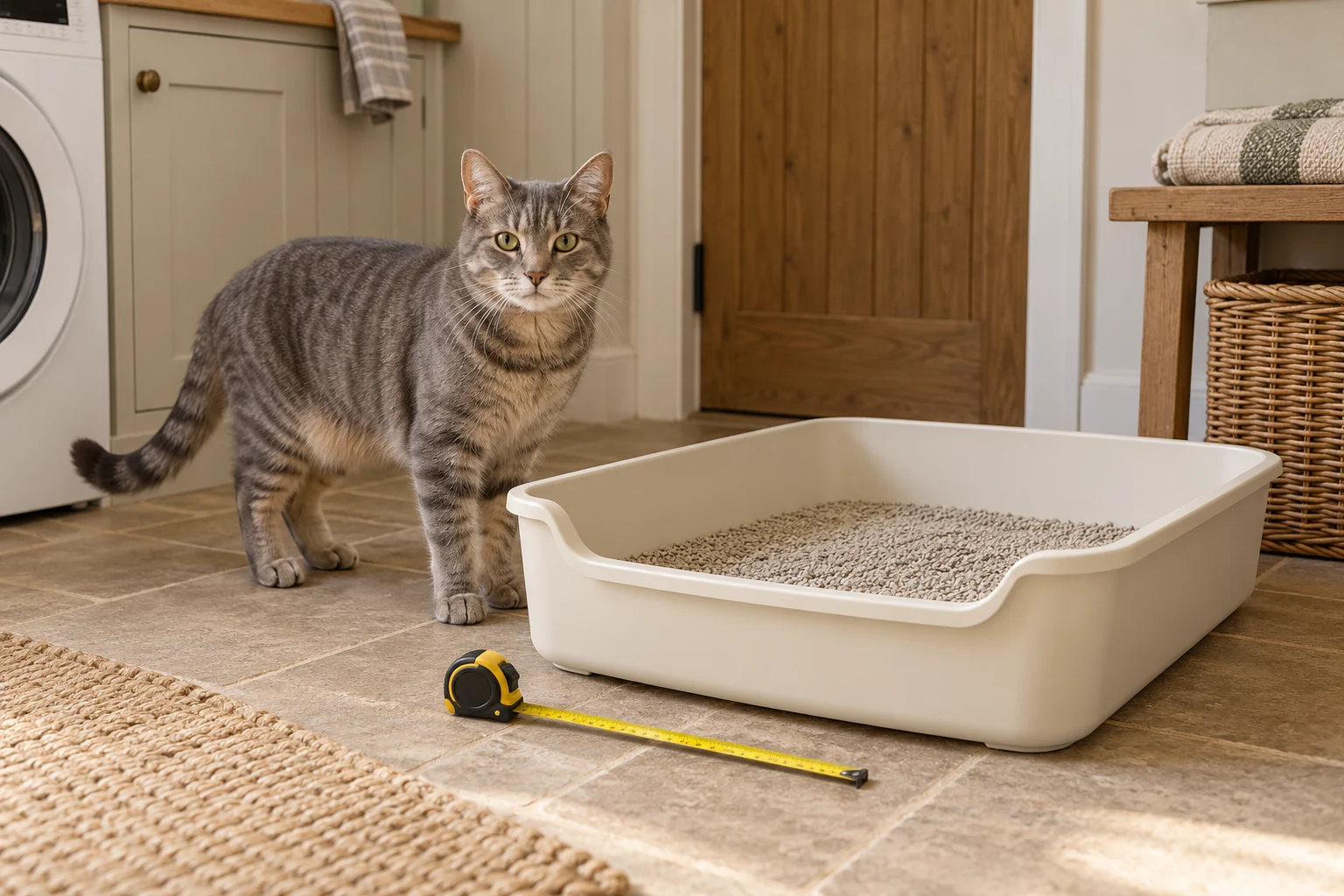
The short answer
Start with roughly 1.5 times body length
A useful starting point is a tray about one and a half times your cat’s length from nose to the base of the tail. Apply that target to usable inside length, then check width, turning room and entrance height. A label such as XL, a breed name or an outside measurement does not establish the fit.
A tray can fit neatly under a bench and still be too cramped for the cat using it. The important space is where the cat stands, turns, digs and adopts a toileting position. Rolled rims, sloping sides and a hood can reduce that space even when a listing gives generous measurements.
This guide starts with your cat and works outwards to the tray and its position. If you already know the measurements, our large open litter tray guide compares several shapes. For a difficult step, start with low-entry litter trays.
Use body length as a starting point
International Cat Care recommends a tray length of about one and a half times the cat’s nose-to-tail-base length. It is a practical selection rule, rather than a guarantee that every tray with that number will suit every cat. Width, the shape of the floor and freedom of movement still need checking.
Watch your cat standing normally on the floor. Estimate the distance from the tip of the nose to the point where the tail begins. A soft tape held nearby, or a photograph beside a known floorboard length, can help. Do not pull the tail straight, stretch the cat or chase a precise measurement if they move away. Repeat the estimate another time if necessary.
For a growing kitten, buy for the current ability to enter and plan to replace the tray as the kitten grows. An adult-size footprint with a genuinely low entrance can sometimes bridge those needs, provided it remains easy to use.
Work through the numbers before shopping
These examples show the calculation; they are not breed-specific size recommendations.
| Nose to tail base | Starting target for usable tray length | What to check next |
|---|---|---|
| 35 cm | About 52.5 cm | Is that length available on the inside floor? |
| 40 cm | About 60 cm | Can the cat turn without being squeezed by the sides? |
| 45 cm | About 67.5 cm | Is the tray wide enough as well as long enough? |
| 50 cm | About 75 cm | Is a larger rectangular design needed? |
Do not round a target down simply because the nearest product is called “jumbo”. If the suitable size will not fit the intended alcove, look for another location. Keeping an inadequate tray because it fits the furniture puts the room’s measurements ahead of the cat’s needs.
Separate outside dimensions from usable floor
An advertised length often runs from one outside edge to the other. That is useful for planning floor space, but it may include a rolled lip, projecting handle or sloped wall. The flat area at the bottom can be shorter and narrower. An entrance step may occupy part of that floor too.
Ask for internal base length and width when these are missing. A top-down product photograph can reveal shape, but it cannot reliably provide a measurement. Perspective and the size of the pictured cat make visual guesses unreliable.
Measure a tray you already own at the level where the cat stands, with any removable rim fitted as it will be used. Note the clear entrance width separately. For a covered tray, check headroom above the litter and the space available when the cat turns; the outer height includes the base, litter and roof thickness.
Check width and the full movement
There is no single centimetre width that fits every adult cat. A long, narrow tray can meet a length target and still restrict turning. Observe the sequence: entering, choosing a position, turning, digging, toileting and stepping out. The cat should be able to do this without repeatedly bracing against the walls or balancing on the rim.
A paw briefly touching an edge does not prove the tray is wrong. Look for a pattern of awkward repositioning or a body squeezed diagonally across the available space. Equally, a cat continuing to use a small tray does not prove it is comfortable; familiar equipment may be used despite its limitations.
Long-haired cats may also need practical clearance so their coat does not brush every surface. A broad rectangular floor is easier to assess than a narrow triangle with a long diagonal measurement.
Treat entrance height as a separate measurement
High rear walls may help contain an enthusiastic digger’s litter, while a lower front reduces the step. Overall wall height tells you little about the actual entrance. Check the lowest intended crossing point and whether a projecting pedal creates an extra obstacle.
Reduced mobility changes the choice. A low entrance and a grippy, clear approach can matter as much as the floor dimensions. If a cat is newly reluctant to step into a familiar tray, discuss the change with your vet. A lower tray can improve access but cannot explain or treat pain.
Avoid improvised sharp cut-outs in brittle plastic. A purpose-made opening with a smooth edge is easier to inspect and keep clean. Put any litter-catching mat where it will not bunch up or force a difficult step.
Two useful shapes to compare
The TRIXIE Primo XXL provides a large open footprint. Its listed 71 × 56 × 25 cm measurements are outside dimensions, so it still needs an internal-floor check against your own calculation. It is a useful candidate when a standard adult tray is clearly restrictive, rather than an automatic fit for every large cat.
Larger open pan
TRIXIE Primo XXL open litter tray
An open tray with a removable rim and a large 71 × 56 cm outer outline. The selected 40175 is the open version, distinct from a hooded Primo XXL Top.
Check: Usable floor is smaller than the rim outline
View on Amazon ↗The Vealind XL has a lower corner entrance and a 60 × 40 cm outside footprint. That can be useful when the access problem is more pressing than adding tall walls. It is not equivalent in usable size to the larger TRIXIE, and the corner entry changes the approach.
Lower corner entry
Vealind XL low-entry litter tray
An open tray listed at 60 × 40 × 15 cm with a 7.5 cm corner entrance and an exit pedal. It provides a larger rectangular outline without asking the cat to climb over the full side wall.
Check: Outer dimensions do not give usable inside space
View on Amazon ↗These examples show why “largest” and “easiest to enter” are separate decisions. Neither listing’s outside length should be copied into the usable-length column of your measurements.
Allow room around the tray
Tape out the outside footprint on the floor, then add the space needed for the cat to walk in, turn towards the entrance and leave. Open the nearby door fully. Check whether a laundry basket, bin or another cat could block the route. Keep the tray away from food, water and busy household traffic.
For a hooded model, leave enough clearance to lift the cover for scooping and washing. A tray that is difficult to reach often becomes difficult to maintain. Our covered versus open comparison explains how the hood changes both access and cleaning.
In a multi-cat home, distribute trays rather than making one large toilet corner. Two trays side by side can be blocked together. Separate places give a cat another option if a room is occupied or an approach feels uncomfortable.
Introduce a larger tray without changing everything
Where space allows, offer the larger tray alongside a familiar option. Keep the litter material and the general routine consistent so the new floor area is the main change. Forcing a new hood, new litter and new location at once makes a refusal difficult to interpret.
Watch normal use without hovering. Record whether entry and turning look easier and whether cleaning remains manageable. If the cat avoids all trays, appears distressed or strains, contact your vet. Repeated attempts to pass urine with little or no output require urgent help.
Check the fit before you order
Litter tray sizing checklist
0 of 5 checks complete.
If one answer is missing, resolve that measurement before choosing a colour or accessory. A straightforward tray that fits the cat and the home is more useful than a feature-rich one with too little usable space.
After calculating the footprint, plan litter tray locations in a small home without trading away usable size or reliable access.
Frequently asked questions
Do I include the tail when measuring my cat for a litter tray?
No. Measure from the nose to the point where the tail joins the body, while your cat stands naturally. Including the full tail would produce a different and unnecessarily long measurement. Take a calm estimate rather than restraining your cat for precision.
Is a 60 cm litter tray big enough for an adult cat?
It depends on the cat and whether 60 cm describes the inside floor or the outside rim. For a cat measuring 40 cm from nose to tail base, the 1.5-times starting point is 60 cm of usable length. A tray advertised as 60 cm overall may provide less than that inside.
Can a litter tray be too large?
Extra floor room is usually more useful than a cramped fit, but access and placement still matter. A large tray with an entrance a kitten cannot climb, or one squeezed into a blocked corner, is unsuitable. Choose generous space with an easy entrance and somewhere you can clean it properly.
Does a bigger tray replace the need for several trays?
No. Size and the number of separate toileting locations solve different problems. A common starting point is one tray per cat plus an extra, spread through the home. A single oversized tray can still be guarded by another cat or become unavailable when a door closes.
Does litter outside the tray mean it is too small?
Not necessarily. Digging, litter texture, wall height and the position of the entrance can all affect scatter. Watch whether your cat can turn and toilet comfortably before changing the size. New toileting problems, straining or repeated unsuccessful attempts need veterinary advice rather than repeated equipment changes.