
Practical guide · Cat trees & climbing
Where to put a cat tree
Find a stable, inviting cat tree position with usable climbing routes, safe window access and room for landing. Plan around doors, heaters and other cats.
The short answer
Plan a place to climb, rest and leave freely
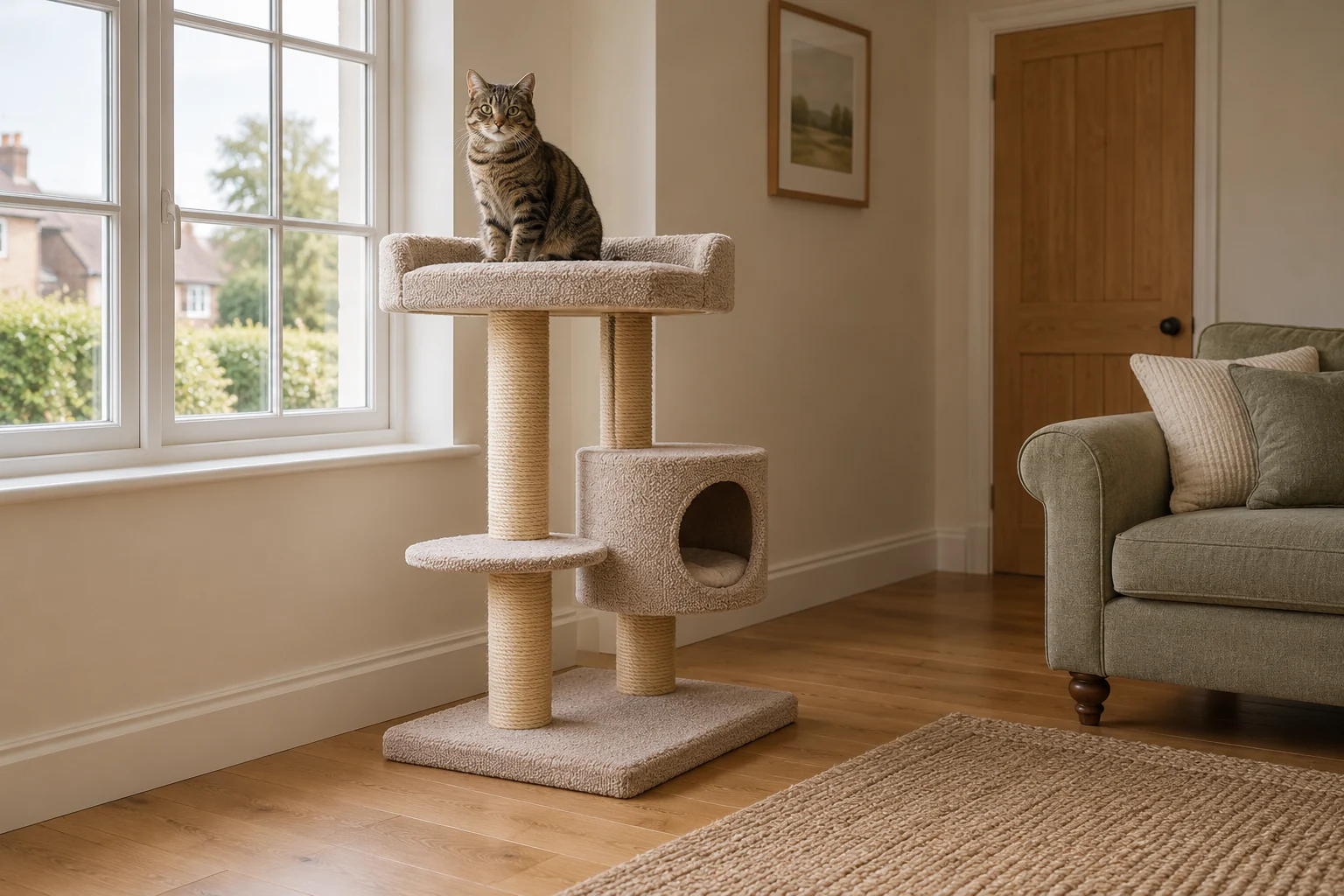
Put a cat tree where your cat already likes to spend time, on a level stable surface with a clear route up and down. A living-room window can be useful if the view is comfortable and the window is secure. Leave space for the whole tree, projecting beds and landings, and avoid doors, blind cords, heaters and routes another pet can block.
A cat tree is part of a route through the room. The cat needs somewhere to approach, a sequence of usable surfaces and a comfortable way back down. A tree that fits an empty corner can still be a poor choice if the first platform faces the wall or the best bed overhangs a doorway.
Start with the position before ordering a larger tree. This guide covers placement and everyday use; our cat-tree selection guide helps compare structure and size, while trees for small homes focuses on compact footprints.
Begin where the cat already chooses to be
Notice the ordinary resting and watching places: the sofa back, a quiet window, the top of a low cabinet or a chair near the family. These choices offer clues about the view, height and level of company your cat enjoys. A tree near a well-used spot has a clearer purpose than one hidden in an unused spare room.
Do not assume every cat wants the busiest room. Some prefer to watch from a distance, with a retreat nearby. A cat that moves away whenever a television becomes loud may value a quieter position. Think about how the room changes through the day, including visitors, children and other pets.
Cats Protection’s indoor-cat advice includes opportunities to climb and explore. Its sleeping-place guidance also emphasises accessible elevated options and undisturbed rest. Apply both ideas: height is useful when the route and the resting conditions suit the cat.
Measure the complete tree, not only the base
Mark the base outline on the floor, then add any platforms, hammocks or beds projecting beyond it. Check those projections at their actual height. A lounge above a desk may conflict with a screen, while a low platform can obstruct a cupboard that appeared clear at floor level.
Allow working space for assembly, inspection and cleaning. You should be able to reach fixings and remove washable parts without dismantling the room. If the tree is too close to a wall for the cat to enter a den or turn on a platform, the advertised number of features becomes less meaningful.
There is no universal clearance number that works for every design. Use the maker’s dimensions and your cat’s normal movements. A long-bodied cat may need a broad landing even when the base is compact. A cat that jumps sideways from the sofa needs that route considered too.
Assess the window through the day
A view can make a tree appealing, but check more than the morning photograph. Strong afternoon sun can make a resting platform uncomfortable. A radiator below the window can create a heat problem, and curtains may cover the easiest route when closed.
Keep windows secured appropriately for cats. A normal insect screen is not automatically a secure barrier. Remove access to blind cords and do not create a launch point towards an open window, balcony or unsafe ledge. The tree should not undermine an existing window-safety arrangement.
Watch the cat’s response to the view. Quiet watching differs from persistent agitation when another cat passes outside. If the view creates tension, change the angle, offer visual screening or choose another location with professional advice where needed. A window position is an option, not a requirement.
Check floor and fixing instructions
Set the tree on a level surface and assemble it fully before inviting use. A thick uneven rug or a base straddling a threshold can create movement even in a substantial design. Do not wedge it under furniture to conceal wobble.
Follow the maker’s instructions for anti-tip straps or other fixings. Choose the correct fixing method for the wall and the product rather than improvising with a spare hook. If you cannot install the required restraint, choose a different design or obtain suitable help before use.
Check bolts and wear regularly, especially after moving the tree. A tree can loosen with repeated jumping. Inspect posts, platform connections and any fabric hammock attachments. Stop use if a structural part is damaged; moving the tree against a wall does not repair it.
Plan an easy route down
Look from the top platform towards the floor. Are there broad intermediate surfaces within the cat’s ability? Can the cat turn without stepping over another sleeping cat? Is the final landing clear of hard edges, bowls or a moving door?
A sofa can sometimes form part of a useful route, but only if it remains in place and offers a stable landing. Do not depend on an office chair that rolls away or a lightweight side table that can tip. Keep loose throws from becoming a sliding approach.
Older cats and cats with changing mobility may need lower choices and smaller transitions. A sudden reluctance to climb is a reason to speak with your vet, rather than simply enticing the cat higher. Provide a comfortable lower resting option while you investigate.
A lower tree for a modest room
The Vesper Base walnut has a 56 × 56 cm base and an 84 cm overall height. It provides a different placement proposition from a tall tower: a lower elevated choice with a den and resting surface. Check how its entrances and platforms face the room before fitting it beside furniture.
Lower wooden-style tree
Catit Vesper Base, walnut
A lower wooden-style tree with a two-entry cube and removable cushions. Its 56 cm square base suits a measured corner, while the den and raised platform offer different resting positions.
Check: Base is wider than many slim towers
View on Amazon ↗Its removable cushions need the specified care rather than an assumed machine wash. Allow room to lift them out and clean around the structure. A smaller height does not remove the need for a stable floor and regular fixing checks.
A broad resting platform for a larger cat
The TRIXIE XXL Klara has a 60 cm square base, a 20 cm diameter post and a single upper resting bed, with an overall height of 100 cm. It illustrates choosing one substantial perch rather than several small levels. Confirm the usable bed interior separately; the base size is not the sleeping-area measurement.
Single raised bed
TRIXIE XXL Klara cat tree, grey
A single elevated resting bed on a 20 cm diameter sisal post, with a 60 cm square base and 100 cm overall height. Check the usable bed interior separately; the base dimensions do not establish the sleeping area.
Check: Inner bed size needs confirming separately
View on Amazon ↗Mark the upper bed’s full reach as well as the base. Check the step from surrounding furniture and the cat’s route to the floor. If you need a larger multi-level structure, our large-cat tree comparison explains why total span, platform size and access deserve separate measurements.
Keep shared rooms from becoming bottlenecks
A high bed can become a valuable resource. If one cat controls the only route up, adding another bed above it may not create another accessible option. Place separate resting or climbing choices in different parts of the home where practical.
Watch for waiting at the base, retreating from an approach or one cat remaining above because another is below. These patterns are more useful than counting how many cats the product listing says a tree can accommodate. The cat’s ability to leave freely matters.
Avoid placing the tree so its base crowds a litter entrance, drinking station or feeding area. Separating functions gives cats more choice and makes household traffic easier. A tree can be near a resting area without being pressed into every essential resource.
Introduce and adjust the position gradually
Allow exploration without placing the cat on the highest bed. A familiar cushion or an appropriate food reward on an easy lower surface can help, but do not force a climb or leave loose string toys hanging from the tree.
If the tree remains unused, change one factor at a time: move it nearer the preferred room, rotate an entrance or clear the approach. Keep favourite existing resting places available. Move cautiously after use becomes established, especially when the tree also serves as a scratching surface.
Walk through the room before buying
Cat tree placement checklist
0 of 5 checks complete.
Repeat the check with curtains closed and doors open. A position that works throughout the normal day is more useful than a tree arranged only to look tidy from one angle.
Before use in the chosen position, work through the assembly and stability checks. For worn columns, the replacement-post reference explains dimensions and fittings.
For changing access needs, compare low trees for older cats. Keep the maintenance practical with cat-tree cleaning and the replaceable-post tree guide.
For a home with several cats, compare trees and separate resting stations for multiple cats by the routes each cat can use independently.
For a window-side alternative, compare window perches by support, glass fit and access rather than height alone.
Frequently asked questions
Should a cat tree go beside a window?
It can be a good choice when the window is secure, the approach is stable and the cat enjoys the view. Keep blind cords and open-window escape routes inaccessible. If unfamiliar cats outside cause staring, agitation or hiding, offer a different viewpoint rather than assuming the window is always enriching.
Can I put a cat tree in a corner?
Yes, if the tree is level, the maker’s fitting instructions are followed and the cat can use the platforms and exits. A corner that blocks access to the lower steps or traps the cat in a single approach may be unsuitable. The base fitting into the corner is only the first check.
Will a heavy cat tree be safe without fixing it?
Weight alone does not prove stability. Height, base shape, overhanging beds, floor level and the force of a jumping cat all matter. Use any required anti-tip fitting exactly as instructed and choose suitable fixings for the wall. Do not treat the wall beside the tree as a substitute for proper assembly.
Why is my cat ignoring a new tree?
The location, surface, platform spacing, access or recent change may not suit them. Place it near an existing resting or watching spot, keep familiar alternatives available and allow voluntary exploration. If the cat suddenly avoids climbing elsewhere too, speak with your vet about the change in mobility.
Should two cats share one tree?
They may choose to, but provide alternative elevated and resting places so one tree is not the only desirable spot. Watch whether one cat blocks a lower platform or exit. Several beds on the same narrow route do not necessarily provide independent access for several cats.