
Buying guide · Cat trees & climbing
Best cat trees for multiple cats
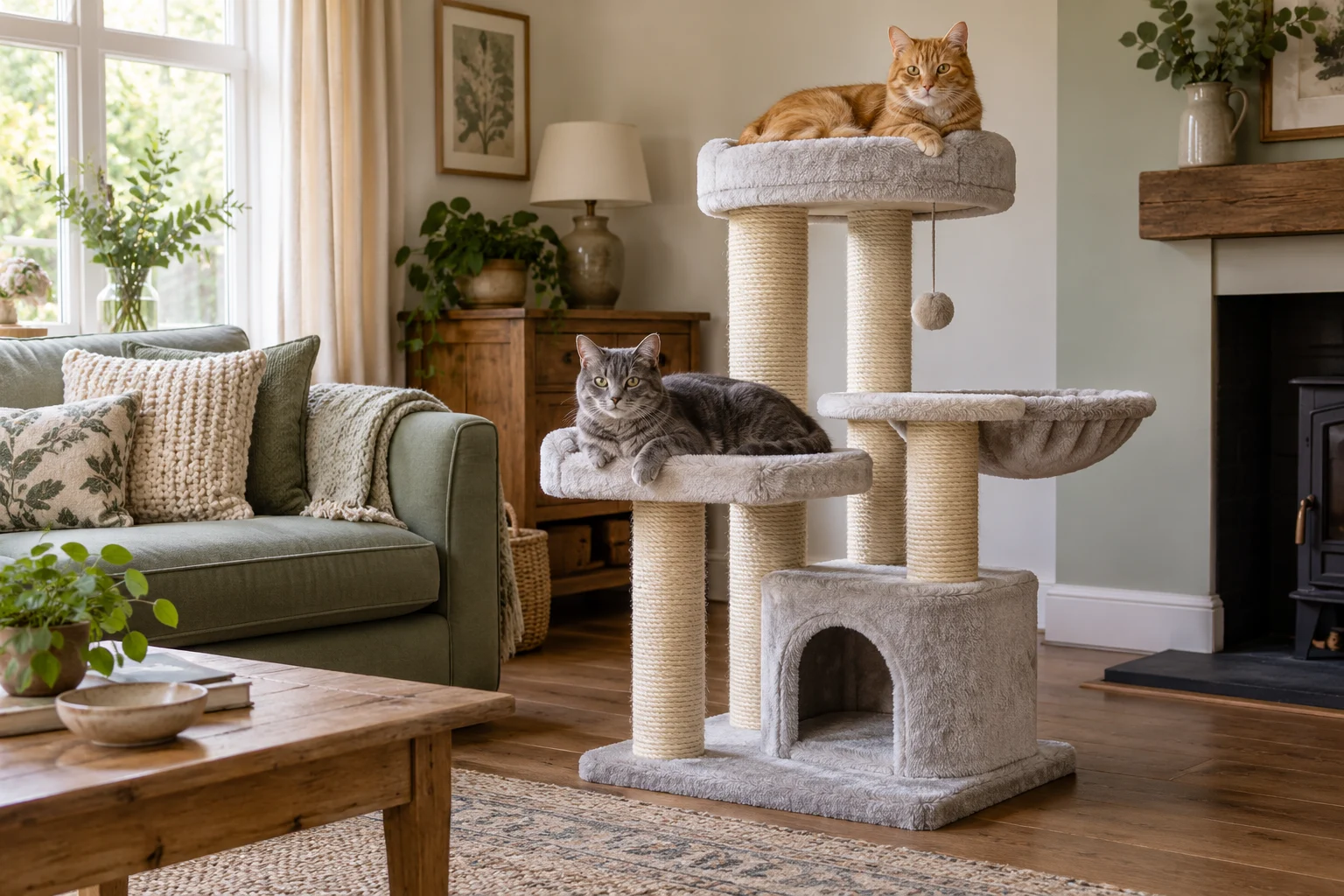
Compare cat trees by independent resting places, approach routes and usable beds. Plan separate climbing choices so one cat cannot control every perch.
The short answer
Choose around the way your cat uses it
Choose independent resting places and unobstructed routes before counting platforms. A substantial shared tree can suit cats that comfortably spend time together, but two trees in separate places often give more choice than one tall tower. The RHR Kilimandjaro is the larger shared-tree option here; Vesper High Base and TRIXIE Klara offer different ways to add a separate resting station. Check every usable bed and the whole assembled outline.
Compare the options
| Option | Role in a multi-cat home | Main check |
|---|---|---|
| RHR Kilimandjaro | Substantial shared structure | Every bed, route and complete span |
| Vesper High Base | Independent climbing and den station | Upper access and both den exits |
| TRIXIE Klara | Separate substantial raised perch | Usable bed and direct access |
A cat tree for multiple cats needs more than a collection of beds stacked above one another. One cat can occupy a central shelf and control the only route to everything above it. The tower may look generous while the second cat has no comfortable way to use it.
Start with the relationships in your home. Cats that sleep touching may choose to rest near each other; cats that maintain separate territories need choices in different places. This guide compares a substantial shared tree with two options for creating an additional independent station.
Count independent destinations, then trace the routes
Draw the tree from the front and mark each actual resting surface. A small intermediate board is a step, not necessarily a bed. A hammock that fits one curled cat does not become two resting places because it is wide in a photograph.
Trace the path from the floor to each destination and back down. Look for a single narrow doorway, a shelf directly outside a den or a top bed reached only by crossing another bed. An open side can help an agile cat, but do not assume every cat can comfortably jump around an obstruction.
Cats Protection’s advice on living with more than one cat supports separated resources and opportunities for space up high. Apply that principle across the room: a second attractive resting location can matter more than another shelf on the same tower.
For a substantial shared structure: RHR Kilimandjaro
RHRQuality Kilimandjaro de Luxe, Blackline cream
Best for: Several resting positions on a tall structure
A tall climbing structure with a listed 60 × 43 cm lounge, hideaway and hammock. Compare the full span of the current layout with your room, rather than planning around its smaller base panel alone.
What stands out
- Different supported resting surfaces
- Manufacturer supplies replacement components
Keep in mind
- Full assembled span must be confirmed for the selected version
- Several upholstered surfaces and joints to inspect
- 195 cm overall height
- 60 × 43 cm listed lounge
- 12 cm diameter sisal posts
The selected Blackline cream Kilimandjaro is around 195 cm high, with 12 cm diameter scratching posts and a listed 60 × 43 cm lounge. It belongs on a shortlist when you have space for a substantial structure and cats that already tolerate resting in the same area.
Confirm the complete assembled span, including projecting beds. The footprint of the base does not describe everything that could meet a sofa arm, doorway or curtain. Compare the usable dimensions of each resting position with your cats’ usual postures; the lounge measurement does not establish the size of every hammock.
Look at the approach to the most desirable upper place. A big tree still needs an unblocked descent and another suitable destination if one cat claims the top. Follow the exact assembly and restraint instructions, and ask about intended combined use where the published load information is limited to individual components.
For a second climbing station: Vesper High Base
Catit Vesper High Base, black
Best for: A furniture-style tree with a hideaway
An MDF furniture-style tree with a cube hideaway, two platforms and cushioned resting areas. Choose it for a combination of climbing and enclosed rest, after allowing for its full outline and the route between levels.
What stands out
- Several distinct resting positions
- Manufacturer offers replacement parts
Keep in mind
- The 56 cm base still needs real floor space
- Upper platforms require climbing and jumping
- 56 × 56 × 121 cm overall
- Two-entry cube den
- Memory-foam cushions
The Vesper High Base stands approximately 121 cm high on a 56 cm square base. Its two-entry cube is useful to consider when comparing den access, and the raised surfaces provide a different resting arrangement from a large upholstered tower.
Two openings do not guarantee that a cat cannot be blocked: one may face a wall, or the route from it may lead straight past the other cat. Position the whole unit with both openings usable and compare the transitions between levels. The upper perch remains a climbing destination.
This option makes most sense here as an independently placed station, rather than a promise that several cats will share its upper bed. If you already own a large tower, a smaller tree with a different view can add more practical choice than another tower immediately beside it.
For a separate substantial resting perch: TRIXIE Klara
TRIXIE XXL Klara cat tree, grey
Best for: One substantial raised bed
A single elevated resting bed on a 20 cm diameter sisal post, with a 60 cm square base and 100 cm overall height. Check the usable bed interior separately; the base dimensions do not establish the sleeping area.
What stands out
- Thick, heavy base plate
- Bed and attached reversible cushion are hand washable
Keep in mind
- Inner bed size needs confirming separately
- Direct route to the raised bed needs checking
- 60 × 60 cm base
- 100 cm overall height
- 20 cm diameter post
Klara is approximately 100 cm high, with a 60 cm square base and a substantial 20 cm diameter post. Its simpler arrangement can provide a separate raised resting destination while avoiding the space demands of another very tall tower.
It is not a gradual staircase and it is not a replacement for several independent beds. Check the usable bed size, entry and final height change. A cat that needs easier access may be better served by a comfortable floor bed or an appropriate lower arrangement elsewhere.
A broad base still needs a clear approach. Tucking Klara into the only passage between a chair and a wall may recreate the same bottleneck you are trying to remove. Place it where the second cat can settle without travelling through the first cat’s favourite position.
Compare one large tree with two separate stations
| Arrangement | What it can add | What to check |
|---|---|---|
| One substantial shared tree | Several nearby resting choices and scratching surfaces | Shared approach, combined use, bed sizes and escape routes |
| Two independently placed trees | Different views and less dependence on one location | Both routes remain useful when the other cat is present |
| One tree plus accessible resting alternatives | Choice for cats with different movement preferences | The alternatives are desirable resting places, not spare floor corners |
A pair of trees does not have to match. One cat may favour a higher window view while the other regularly chooses a lower, quieter resting place. Match those preferences instead of buying identical equipment for visual symmetry.
Measure the cats and the room separately
Record each cat’s normal curled and stretched sleeping outline without disturbing them. Compare the actual resting area and rim shape, not just the overall tree width. A narrow fabric hammock can feel very different from a firm shelf of similar advertised size.
Then mark the assembly’s full outline on the floor, allowing for projecting beds, a stable approach and cleaning access. Include the space needed to tighten fixings and remove a cushion. Our large-cat tree guide covers usable bed size in more detail; this page’s priority is sharing and independent access.
Introduce the arrangement and watch ordinary use
Keep established sleeping places available while the new equipment becomes familiar. Let cats investigate separately and avoid placing them together on the tower for a photograph. Observe who approaches, who turns away and whether a cat waits for the other to leave before moving.
Repeated staring, sitting across an approach or consistently abandoning a favoured place can indicate that the arrangement needs changing. More height is not the only response. Changing the location of a second station, creating more room around a base or offering an alternative view may be more useful.
Plan stability and maintenance for repeated use
Inspect the base and joints during assembly, then follow the maker’s rechecking instructions. Several cats can repeatedly use different edges of the same structure. Stop using damaged components rather than attempting to solve a structural problem by pushing the tree more tightly against furniture.
Compare the practical cleaning routine too. More upholstered beds mean more hair removal, covers and drying space. The tree cleaning guide and replaceable-post comparison explain those ownership decisions. Choose the arrangement whose destinations remain comfortable, accessible and maintainable over time.
Frequently asked questions
How many cat trees do two cats need?
There is no fixed number of trees. Provide enough separated resting and climbing choices that each cat can use a suitable place without passing the other. Two trees can work better than one crowded tower. Count comfortable independent destinations around the whole home, including suitable existing resting places.
Do several platforms make a tree suitable for several cats?
Not automatically. Some platforms are steps rather than beds, and every upper level may depend on the same narrow approach. Check whether a resting cat blocks access, whether both cats have enough usable room and whether another comfortable station is available elsewhere.
Can two large cats share one tree?
Possibly, if the maker supports the intended use, the whole structure is stable and each usable bed fits. A load rating for one hammock is not the total assembly rating. Ask the manufacturer about the exact version rather than adding individual limits together.
Should I put both trees next to each other?
Two adjacent trees may still function as one contested location. Separate them when that creates a meaningful choice of approach, view and retreat. Observe the cats: the important question is whether each can use a resting place comfortably while the other is nearby.
Will buying a larger tree stop my cats arguing?
Furniture cannot guarantee harmonious relationships. Add separate resources and observe staring, blocking and avoidance as well as obvious disputes. Seek veterinary and qualified behaviour advice when tension persists or behaviour changes. Do not force cats to share a tree to get used to each other.