
Practical guide · Cat trees & climbing
How to clean a cat tree
Remove hair, check fabric labels and clean cat-tree surfaces without soaking structural boards or rope. Inspect joints, dry fully and plan supported replacement parts.
The short answer
Clean each material by its own instructions
Remove loose hair and debris first, then follow the exact care instructions for each surface. Wash only removable parts that permit it; keep structural boards, fixed rope and bonded coverings within their supported cleaning methods. Dry fully, inspect joints and reassemble correctly before the cat returns. A fresh cushion does not resolve a contaminated or damaged core.
A cat tree is several materials joined together, not one large washable bed. The same structure may contain a removable cushion, fixed plush covering, a rope-wrapped column, laminated board and hidden fasteners. Cleaning works best when those parts are identified before any water is added.
Start with loose hair and an inspection. More intensive washing should solve a particular problem by a method the component can tolerate, rather than making every surface wet because the tree looks dusty.
Give the cat another resting place
Choose a time when the cat can use another familiar bed or perch away from cleaning activity. Move bowls, toys and other belongings out of the work area, and keep the cat away from removed fittings and cleaning tools.
Photograph the assembled tree and find its model instructions. Identify removable pads, covers and mats without forcing apart anything that is not designed to detach. Label the parts privately if several similar cushions or fixings occur on the same structure.
Do not start dismantling a loaded or unstable tree while the cat remains above you. If structural damage is already visible, stop normal use and resolve it through the stability and assembly checks before treating the job as ordinary cleaning.
Remove dry hair and loose debris first
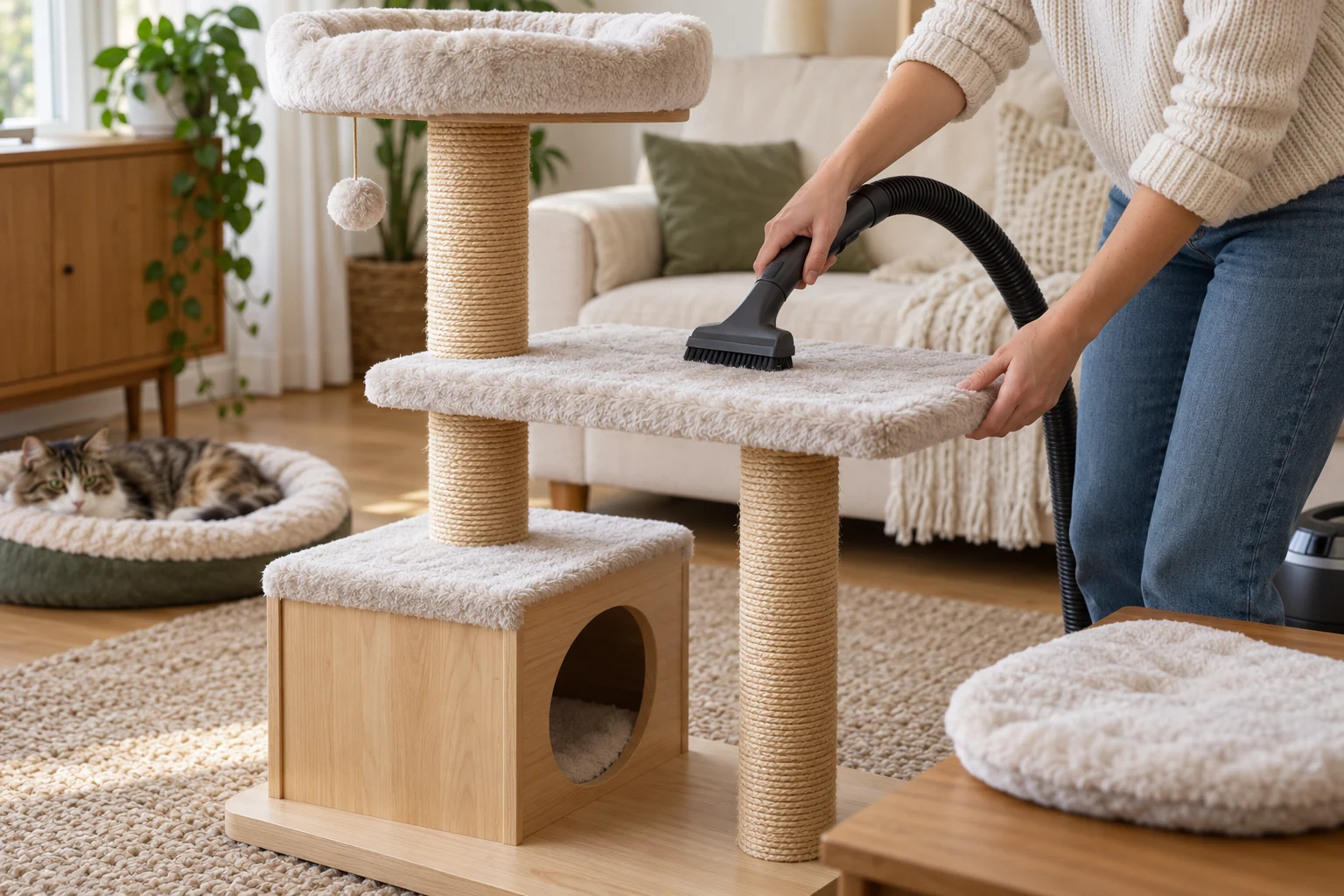
Use a suitable vacuum upholstery attachment or another method the maker permits, gently working across accessible fabric. Avoid pulling at seams, loose loops or damaged coverings. Keep small toys and hanging accessories away from the suction head.
Check the underside of platforms, den corners, cushion edges and the base perimeter. Hair often collects in places that are not visible from standing height. Removing it before spot cleaning reduces the amount of damp debris left in the fabric.
Use an appropriate attachment for your appliance and the surface. Do not drag a hard tool across laminate or use high suction to hold and lift a loose cover. If the fabric begins to separate, stop and inspect the bond or stitching.
Separate the materials before choosing a method
| Surface or part | First task | Care limit to confirm |
|---|---|---|
| Removable cushion or cover | Read its individual label | Whole item or cover only; washing and drying method |
| Fixed plush fabric | Remove loose hair and inspect | Whether spot cleaning is supported |
| Laminated structural board | Check seams and fastenings | Permitted wiping; avoid unsupported soaking |
| Rope-covered column | Inspect fibres, covering and core | Supported debris removal and contamination limits |
| Hardware and connections | Check condition and assembly | Exact tightening and replacement instructions |
A removable part may still contain an insert that must stay dry. A zip or hook-and-loop fastening identifies a connection, not permission to use a particular wash programme.
Furniture-style surfaces: Catit Vesper High Base
Furniture-style tree
Catit Vesper High Base, black
An MDF furniture-style tree with a cube hideaway, two platforms and cushioned resting areas. Choose it for a combination of climbing and enclosed rest, after allowing for its full outline and the route between levels.
Check: The 56 cm base still needs real floor space
View on Amazon ↗The High Base combines a rigid furniture-style structure with cushioned areas and scratching columns. Its manufacturer information identifies replacement support and retaining the assembly tool for later adjustments.
Separate cushion care from the body’s cleaning method. Follow the supplied instructions for hand washing and drying permitted soft parts, and do not put a rigid panel or fixed column into the wash. Wipe only surfaces and seams that the maker permits, removing residue without soaking the board.
Check the condition around joints and panel edges before returning the cushion. A clean removable pad can hide dampness or damage beneath it. If a scratching column needs replacement, use the exact part system rather than assuming another Vesper range uses the same dimensions.
A separate hand-wash example: TRIXIE Klara
Single raised bed
TRIXIE XXL Klara cat tree, grey
A single elevated resting bed on a 20 cm diameter sisal post, with a 60 cm square base and 100 cm overall height. Check the usable bed interior separately; the base dimensions do not establish the sleeping area.
Check: Inner bed size needs confirming separately
View on Amazon ↗TRIXIE specifies hand washing for the Klara’s cuddly bed with its attached reversible cushion. That scope does not make the whole 100 cm structure washable. The thick scratching column, base and fittings require their own inspection and supported care.
Follow the exact Klara model information and supplied label when removing or cleaning bedding. Do not turn a hand-wash instruction into machine or tumble-drying permission because a similar-looking bed tolerates it.
Keep the parts supported while working and use the assembly instructions for any detachment. Inspect the bed’s fastening and the post connection before it returns to normal use. A thick column does not remove the need for a sound complete assembly.
Treat a small mark without saturating the structure
Where spot cleaning is allowed, use the compatible product and method specified for that material. Work with the least moisture needed by that method, avoid spreading contamination into seams, and remove cleaning residue as instructed.
Test any permitted cleaner as the manufacturer directs, paying attention to colour, backing and bonded surfaces. Do not add fragrances or essential oils to make the tree smell fresh. The cat needs a clean usable surface, not a stronger scent.
A stain disappearing is not proof that the underlying material is clean or sound. If soiling has reached a core that cannot be cleaned adequately, ask about a supported replacement component or consider replacing the structure.
Care for the scratching columns separately
Remove loose debris by the permitted method and inspect the full circumference and both ends. Look for peeling rope, long loops, exposed fasteners or a column that has softened or shifted at a connection.
Avoid soaking the covering to reach the core. Fixed rope can hold moisture, and the material beneath it may not tolerate wet cleaning. Rewrapping a contaminated or damaged column can hide the condition rather than repair it.
Use when to replace a scratching post to distinguish ordinary wear from a stopping point. For a supported spare, the replacement-post reference explains identification and fitting checks.
Allow every cleaned component to dry fully
Dry soft parts by their permitted method in a suitable ventilated place. Check seams, cushion centres and thick rims rather than judging only the surface. Keep heat sources and drying appliances within the label instructions.
Return no damp cushion to a den or platform, and do not reassemble a structure that traps moisture around a panel or fixing. Keep another resting place available for as long as drying takes. A short cleaning window is not a reason to return an incompletely dry part.
Keep special hygiene concerns separate
Urine contamination, parasites or a diagnosed infectious condition may need a plan beyond routine washing. Ask your veterinary team what process is needed, then check with the maker whether the affected materials can tolerate it.
Avoid a universal disinfectant recipe, extra-hot wash or steam treatment across mixed materials. A process that damages the structure or leaves unsuitable residue is not a successful shortcut. Where the necessary process is incompatible, a supported part replacement or a new item may be appropriate.
Inspect the whole tree before reuse
Reassemble using the correct parts and the maker’s order. Check that the base is flat, connections are sound, cushions are secure and required restraints are fitted. Keep the approach and landing areas clear.
Let the cat investigate voluntarily when cleaning activity has finished. Preserve another familiar resting choice and avoid moving the tree into a completely different position at the same time unless the old location was unsuitable.
Finish the cleaning and assembly check
Cat-tree cleaning checklist
0 of 5 checks complete.
If future maintenance is a priority when replacing the tree, compare trees with replaceable posts and check the specific spare-parts route before buying.
Frequently asked questions
Can I wash an entire cat tree?
Do not assume that. Many trees combine fabric, rope, engineered board, glue and metal fittings with different care requirements. Wash only components for which the maker permits it. Soaking a whole structure can affect boards, bonds and trapped moisture even if the outer fabric looks washable.
Can I steam-clean a cat tree?
Only if the manufacturer explicitly permits the method for the exact materials and components. Steam can add heat and moisture to bonded surfaces and structural boards. It is not a general substitute for a supported cleaning or veterinary infection-control process.
How do I clean rope-covered scratching posts?
Remove loose debris by the maker-approved method and inspect the covering and core. Avoid saturating fixed rope or adding fragrances and unsupported chemicals. If contamination cannot be removed within the supported care method, ask about an exact replacement post rather than hiding the problem under new rope.
Can cat-tree cushions go in the washing machine?
Only where the exact label permits it. Catit Vesper cushions and TRIXIE Klara bedding need their own instructions; Klara’s cuddly bed and attached reversible cushion are specified for hand washing. A removable cushion is not automatically machine washable, and its cover and filling may differ.
What if the cat tree has fleas, urine or an infection concern?
Separate the care question from routine hair removal. Obtain veterinary advice for parasites or infection concerns, and ask the tree maker which compatible cleaning methods are supported. If the structural core remains contaminated or damaged, replacing an outer cover alone does not resolve it.