
Practical guide · Feeding
Timed versus microchip cat feeders
Compare timed food access with microchip identification. Choose around late meals, food stealing, separate diets and the limits of cooling and portion control.
The short answer
A clock controls when; identification controls who
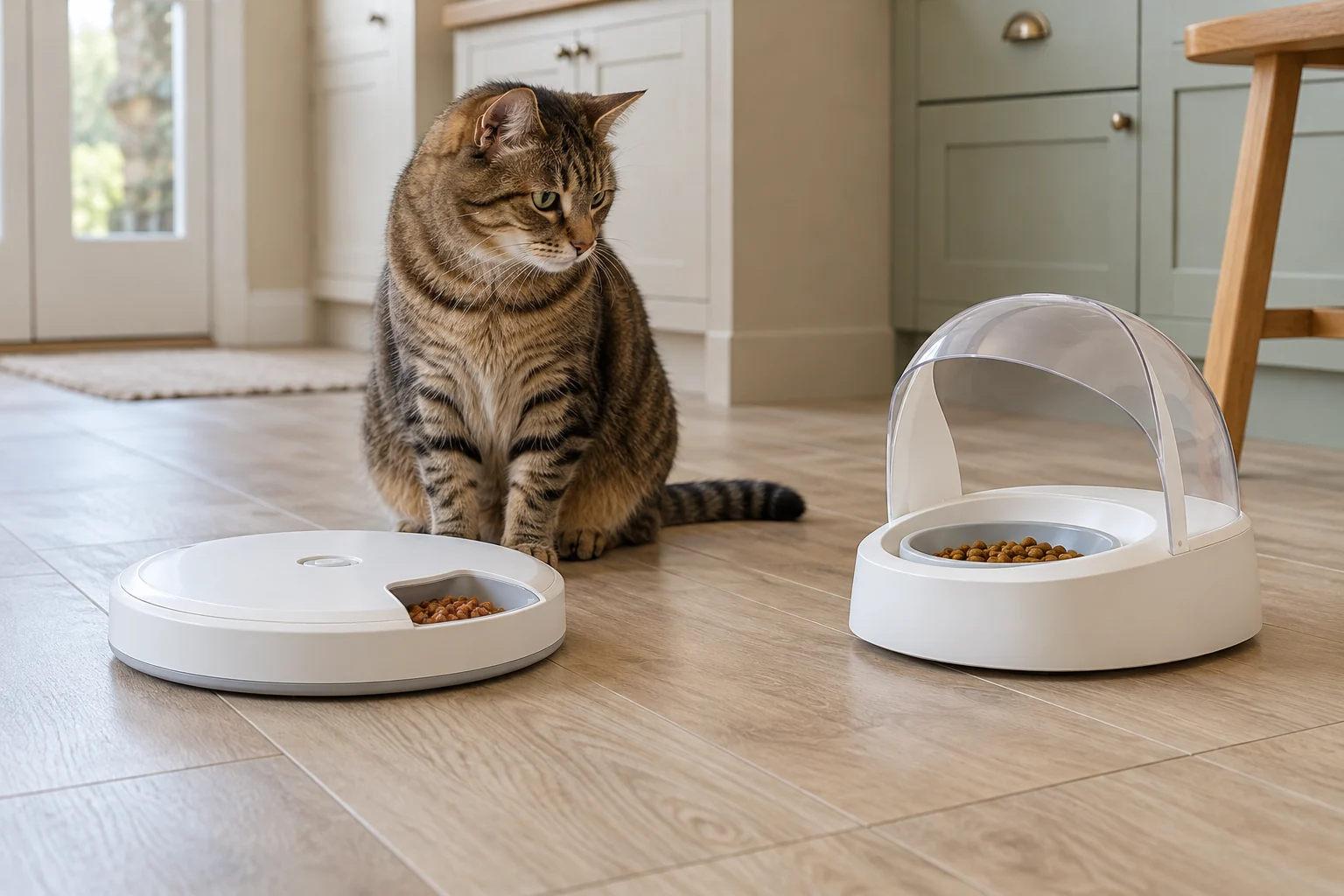
A timed feeder controls when food becomes available. A microchip feeder controls which registered pet can reach food already in its bowl. Choose a timer for a later serving and selective access for food stealing or separate diets. A standard example of either type does not automatically provide both functions, identify every bite or refrigerate wet food.
Two feeders can both be called automatic while solving different problems. One reveals a meal later; the other recognises a permitted animal. Confusing those tasks can lead to a well-programmed meal being eaten by the wrong cat, or a protected bowl remaining accessible all morning when a timed serving was intended.
This guide explains the mechanism and the household decision. For full product comparisons, use our dry-food timed feeder guide, wet-food feeder guide or microchip feeder comparison.
Describe the problem before choosing the machine
Write one ordinary example: “I need a serving available after I leave” or “the faster eater takes the slower cat’s food”. The first is mainly a timing problem. The second is an access problem. A household can have both, but it is useful to identify them separately.
If the concern is not knowing how much the cat eats, neither mechanism alone gives a complete answer. You may need measured portions, observation and veterinary advice. App records or a bowl disappearing behind a lid do not establish why appetite has changed.
Think about the cat’s current routine too. A cat used to several small visits may need a different arrangement from one comfortable eating a set serving. Any prescribed diet or meal restriction should guide the equipment choice, rather than being changed to fit a convenient product.
What a timed feeder actually controls
A timed tray or lidded feeder exposes food according to a schedule. You usually prepare the portions yourself. A dry-food hopper instead dispenses food from storage, with compatibility and portion-mechanism checks that a rotating tray does not share.
Once the food is exposed, the timer normally does not know which pet is eating. If two cats can approach the same station, both may be able to reach it. A tamper-resistant closed lid is also a different feature from identification when the bowl is open.
Check the number of later openings carefully. A five-compartment tray can include one compartment available immediately, leaving four scheduled openings. Product names do not always describe the number of future meals in the way an owner expects.
A timed tray example: Cat Mate C500
The C500 has one initially available compartment and four scheduled openings. It uses a local digital timer and three AA batteries, with two supplied ice packs. It is relevant when you want pre-portioned wet or dry servings without an app.
For several meals
Cat Mate C500 five-meal feeder
A rotating tray with one compartment open initially and four scheduled openings. A sensible starting point when you want several pre-portioned meals without an app.
Check: Ice packs require preparation
View on Amazon ↗Closer Pets’ C500 information describes that sequence and its removable cleaning parts. The ice packs need preparation and are not refrigeration. Keep food handling separate from the timer’s maximum scheduling range.
Practise an opening while you are home. Check the time setting, tray alignment, battery indication and whether the cat approaches normally. A successful button press is not the same as confirming that the meal was accessible and eaten by the intended animal.
What a microchip feeder actually controls
A selective feeder recognises a registered identification microchip or supported collar tag and opens its lid. The food is already in the bowl. This can help separate access, but it does not automatically prepare meals, weigh an individual serving or reveal food at a chosen time.
Registering several pets gives those pets permission to the same bowl. It does not divide the contents into named portions. If different diets must remain separate, plan separate feeding arrangements rather than treating the memory for several identities as meal allocation.
“RFID” alone is not enough information. Some devices require the brand’s own collar tag and do not read an implanted identification chip. A motion-opening bowl is different again: it may open for any approaching animal without identifying them.
A selective-access example: standard SureFeed
Standard SureFeed is a battery-powered selective bowl with a 400 ml capacity. It has local registration controls and training stages for lid movement. The volume is a bowl specification, not a recommended meal quantity.
For individual access
SureFeed Microchip Pet Feeder
The lid responds to a registered cat’s microchip or compatible tag. It belongs on your shortlist if another pet steals food, but it does not release meals at scheduled times.
Check: Does not schedule meals
View on Amazon ↗Sure Petcare’s standard-model information includes a compatibility check for identification chips. Confirm the actual chip or tag arrangement before ordering. This standard version does not gain app records by buying a Hub; Connect is a separate model.
Watch for another animal approaching alongside the permitted cat or reaching from an exposed angle. Selective access supports a feeding arrangement, but placement and persistent food-stealing behaviour still matter. Keep the cat’s approach and route away comfortable.
Compare the everyday tasks
| Household need | Timed feeder | Microchip feeder |
|---|---|---|
| A later meal | Main purpose of an appropriate timed design | Standard selective bowl does not schedule it |
| Restrict food to one permitted pet | Not provided by timing alone | Main purpose of a suitable selective design |
| Serve a measured amount | Pre-portion a tray or verify hopper dispensing | Owner measures food into the bowl |
| Keep diets separate | Open bowl still needs protected access | Can support separate access; observe actual use |
| Avoid an app | Some models have local controls | Standard SureFeed has local controls |
| Refrigerate wet food | Not provided by the C500 | Not provided by standard SureFeed |
Use the table to choose the task, then compare exact models. It does not imply that every product carrying a similar label has the same capabilities.
When the home has both problems
Imagine a slow eater needing protected food and another cat that finishes quickly. A timed tray may expose the right quantity later but still allow the quicker cat to take it. A selective bowl may protect the slow eater’s food but leave it available whenever that cat approaches.
Do not improvise a combined mechanism by putting one feeder inside another or blocking detection areas with homemade covers. Lid movement, cleaning access and escape routes can be affected. Check a purpose-designed integrated product if one meets the full requirement, or use a carefully planned human-managed arrangement.
Where the feeding need is medical, describe both timing and access to your veterinary team. Equipment can support their plan, but it should not lead to unapproved changes in meal intervals, food type or portion size.
Plan locations before programming
Give each station a quiet approach with room for normal eating posture. Several bowls crowded together can still create competition even when some lids recognise chips. Avoid trapping a cat between a feeder, wall and another pet.
Keep feeding separate from litter and drinking stations. Consider who can reach the room when household doors are in their usual position. A selectively opening bowl inside an inaccessible room is not a reliable feeding resource.
Check whether the feeder slides or rocks as the cat approaches. Follow the maker’s supported setup; do not use a bulky mat that interferes with a moving tray or identification arch. Clear everyday access matters as much as the feature list.
Introduce and test under supervision
For a timer, allow the cat to investigate and hear an opening while you are present. For a selective lid, use the exact training stages and increase movement gradually. Maintain an easy feeding option during learning rather than relying on hunger to create acceptance.
Test a complete normal cycle before depending on the setup. Confirm that food is exposed or recognised as intended, the cat can eat, and another pet cannot undermine the arrangement. Repeat after cleaning or a settings change.
Keep a person responsible for fresh food, water, cleaning and battery checks. No feeder replaces appropriate care visits when you are away. The app-free feeder guide covers local operation and how another person can manage the routine.
Make a clear decision
Choose timing if the main missing piece is a later serving. Choose selective access if the meal is available but needs protecting from another pet. If both are essential, resolve the whole arrangement before buying separate gadgets.
The right feeder is one whose actual mechanism fits the problem, whose limitations are understood and whose daily care the household can maintain. A more connected or more expensive version does not automatically add the missing function.
For ongoing ownership, identify Cat Mate bowls and ice packs by exact model before changing a food-contact part.
When choosing a SureFeed for access control, check Standard versus Connect bowls and rear covers before adding accessories. The device family matters as much as the shared SureFeed name.
Frequently asked questions
Can a timed feeder stop my other cat eating the meal?
Not unless that exact model also has genuine selective-access controls. A timer opens food at a time; any animal able to reach the exposed bowl may then eat it. Separate feeding locations and supervision may still be needed, especially where diets must remain different.
Can a microchip feeder provide breakfast at a set time?
The standard SureFeed discussed here does not schedule meals. It opens for a registered pet approaching food you have already served. If timing is the main need, compare a timed design rather than expecting microchip identification to add a clock function.
Do I need Wi-Fi for either type?
Not necessarily. The C500 and standard SureFeed examples use local controls and batteries. Other timed feeders may use apps, and SureFeed Connect has separate Hub-and-app features. Check the exact model rather than assuming a whole mechanism always needs, or never needs, a connection.
Can I combine a timer and a microchip feeder?
Do not assume two separate devices can be stacked or fitted together safely. Their lids, detection areas, portions and access routes may conflict. If you need both timing and individual access, look for a verified integrated solution or agree a practical supervised feeding arrangement with your vet where diet management is involved.
Does either type keep wet food safe for a fixed number of hours?
Neither example refrigerates food. A cover or ice pack does not establish a universal safe holding time. Follow the food’s storage guidance and any veterinary feeding plan, and account for the room and the way the meal will be served.