
Practical guide · Play & enrichment
Indoor cat enrichment on a small budget
Build a varied indoor routine with safe boxes, food searches, short play sessions and resting choices. Prioritise a few useful purchases without clutter or fixed budgets.
The short answer
Build variety before buying more toys
Start by improving the choices your cat already has: a safe hiding box, an accessible lookout, short interactive play, simple food searches and a suitable scratching surface. Rotate a few activities instead of buying a pile of toys. Spend only where a reusable item solves a clear gap, and keep food rewards within the cat’s normal daily allowance.
Indoor enrichment works best when it gives a cat something meaningful to do. A box to hide in, an interesting route across a room and a short game with a person can matter more than a collection of untouched gadgets. The aim is variety and choice, with activities that suit the individual cat.
A small budget is easier to manage when you separate essentials from optional extras. Food, water, litter, secure access and veterinary care remain priorities. This guide focuses on low-cost changes around those essentials, without promising a particular basket total or making shopping the main activity.
Look for the missing behaviour
Cats Protection’s indoor-cat guidance highlights play, climbing, scratching, food puzzles and separate resources. Walk through your home with those needs in mind. Can the cat hide without being bothered? Is there somewhere to watch the room? Is the scratching surface stable and placed where the cat will use it?
Notice what the cat already chooses. A cat that follows moving toys may enjoy short hunting games; one that spends time in delivery boxes may value a quiet hide. A senior cat may prefer an easy floor-level search to a route involving repeated jumps. Start with that observation rather than a generic list of “must-have” toys.
A sudden reduction in play or a marked change in activity needs attention beyond enrichment. Speak with your vet if your cat stops doing normal activities, seems uncomfortable or has changes in appetite or toileting. More stimulation is not an explanation for every change.
Make a simple hiding and exploring box
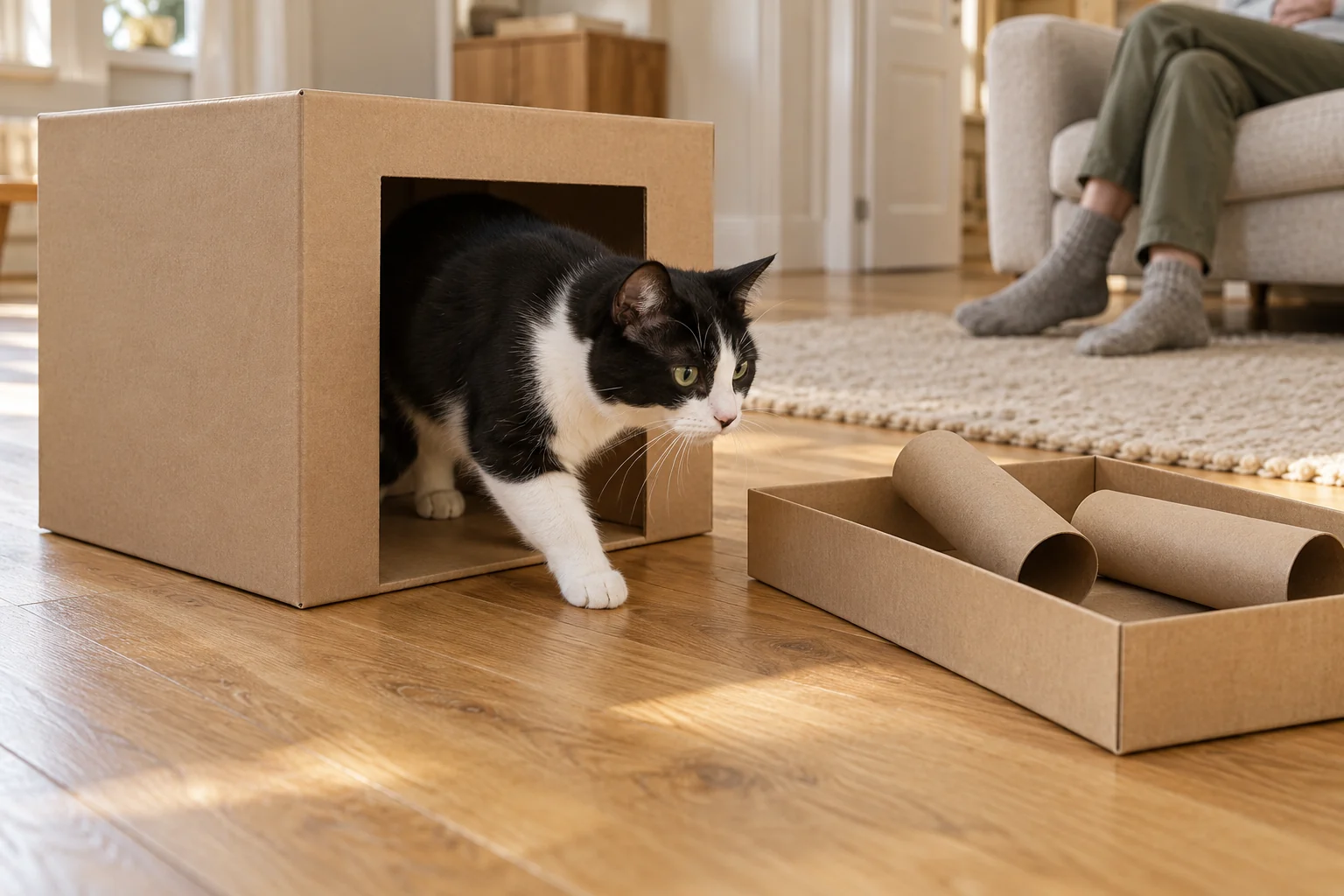
Choose a clean, dry box large enough for the cat to enter and turn without getting wedged. Remove staples, loose tape, plastic handles, packing material and dangling labels. Cut smooth, generous openings and inspect the edges. A second exit can be useful where another pet might occupy the first approach.
Put it on the floor in a calm part of the room. Avoid unstable stacks, high shelves or a narrow space where it could collapse around the cat. Leave it empty initially; a familiar folded cloth may help a cat that likes soft resting surfaces. Do not force the cat into it or tip the box during play.
Inspect it after use. Replace damp, chewed or collapsing cardboard. If your cat eats pieces, choose another form of enrichment and ask your vet about persistent chewing or ingestion. A homemade item can be inexpensive while still needing daily judgement.
Use short games with a clear finish
Try a few brief sessions at times your cat is naturally alert. Move a suitable toy away from the cat along the floor, pause behind a safe obstacle and allow stalking and catching. Constant waving in the cat’s face gives less choice than a toy that moves like something to follow.
Let the cat catch the toy regularly. Finish before enthusiasm becomes frustration or overexcitement, then put the toy away. Keep hands and feet out of the game. For cats that prefer slower play, use short movements close to the ground with longer pauses.
String, ribbon, elastic, feathers and small attachments need close supervision and secure storage afterwards. A wand toy left out is not automatically safe because it was sold for cats. Inspect attachments and retire damaged toys. Choose a larger simple toy instead if your cat tries to swallow loose parts.
Turn a little normal food into a search
For a cat on a suitable dry-food plan, begin with a few pieces placed visibly on a clean shallow tray. Once finding them is easy, spread them between two or three accessible places in the same room. Keep them away from litter, household chemicals and areas the cat should not investigate.
Make the first version almost effortless. Empty large cardboard tubes can be placed on their sides in a shallow tray, with food near the open end rather than pushed into a difficult recess. Supervise, keep pieces large enough not to become swallowed objects, and abandon the setup if the cat chews the cardboard instead of searching.
Do not move all food into a puzzle at once. Maintain an easy feeding option while the cat learns. Use measured food from the daily allowance, and account for any treats. For wet food, use a purpose-designed food-safe surface that can be cleaned promptly; damp cardboard is a poor reusable feeding tool.
When a reusable puzzle earns its place
The Catit Senses Digger is a useful next step for a cat that already enjoys retrieving visible dry food. The removable tubes allow a straightforward introduction, but the cat still needs to learn the action. Begin with the easiest access and keep the device steady.
Paw-based puzzle
Catit Senses 2.0 Digger
Five removable tubes hold dry treats or kibble for your cat to retrieve with a paw. Begin with an easy-to-reach reward and watch whether the activity appeals before making it more challenging.
Check: Treats still count towards the normal feeding plan
View on Amazon ↗Use it for a small part of a meal initially. Watch whether your cat can retrieve food calmly; repeated batting without success means the challenge needs simplifying. The goal is an achievable activity, not keeping a hungry cat occupied for the longest possible time. Our beginner puzzle feeder guide compares other mechanisms and ways to introduce them.
Choose one puzzle before buying several. A familiar device used in an interesting routine can provide more value than a cupboard full of increasingly difficult ones. Wash food-contact parts according to the instructions and let them dry before refilling.
Add a useful scratching outlet
Scratching is an everyday need, so prioritise a suitable surface if one is missing. A cat that scratches rugs may appreciate a horizontal cardboard pad. A cat reaching up a doorframe may need a stable tall post instead. Material and scratching direction both affect the choice.
The linked Amazon Basics pack contains two compact curved cardboard pads. Their relatively small size is a reason to check your cat’s full scratching movement, rather than assuming every pad fits every cat. Place a pad where it cannot skate across a smooth floor.
Floor-level option
Amazon Basics curved cardboard scratch pads, 2 pack
Two curved, double-sided cardboard pads for a cat that prefers scratching near floor level. The separate pads also let you offer a surface in two places without buying two large pieces of furniture.
Check: Cardboard wears and can shed pieces
View on Amazon ↗Cardboard produces debris and wears out. Include replacement in the long-term decision instead of treating the first purchase as the total cost. For a larger horizontal surface, compare our horizontal scratcher guide. The sisal versus cardboard comparison explains when a different material or posture is worth trying.
Improve a lookout without building an obstacle course
A wide, stable piece of furniture can provide a view if the approach and landing are safe. Clear breakable objects and remove access to blind cords, open windows, hot surfaces and toxic plants. Do not create a path across furniture that tips or slides when jumped on.
Low-cost does not mean improvising structural fixings. A shelf intended to bear a cat’s moving weight needs suitable support and installation. If that is outside the budget, offer a safe lower viewpoint and a quiet floor hide while you plan a secure option.
Give the cat a way down that matches their ability. A resting place loses much of its value if another pet can block the only route. In a shared home, provide more than one usable spot in separate locations. Our cat-tree placement guide applies the same route-planning principles to bought furniture.
Build a small routine you can keep
Try a simple sequence: a brief game before breakfast, a small easy food search later, then quiet time in the preferred resting area. The next day, change the search location or bring out a different safe toy. Keep the cat’s familiar essentials available throughout.
| Time or opportunity | A simple option | What to watch |
|---|---|---|
| When the cat is alert | Short interactive chase and catch | Engagement without panting or frustration |
| Part of a normal meal | Easy tray search or beginner puzzle | Food can be retrieved comfortably |
| Quiet afternoon | Hiding box or safe lookout | The cat can leave and rest undisturbed |
| Before tidying up | Inspect and store loose toys | No string or damaged parts left out |
Treat this as a menu, not a compulsory timetable. A sleeping cat does not need waking for enrichment. A cat that declines one activity may enjoy a different texture, location or level of difficulty.
Decide whether an idea is worth keeping
Keep a simple note of what is used, what needs supervision and what is difficult to clean. An activity earns its place when the cat chooses it and you can maintain it safely. Remove items that repeatedly frustrate, frighten or clutter the route through the room.
Spend next on the clearest remaining gap. That may be a better scratcher, a washable food puzzle or no new product at all. A well-placed box and a reliable play routine can remain part of a good indoor environment alongside carefully chosen equipment.
For a manageable ongoing selection, see how to rotate cat toys. Keep long lines and wand toys for supervised play.
For a reusable alternative, compare play tracks with treat balls by the action your cat enjoys. Neither needs adding if an existing safe activity already fills that role.
Frequently asked questions
Can cardboard boxes replace bought cat toys?
They can provide useful hiding and exploration, but they do not cover every need. Use clean, sturdy boxes without staples, handles, tape loops or loose pieces, and supervise new setups. Your cat still needs scratching outlets, interaction, comfortable rest and access to separate essential resources.
How often should I rotate enrichment activities?
Use your cat’s response rather than a rigid calendar. Put away a safe toy when interest fades and bring it back later, while leaving familiar resting places and essential resources available. Change one activity at a time so you can see whether the new arrangement is enjoyable or unsettling.
Should I add extra treats for food puzzles?
Usually use a portion of food already allowed in the daily feeding plan. Extra puzzle rewards can quietly add up. If your cat has a prescribed diet or you are unsure about portions, ask your vet how enrichment can fit the existing plan. Never withhold normal food to force puzzle use.
Is a window perch enough enrichment for an indoor cat?
A safe lookout is one useful choice, but it does not replace play, hiding, scratching and food-related activity. Some cats find unfamiliar cats outside unsettling, so watch the response. Use a secure window arrangement and give your cat another resting place away from the view.
What should I buy first on a limited budget?
Buy for the missing behaviour. A stable scratcher is useful if there is no suitable scratching surface; a reusable beginner food puzzle may help if simple food searches are enjoyed. Try the free version first where safe, and avoid buying several similar items before knowing what your cat uses.