
Practical guide · Play & enrichment
How to use a cat wand toy safely
Plan supervised wand play with safe floor movement, regular catches, equipment checks and secure storage. Adapt the game to your cat’s movement and confidence.
The short answer
Supervise, allow catches and store the whole toy
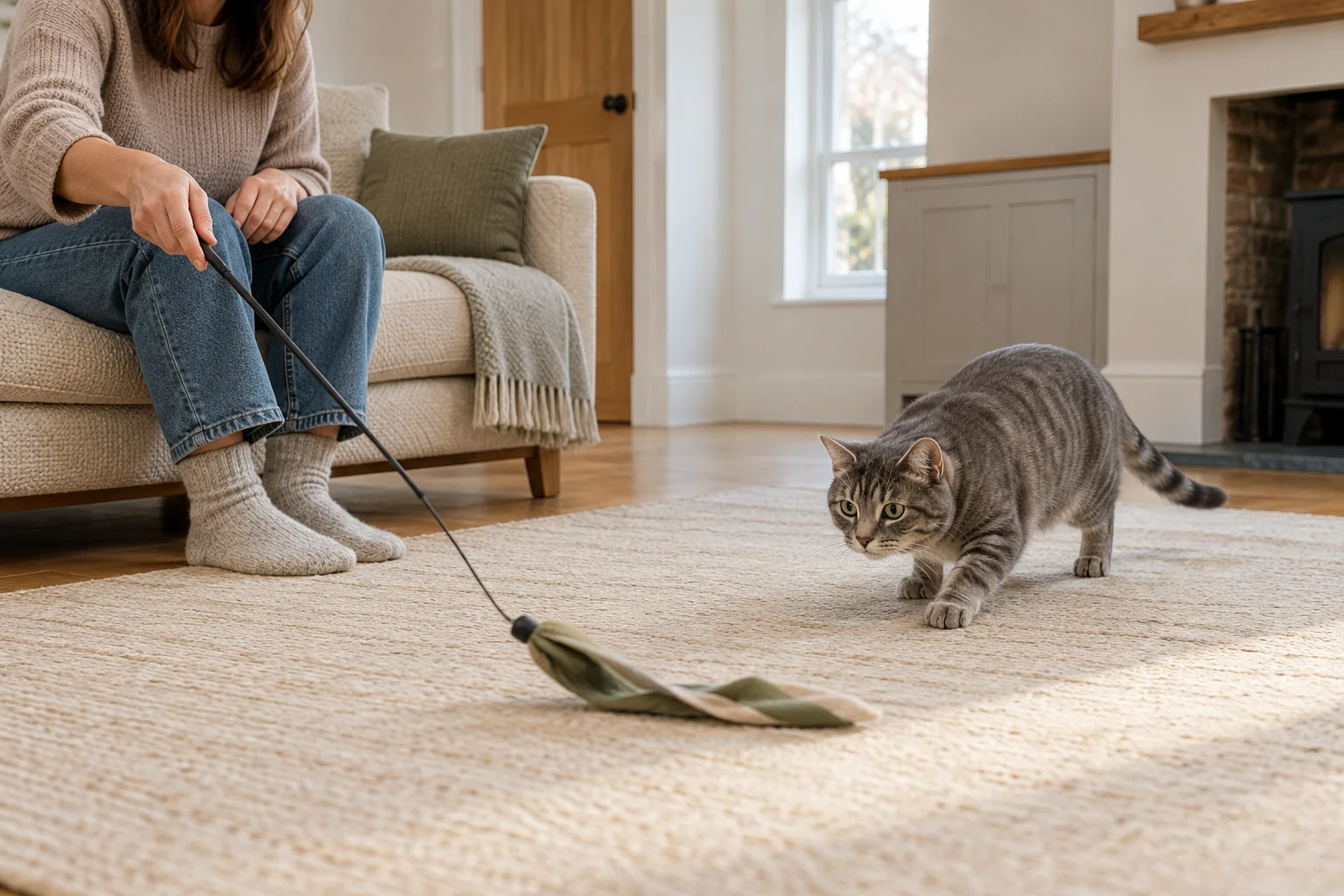
Use a wand only with a person actively supervising. Inspect the handle, line, lure and attachments, clear the floor, then move the lure away from the cat with pauses and regular chances to catch it. Keep movements within the cat’s ability, avoid pulling against teeth or claws, and put the entire toy securely away when the game ends.
A wand gives you control over a moving lure, which can make stalking and catching more interesting than a toy lying still. That control also brings responsibility: the movement, line position and end of the game all depend on the person holding it.
Safe play is less about spectacular jumps and more about a manageable sequence the cat can follow and finish. This guide covers supervised floor play, equipment checks and storage. The toy-rotation guide explains how wands fit into a wider routine without becoming unattended toys.
Inspect the entire toy before each game
Look along the handle, line or fabric strip and the lure attachment. Check for cracks, loose clips, lifting glue, frayed sections and small pieces that could detach. A toy that was sound yesterday may have been damaged during the last catch.
Follow the maker’s age, use and replacement guidance, but do not treat broad marketing language as permission to leave the toy accessible. The cat’s actual chewing and gripping behaviour matters. Remove a suspect toy from the play selection immediately.
Keep replacement lures compatible with the particular wand and connector. A similar-looking clip is not proof of a secure connection. Do not use loose household ribbon, elastic bands or improvised sharp fasteners to keep a broken toy in service.
Prepare a clear play area
Choose a stable floor surface with space for approaching, turning and stopping. Move breakable objects and avoid slippery sections, stair edges, hot surfaces and furniture that can roll. Keep doors from opening suddenly into the game.
Do not encourage a leap towards a window, narrow shelf or unsteady table. The cat should have a usable landing area, not merely enough space to launch. For cats with reduced mobility, keep the game low and easy rather than using high movement as a measure of success.
Arrange other pets so they do not crowd the same lure. One-to-one play can help a cautious cat take part without being overtaken. Children need close adult supervision and a simple explanation that the toy should move away from the cat, not wrap around it.
Move like something to follow
Begin with slow movement along the floor, away from the cat. Pause and let the cat watch, stalk or choose an approach. A lure that disappears briefly behind a safe low obstacle can be interesting without needing speed or height.
Avoid repeatedly tapping the cat’s face or pushing the toy towards their body. Keep the line clear of legs, tail and neck. Do not draw circles around the cat or leave a loop where they can step into it.
Cats Protection’s play advice supports games that allow stalking, chasing, pouncing and catching, with regular opportunities to capture the toy. Watching and waiting can be part of the game, so you do not need to keep the lure moving continuously.
Give the cat regular achievable catches
Let the lure come to rest within reach. Once the cat catches it, reduce the tension and pause. Do not pull hard against teeth, hooked claws or a held fabric strip to restart the chase.
Wait for release and resume gently if the cat remains interested. If they hold and chew the lure rather than releasing it, stop the activity and choose another suitable game. Protect fingers by keeping them away from the cat’s mouth and the caught end.
Never use the cat’s grip to lift, drag or pull them across the floor. The toy is for following and catching, not tugging against body weight. An exciting game does not need to become a contest over the object.
A simple fabric-lure example
The Cat Dancer Cat Charmer has a polycarbonate wand and a colourful fabric strip. It provides hand-controlled movement without an app or motor, and the supplied colour varies. The strip still needs the same close inspection and supervised use as other long flexible lures.
For interactive play
Cat Dancer Cat Charmer wand
A hand-held polycarbonate wand with a colourful fabric strip for interactive chase-and-catch games. The supplied colour varies; keep the whole toy for supervised use and store it securely afterwards.
Check: Fabric can be chewed or swallowed; supervise closely
View on Amazon ↗The maker’s Cat Charmer information describes a polycarbonate wand with a fabric strip. If your cat persistently chews the fabric, stop using the lure and choose an activity they can enjoy without chewing or swallowing pieces.
Keep the whole wand with its instructions and inspect the attachment after catches. Do not shorten or knot the strip as an improvised repair unless the maker explicitly supports the change. A damaged inexpensive toy can be retired without turning it into a fitting experiment.
Use a tunnel as a separate approach choice
A suitable tunnel can give the cat a place to watch and emerge during a game. Keep exits clear and move the lure outside the opening rather than threading the line through the tunnel around the cat.
The TRIXIE short tunnel is a compact example, listed at 50 cm long and 25 cm in diameter. Check that the actual opening suits your cat and that the structure stays secure in the chosen position.
Short play tunnel
TRIXIE short playing tunnel, assorted colours
A short 50 cm play tube with a listed 25 cm diameter and rustling material. A simpler layout than a long tunnel, provided the openings fit the cat.
Check: Rustling is not suitable for every cat
View on Amazon ↗Inspect supports and seams and remove loose attachments requiring supervision when play ends. A tunnel does not make a cord safe to leave behind. Our home tunnel guide compares larger and smaller arrangements.
Adapt to age, confidence and movement
An older cat may enjoy a short slow chase close to the floor, while a younger cat may seek more movement. Use the individual response rather than assigning a fixed exercise target by age. The same cat can also prefer a different pace on another day.
Give hesitant cats pauses and distance. A cat that hides from the lure or repeatedly retreats needs an easier approach, not faster waving. A cat that redirects play towards hands may benefit from the toy being kept farther from the body and a calmer ending.
For new difficulty jumping, unusual fatigue, discomfort or a sudden change in normal activity, speak with your vet. Adjusting the game can keep choices manageable, but it should not be used to dismiss a change in health or mobility.
Finish before it becomes frantic
Make the final catch achievable and bring movement to a calm stop. Allow the cat to disengage without immediately teasing the lure away again. A few brief games can fit daily life better than one prolonged session that becomes frustrating.
Inspect the toy after use and remove loose debris. If a piece is missing and ingestion is possible, contact your vet rather than waiting for the next game. Keep the product information available so you can describe what may be involved.
Do not use fingers or feet as the substitute prey once the wand is put away. Offer a different suitable activity or quiet rest. The budget enrichment guide includes easy choices beyond chase games.
Store the whole toy beyond reach
Use a secure closed cupboard or container, with the complete line and lure inside. Hanging the handle high can leave the interesting end reachable from a sofa or cat tree. Check storage from the cat’s climbing routes, not just from standing height.
Keep wet or dirty parts separate until cleaned by their permitted method and fully dry. Put damaged items somewhere they cannot be mistaken for the next usable toy. Agree the storage routine with everyone who plays with the cat.
Use a five-point start-and-finish check
Wand play checklist
0 of 5 checks complete.
A useful wand game gives the cat choice and achievable movement. Equipment checks and secure storage are part of that same routine, rather than jobs left until something breaks.
If a lure needs replacement, compare wands with supported attachments and check the complete rod, cord and connector first.
Frequently asked questions
Can I leave a cat wand hanging up for solo play?
No. A reachable line or fabric strip can be chewed, swallowed or become tangled even when the handle is out of reach. Store the whole toy in a secure closed place after the game. A wand attached to furniture is not a substitute for active supervision.
Should I let my cat catch the lure?
Yes, provide regular achievable catches rather than making the toy permanently impossible to reach. Reduce movement and tension when the cat catches it. Do not yank against teeth or claws; pause and wait for release, and end the game if the cat begins chewing pieces off.
Is a fabric-strip wand safe because it has no separate string?
It still needs supervision. A long strip can be chewed, swallowed or tangled, and attachments can wear. Inspect the exact toy and stop if the cat is trying to ingest it. A different construction does not make a toy suitable for unattended use.
How long should a wand game last?
Use a short session that suits the individual cat’s interest and movement. Brief games can be enough; there is no compulsory duration or jump count. Offer breaks and stop if the cat appears distressed or uncomfortable. A marked change in exercise tolerance needs veterinary advice.
What should I do if part of the toy is missing?
Stop play and check the toy and surrounding area. If swallowing is possible or the cat is unwell, contact your vet promptly and describe the material and missing part. Do not continue the game or assume a small piece is harmless because it came from a pet toy.