
Practical guide · Scratching posts & pads
Sisal versus cardboard cat scratchers
Compare woven sisal, sisal rope and corrugated cardboard by scratching direction, stability, wear and replacement. Use your cat’s existing habits to choose.
The short answer
Compare posture and stability before fibre
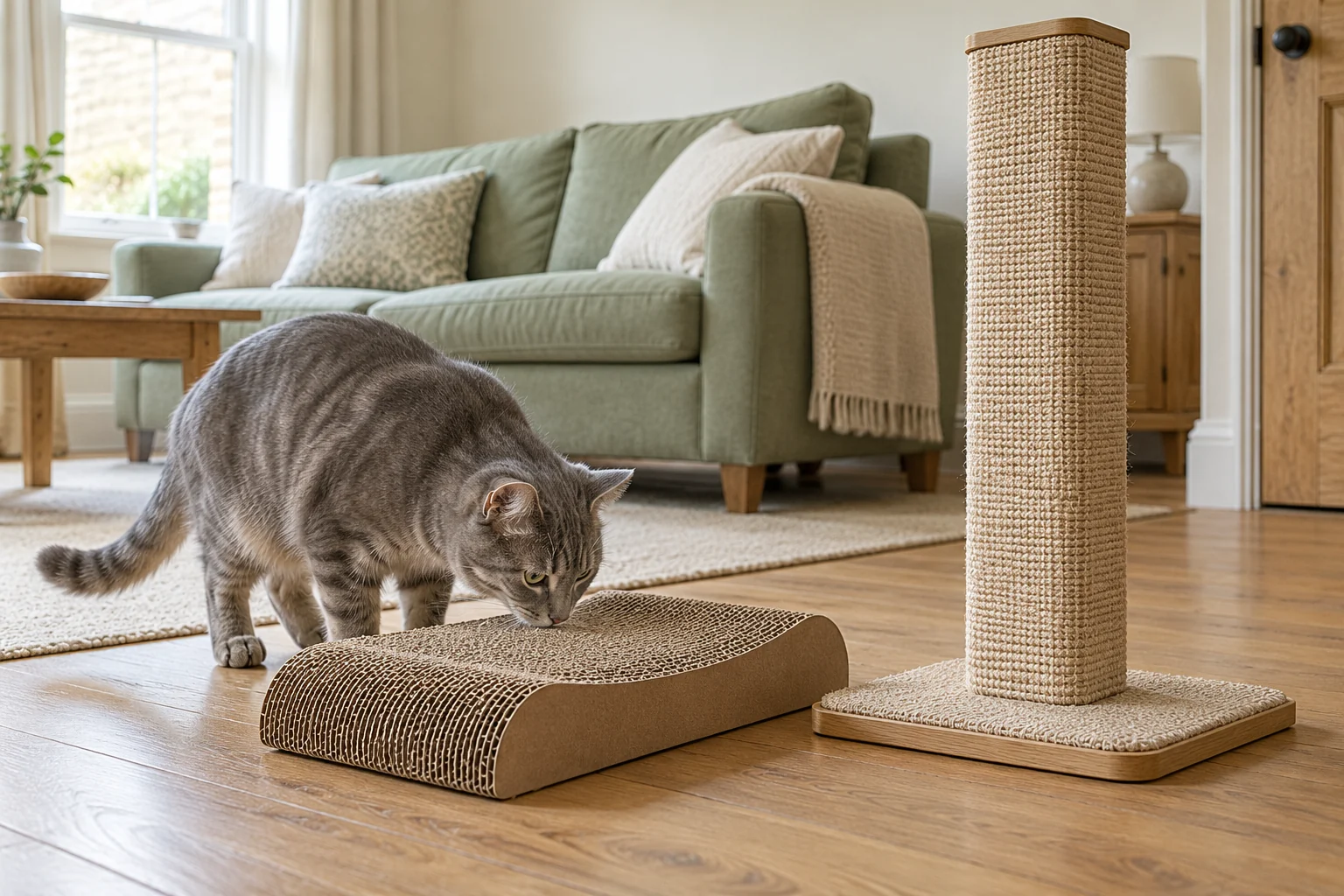
Neither material is best for every cat. Choose the scratching direction and a stable usable surface first, then compare woven sisal, sisal rope and corrugated cardboard. Sisal can suit a substantial upright post; cardboard offers useful horizontal options with more visible debris and replacement. If your cat uses both postures, offering both can be more helpful than forcing one material.
A scratcher can fail for reasons that have little to do with its fibre. A lightweight post may wobble; a small pad may slide; a good surface may be hidden behind a door. Before replacing cardboard with sisal or vice versa, watch how and where your cat scratches.
This comparison separates material from posture. It also distinguishes tightly woven sisal from rope-wrapped posts, since the two often get grouped together in shopping results. For product shortlists afterwards, see our tall scratching posts and horizontal scratchers.
Start with the scratching movement
Watch a normal scratch without interrupting. Does the cat reach up with a long stretch, pull down a surface at an angle or work forward along the floor? Note the height or length used and whether the surface stays still under pressure.
Cats Protection explains that scratching supports claw care and communication. It recommends a stable base, enough height for a full stretch and a horizontal alternative for cats that scratch carpets or stairs. The scratching outlet should serve that movement rather than merely matching the room’s decor.
A cat may use more than one posture. An upright post beside a sleeping area and a horizontal pad near a rug can provide different choices. You do not have to prove one material is universally superior before offering a useful second surface.
What woven sisal offers
Woven sisal forms a continuous textured panel over a structure. The surface does not have the same spiral gaps as rope wrapped around a cylinder. Look for a securely attached panel and edges that cannot lift into loose loops.
The SmartCat Ultimate uses woven sisal on a substantial upright structure. Its 81 cm overall height and 41 cm square base make it a candidate for a cat that likes reaching up, but overall height is not a promise that every centimetre is usable scratching surface. Check the cat’s stretch and the position of the base and top.
Upright scratching
SmartCat Ultimate scratching post, grey
A tall, straightforward post with a woven sisal surface and a broad square base. It is a useful option for a cat that chooses upright scratching and needs room to stretch, without adding a whole climbing tower.
Check: Needs assembly and a flat, steady position
View on Amazon ↗It takes more standing floor space than a slim cardboard pad and should be placed where the cat will actually scratch. The woven surface is a reason to compare texture, not a guarantee that every cat will prefer it. Allow voluntary investigation without pushing paws onto the panel.
What rope-wrapped sisal changes
Sisal rope is wound around a post, creating a ridged surface. Check the winding for secure attachment and inspect where the rope begins and ends. Loose strands can appear with use; the important question is whether they remain safely attached and the underlying structure stays sound.
A narrow post and a broad post can feel quite different even when both use sisal rope. Diameter changes the shape the cat grips, while the base determines how much the structure moves. Do not compare only the word “sisal” across listings.
The Kerbl Opal Maxi provides a rope-wrapped upright option at around 78 cm overall height. It is useful here as a material contrast to woven sisal, rather than a claim that a slightly shorter post suits every large cat.
Slimmer sisal post
Kerbl Opal Maxi scratching post, grey
A 78 cm single post with glued natural sisal rope and a carpet-covered base. It is the narrower-column comparison for a smaller or medium-sized cat that prefers a rope-wrapped upright surface.
Check: Overall height includes the base and top
View on Amazon ↗A jute-wrapped post is a separate material choice. Several natural-looking scratchers use jute, including some products elsewhere in our guides. Colour and a rope-like appearance do not make those products sisal; read the actual fibre specification.
What corrugated cardboard offers
Corrugated scratchers expose the layered cardboard edge as a working surface. Many are low pads or lounges, although cardboard is not inherently limited to horizontal use. Shape, orientation and support remain separate from the material itself.
The Amazon Basics curved pads are a compact horizontal example. The linked pack has two pads measuring about 41.9 × 20.6 × 4.1 cm each. That size is convenient in a modest room, but check whether the cat can make a comfortable full movement without running off the end.
Floor-level option
Amazon Basics curved cardboard scratch pads, 2 pack
Two curved, double-sided cardboard pads for a cat that prefers scratching near floor level. The separate pads also let you offer a surface in two places without buying two large pieces of furniture.
Check: Cardboard wears and can shed pieces
View on Amazon ↗Expect loose cardboard fragments as the surface is used. Put it somewhere you can vacuum easily and check it regularly for dampness or collapsing sections. Do not wash a cardboard pad as though it were a fabric post cover. Replace it when the usable structure is no longer sound.
Compare the practical trade-offs
| Decision | Woven sisal | Sisal rope | Corrugated cardboard |
|---|---|---|---|
| Surface form | Textured continuous panel | Rope wound around a structure | Exposed layered edges |
| Common shape | Upright post or panel | Upright post or tree column | Flat pad or shaped lounge |
| Main inspection | Panel edges and attachment | Loose winding, ends and fixings | Dampness, loose pieces and collapse |
| Cleaning approach | Follow the product’s surface-care instructions | Follow the product’s surface-care instructions | Dry debris removal; replace worn board |
| Space and stability | Depends on supporting structure | Depends on base and post | Needs enough usable length and grip |
These are tendencies, not rules about what every cat likes. A well-supported cardboard lounge can be more useful than a poor upright post, and a stable sisal post can remain valuable alongside a favourite pad.
Test the support before blaming the material
A scratcher should stay secure under the movement it is designed for. Assemble posts fully and inspect the join between post and base. Keep a tall scratcher on a level surface, and follow any fixing requirements rather than balancing it against furniture.
For a floor pad, watch for sliding. Use a suitable secure arrangement that does not introduce a curled mat or loose backing the cat can chew. A pad wedged into a doorway may be stable but still create a trip hazard or block an escape route.
Surface size matters too. A large cat trying to stretch on a tiny pad may appear to dislike cardboard when the real problem is length. An upright post that is too short can create the same misleading impression about sisal.
Offer the surface where the habit happens
Put an alternative beside the existing scratching spot or near a favourite bed, with room for the cat’s body. Do not expect a hidden post in the spare room to replace scratching beside the sofa. Our scratching-post placement guide covers gradual moves after a surface becomes established.
Avoid changing material, location and scratching direction all at once if you want to understand the preference. Try a new horizontal surface near the familiar horizontal habit, or a different upright texture beside the existing post. Keep the old safe option while you observe.
Praise or reward voluntary use. Do not grab paws and rake them down the surface. If scratching becomes widespread around doors and windows or occurs alongside tension between cats, consider the wider environment and seek qualified help where needed. A different fibre cannot resolve every source of insecurity.
Think about replacement and household upkeep
Purchase cost is only part of the decision. A cardboard pad that is regularly used may need replacement sooner than an unused sisal post, but that does not make the unused post better value. Compare the useful life, cleaning effort and your cat’s actual preference.
Keep manufacturer replacement parts in mind for substantial furniture. A replaceable mat or column can be useful when the rest of the structure remains sound. Check exact compatibility rather than buying rope or panels that merely look similar.
For disposal, follow local recycling guidance and consider the whole product, including glue, plastic, fabric and attached toys. Avoid broad claims that all cardboard scratchers can be recycled in the same way or that every natural fibre is automatically the most sustainable choice.
Make the choice in a sensible order
First match posture and surface size. Then secure the structure and place it beside the relevant habit. Finally, compare the textures and keep the one the cat chooses, or retain both if they serve different purposes.
If replacing a favourite worn surface, leave a safe familiar option available during the transition. Do not remove every scent-marked scratcher at once simply to make the room look new. A practical scratching setup is one the cat can find, use comfortably and return to every day.
If cardboard is the preferred surface but the cat pulls along an incline, compare angled cat scratchers for working slope and floor grip. Material and scratching direction are separate choices.
Frequently asked questions
Is woven sisal the same as sisal rope?
No. Woven sisal is a fabric-like panel, while sisal rope is wound around a structure. Their surfaces and wear patterns differ. A product described as natural fibre may also use jute rather than sisal, so check the exact material instead of relying on colour or appearance.
Does cardboard make cats scratch cardboard boxes and furniture?
A suitable cardboard scratcher provides an outlet, but it does not guarantee a change in furniture scratching. Position, posture, stability and the reason for scratching all matter. Offer the scratcher near the existing habit and reward voluntary use rather than punishing the cat.
Should I replace a scratcher as soon as it looks worn?
Some visible wear is normal. Replace or repair according to the maker’s guidance when there are loose loops, exposed fixings, unstable parts, damp cardboard or areas breaking apart. Do not discard an otherwise safe familiar surface solely because it no longer looks new.
Can I re-rope a sisal post myself?
Only when the structure is sound and you can restore it safely with suitable materials and secure hidden fixings. Follow the manufacturer’s guidance and inspect the full result. If a post is unstable or the repair would leave exposed staples, adhesive or loose loops, replace it instead.
Is cardboard suitable if my cat eats it?
Stop using a scratcher that the cat is ingesting rather than simply scratching, and discuss persistent chewing or swallowing with your vet. Supervise new materials and remove loose pieces. A different scratching surface may be needed, but changing material does not explain the underlying behaviour.