
Buying guide · Litter & cleaning
Best stainless-steel litter trays
Compare stainless-steel litter pans by usable floor, entry height, handling and care. Avoid choosing a tray by its material or XL label alone.
The short answer
Choose around the way your cat uses it
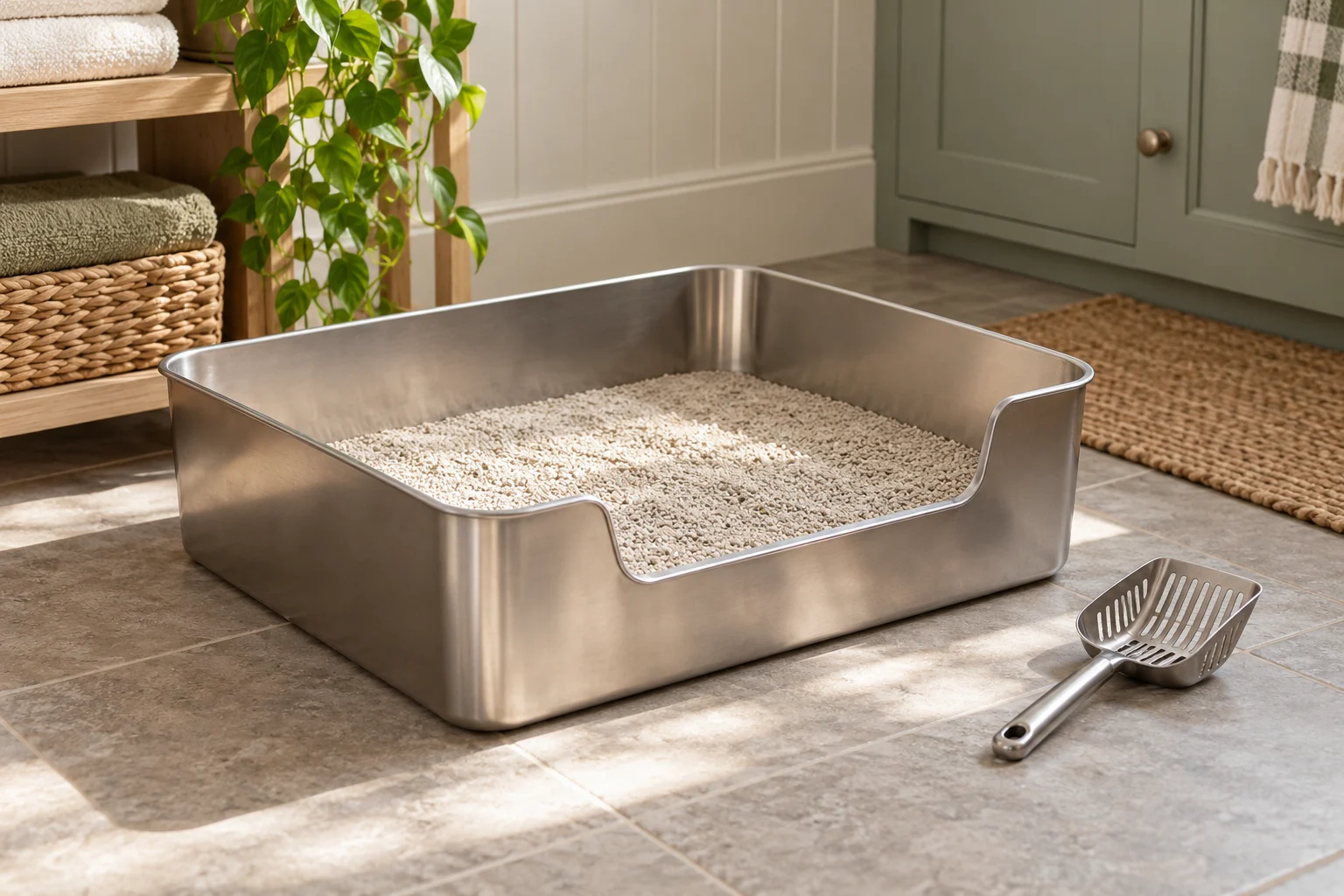
Choose a stainless-steel tray only after its usable floor and entry suit your cat. The selected Petslucent pan is about 50 × 35 × 15 cm outside; Suhaco’s selected version is 60 × 40 × 15 cm. Both require a full step over a 15 cm wall. Steel can offer a simple smooth shell, but it is not automatically large enough, scratchproof, odour-free or easier for every cat to enter.
Compare the options
| Option | Outside dimensions | Useful distinction | Main limitation |
|---|---|---|---|
| Petslucent open pan | Approx. 50 × 35 × 15 cm | Simple smaller outline | May be too small for an adult cat |
| Suhaco open pan | 60 × 40 × 15 cm | Longer and wider outline | Full-height entry; confirm internal base |
A stainless-steel litter tray can appeal when you want a plain smooth pan with few joints to dismantle. It still has to do the same basic job as any tray: give the cat enough room to turn, dig and toilet with comfortable access.
This guide compares two open steel pans with different floor outlines and the same listed wall height. It does not treat every product described as XL as suitable for a large cat, or repeat claims that metal never smells, scratches or needs proper cleaning.
Cats Protection’s toileting guide covers the wider tray, location and cleaning decisions. Use that context alongside the pan’s dimensions; a change to steel does not resolve unsuitable access or placement.
Check usable floor before changing material
Start with your cat’s body length from nose to the base of the tail and its normal movement in the tray. Use the litter-tray sizing guide to compare a sensible starting footprint, then confirm the actual internal floor of the exact product.
Outside rim measurements include wall thickness, rolled edges and any sloping sides. A pan advertised as 50 cm long can have less room at the bottom, exactly where the cat stands. Ask for base measurements if the listing does not provide them.
Do not downsize to obtain a preferred material. A roomy plastic tray can be a better choice than a steel pan that restricts normal turning. Our large open-tray comparison gives alternatives when the steel sizes here are not suitable.
For a simple smaller outline: Petslucent 50 cm pan
Petslucent stainless-steel litter pan, 50 × 35 × 15 cm
Best for: A simple pan where the usable floor fits
A plain open metal pan with rounded edges and an approximately 15 cm high rim. Its simple shell avoids a separate hood, but the outside 50 × 35 cm dimensions may be too restrictive for a larger adult cat.
What stands out
- Few joints to dismantle
- Open view and straightforward shell
Keep in mind
- No lowered entrance
- XL wording does not establish a large enough floor
- Approx. 50 × 35 × 15 cm outside
- SUS 304 steel claimed in brand listing
- Open top; rounded corners
The selected Petslucent pan is listed at approximately 50 × 35 × 15 cm outside. It is a plain open design with rounded corners and no separate hood or raised plastic enclosure to remove during cleaning.
The straightforward shell is the useful feature; the XL wording in its listing is not a sizing recommendation. For many larger adult cats, this footprint may be too restrictive. Compare the internal base with the cat’s existing successful tray before switching.
The brand listing describes SUS 304 stainless steel. That is a material claim for this offer, not evidence that the pan is immune to scratching, corrosion or inappropriate cleaners. Check the supplied care instructions, inspect edges and retire any unit that becomes sharp, unstable or damaged.
For more outside floor area: Suhaco 60 cm pan
Suhaco stainless-steel litter pan, 60 × 40 × 15 cm
Best for: More floor area in a simple open pan
A longer open steel pan with the same listed 15 cm rim height as the smaller Petslucent option. It provides more outside floor area, although the usable base is smaller than the outer rim and entry remains a full step over the wall.
What stands out
- More outside floor area than the 50 cm pan
- No hood or rim assembly to dismantle
Keep in mind
- No lowered entrance
- Check inside floor and comfortable step height
- 60 × 40 × 15 cm listed outside size
- Stainless-steel open pan
- Selected 15 cm rim version
The selected Suhaco version is 60 × 40 × 15 cm outside. Its longer and wider outline provides more starting space than the Petslucent pan, while retaining a plain open format without a hood.
Confirm the selected height before ordering. The Suhaco listing family includes 10, 15 and 20 cm versions; this recommendation and its link are for the 15 cm version. Photographs of a different height do not establish the entry of the item in your basket.
More floor area does not mean comfortable access for every cat. Both options in this comparison require stepping over a full wall. If a cat hesitates at the entrance, choose around its access needs rather than assuming an open top solves the problem.
Separate outside area, inside area and wall height
| Measurement | Petslucent selected pan | Suhaco selected pan |
|---|---|---|
| Listed outside length | About 50 cm | 60 cm |
| Listed outside width | About 35 cm | 40 cm |
| Listed wall height | About 15 cm | 15 cm |
| Lowered doorway | None | None |
| Internal floor | Confirm before ordering | Confirm before ordering |
For illustration, a cat with a 40 cm nose-to-tail-base body length gives a rough 60 cm length starting point at one and a half times body length. A tray that measures 60 cm outside may still fall short inside. Treat that calculation as a reason to ask for measurements, not as proof the Suhaco fits.
A high litter fill reduces the remaining wall height above the litter and changes the step into and out of the tray. Follow the litter maker’s depth guidance and observe how the cat actually moves. Do not overfill to disguise a difficult entrance.
Assess grip, sound and lifting when the pan is filled
A smooth pan on a smooth floor can move. Check any feet or base treatment supplied with the exact version and test whether normal pressure makes it rock or slide. An appropriate stable mat can help, but it should not curl under the tray or obstruct the exit.
Metal can also sound different when claws or a scoop contact it. Introduce the new tray without immediately removing the established successful option. Keep the litter and general location familiar where possible so you can assess the change in tray itself.
Think about filled weight and handling. A wide metal pan with litter is awkward to lift through a narrow bathroom door. Plan a washing and emptying route without carrying a heavy open tray over food preparation surfaces or tipping it where litter can spill into drains.
Clean the surface without relying on marketing claims
Scoop routinely and wash using the permitted cleaner and method for the exact pan. Remove residue from rolled rims and corners as well as the main base, rinse as directed and dry before adding clean litter.
Avoid metal scouring tools, strong chemicals or mixed cleaning products unless the manufacturer explicitly permits them. Stainless steel is not a universal cleaning instruction. A rough scratch, damaged seam or sharp rolled edge can make an otherwise simple shell unpleasant to use.
Do not interpret non-stick or odour-free wording as a guarantee. Waste, residue and dirty litter still need removing. Sudden changes in toileting behaviour need veterinary advice; a material swap should not delay it.
Keep the whole toileting arrangement comfortable
Give the tray a quiet accessible position with an unobstructed approach. Do not force a larger pan into a cupboard that leaves the cat squeezed between the rim and a wall. The small-home placement guide covers access and separation from other resources.
A suitable litter mat and scoop can make daily care easier, but choose those after the tray fits. Low sides, a mat and steel material do not automatically combine into a comfortable arrangement.
Choose the 50 cm pan only when its usable base is appropriate. Choose the 60 cm Suhaco when the larger internal space and full-wall entry both work. If the cat needs more room or a lower doorway, choose a different tray rather than compromising the basic fit to obtain steel.
For the ongoing routine, use how to clean a litter tray to separate daily waste removal from a full wash.
Frequently asked questions
Is stainless steel better than plastic for a litter tray?
It offers a different cleaning surface and can avoid the worn plastic condition that prompts some owners to replace a tray. Size, entry and the cat’s preference still come first. Steel does not remove the need for regular scooping, washing or inspection, and it is not a guarantee against smells or damage.
Is a 60 cm steel tray large enough for a large cat?
Not necessarily. The 60 cm dimension is the outside length and the usable base will be smaller. Compare the internal floor with the cat’s nose-to-base-of-tail length and normal turning movement. Our sizing guide explains the commonly used starting point of roughly one and a half times body length.
Are these steel trays low entry?
Neither selected version has a lowered doorway; both list a 15 cm outer wall height. The comfortable step depends on the cat and litter depth, which also reduces wall height above the litter. Choose an appropriate low-entry design if stepping over the wall is difficult.
Can a metal litter tray go in the dishwasher?
Do not assume it can. Follow the exact manufacturer’s care instructions and consider where the tray will be washed hygienically. Rubber feet, coatings or added parts may have separate restrictions. A plain metal appearance does not establish a permitted cleaning temperature.
Will stainless steel stop litter tracking or urine going over the edge?
No. Tracking depends on litter, digging, exit route and the cat’s coat and paws. A 15 cm wall may not contain urine from a cat that stands high. Observe how the cat uses its existing tray and choose the overall arrangement rather than relying on the metal alone.