
Buying guide · Scratching posts & pads
Best angled cat scratchers
Compare inclined cardboard scratchers by slope, working surface, floor grip and replacement needs. Choose a ramp around the way your cat already scratches.
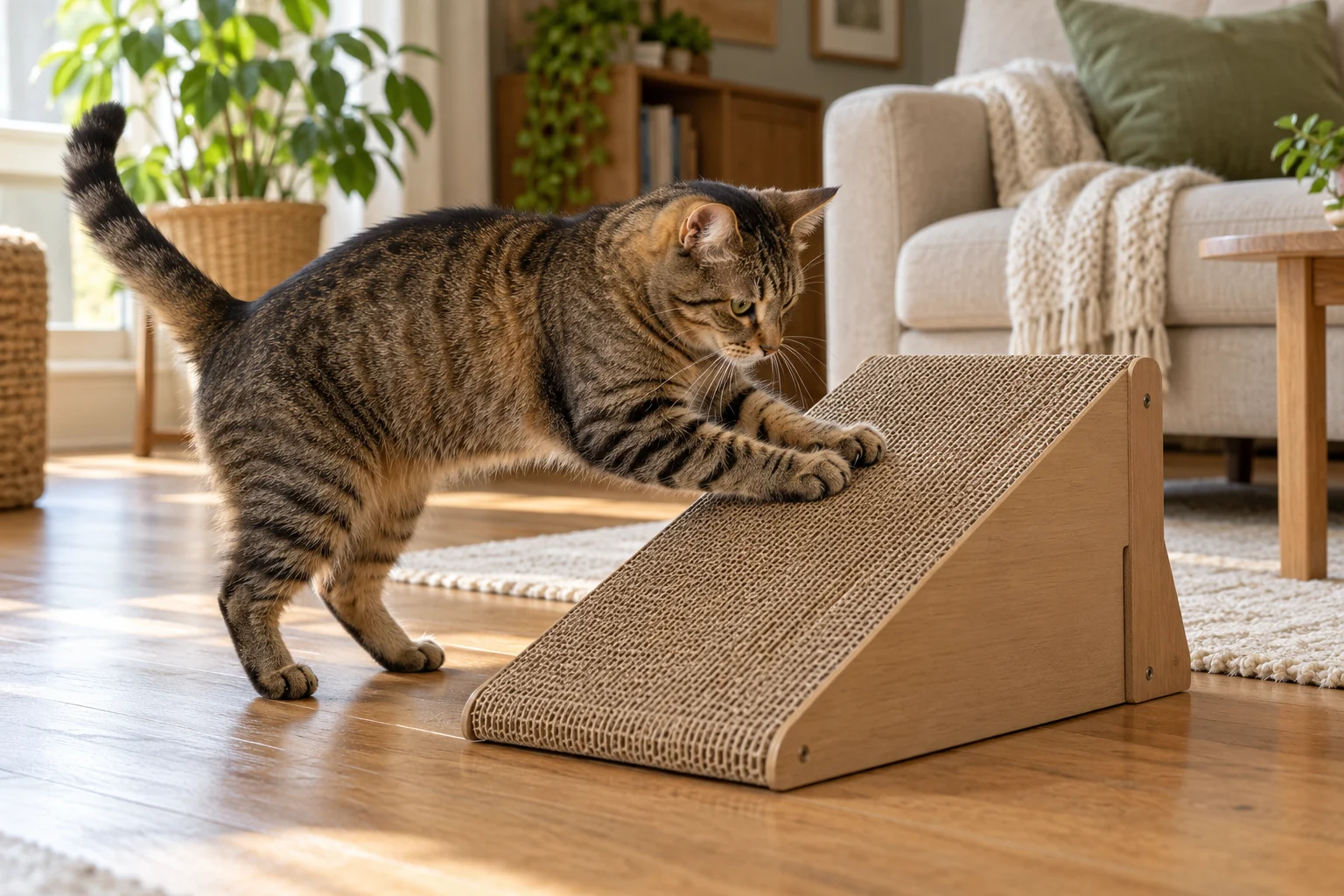
The short answer
Choose around the way your cat uses it
Choose an incline when your cat already seeks a sloping scratch or when you want to offer that choice alongside a horizontal pad and upright post. Compare the working surface and slope with the outside dimensions, then check that the ramp stays put. LIKEA provides a single cardboard incline; the Furjoy package offers two differently sized pieces. Neither is a permanent surface or a mobility ramp.
Compare the options
| Option | Format | Most useful distinction | Check before choosing |
|---|---|---|---|
| LIKEA incline | One body; approx. 45 × 25.4 × 19 cm | One simple sloping station | Working face and hollow opening |
| Furjoy two-in-one | 50 × 24 × 20 and 37 × 24 × 15 cm | Two differently sized pieces | Both surfaces and separate placement |
An angled cat scratcher sits between a floor pad and a tall upright post. Its sloping face offers a different direction to pull against, often with the cat’s back feet on the floor and forepaws higher up the board. That can be a useful choice, but it is not a universal upgrade.
This shortlist focuses on two cardboard incline formats rather than combining every L-shaped wall board under the same label. Choose by the surface your cat can use, the way the base behaves and the replacement routine you are happy to keep.
Start with the scratching movement you see
Watch where your cat places its paws during ordinary scratching. A cat that stretches against a sofa arm may want an upright surface; one that pulls at a sloping edge may investigate an incline. A cat that scratches a rug may be perfectly content with a stable horizontal pad.
Keep an established scratcher available while introducing a different orientation. Do not hold the cat’s paws against the new board. Place the incline near an existing scratching route or resting area with a clear approach, then watch what the cat chooses.
Our horizontal scratcher guide compares flat and curved floor options, while tall scratching posts address a full upright stretch. The decision here is whether a supported slope adds something useful.
For one straightforward incline: LIKEA
LIKEA inclined cardboard scratcher
Best for: A simple single cardboard incline
A single inclined cardboard ramp with a hollow centre. It offers a sloping working surface without a tall upright post; check usable width and floor grip before deciding it will suit your cat.
What stands out
- Low inclined scratching surface
- Simple one-piece format
Keep in mind
- Cardboard sheds and eventually needs replacing
- The cubby opening is not a guaranteed adult-cat resting space
- Approx. 45 × 25.4 × 19 cm outside
- Corrugated cardboard
- Hollow central opening
LIKEA’s listed outside size is 17.7 × 10 × 7.5 inches, approximately 45 × 25.4 × 19 cm. Its cardboard body forms an incline with a hollow centre. That gives you a simple single unit to place and move when cleaning around it.
The outside height does not tell you the precise working angle, and the overall length is not a measurement of uninterrupted scratchable face. Look closely at the chosen product’s side profile and ask for working-surface dimensions if your cat is large or has a long stretch.
Treat the hollow opening as a feature to assess, not as a guaranteed adult-cat bed. Check that a cat investigating it has enough room to enter and leave without squeezing. If enclosure is the actual goal, a correctly sized covered bed or cave is a more relevant comparison.
For a choice of two profiles: Furjoy two-in-one
Furjoy two-in-one inclined cardboard scratchers
Best for: Two incline sizes in one package
A larger inclined scratcher and a smaller companion piece, supplied with catnip and a ball feature. Use their different profiles to offer a choice of sloping surface rather than assuming both cats should share one spot.
What stands out
- Two differently sized scratching pieces
- Can offer more than one scratching location
Keep in mind
- Two pieces need more floor space when separated
- Inspect the ball feature and worn cardboard
- 50 × 24 × 20 cm larger piece
- 37 × 24 × 15 cm smaller piece
- Cardboard; ball feature and catnip
The selected Furjoy offer contains a larger piece listed at 50 × 24 × 20 cm and a smaller one at 37 × 24 × 15 cm. Two differently sized pieces let you compare how your cat uses each profile, or offer a scratching surface in more than one useful location.
Separate placement matters in a multi-cat home. Two pieces nested together do not create two independent scratching stations. Consider whether the smaller piece offers enough usable area for the intended cat rather than assuming every included component is equally suitable.
The package also describes catnip and a ball feature. Inspect the ball’s housing and any accessible fittings as well as the cardboard. Choose the scratcher for the working surface first; a toy does not compensate for a unit that slides during a forceful pull.
Read the dimensions in three different ways
| Measurement | What it tells you | What it does not establish |
|---|---|---|
| Outside length and height | Space occupied by the body | The exact usable slope or scratching reach |
| Outside width | Maximum side-to-side outline | Clear working width between edges or features |
| Scratching face | The surface the claws can engage | Whether the base grips your particular floor |
Measure the space beside the ramp too. The cat needs a stable stance and room to reposition. A unit squeezed against a chair leg may technically fit yet make the natural scratching movement awkward.
If a listing gives an angle, check what it measures. An internal joint angle and the slope relative to the floor are different quantities. Do not compare two bare degree figures without a clear diagram.
Check the floor contact before encouraging use
Place the scratcher on a level surface and follow the supplied orientation instructions. Test whether ordinary hand pressure makes it skid, rock or lift. A suitable stable mat underneath may help on some floors, provided it does not curl, trap paws or turn the incline into a rocking platform.
Do not prop a cardboard unit against furniture at a steeper angle unless the maker supports that arrangement. The shape and supporting edges are designed to work together. A loose wedge under the back changes the contact points and may make the whole structure less stable.
Keep a clear landing and standing area around the scratcher. Avoid positioning it where an opening door, passing feet or a vacuum cable repeatedly disturbs the cat. The scratching-post placement guide covers those room-level choices.
Expect cardboard wear and plan the replacement
Cardboard sheds as claws work through it. Remove loose pieces from the surrounding floor and inspect the body for crushed supports, loose seams and softened areas. Rotate or reverse the unit only in the ways its design permits; a fresh-looking underside is not automatically another supported scratching face.
A one-piece cardboard body is usually a whole-item replacement decision unless the exact model has a supported refill. Check refill availability before assuming a photograph of a removable-looking panel means that replacements exist.
Keep cardboard dry. Washing, steaming or spraying it heavily can soften the structural layers. If cleaning requirements favour a different material, compare the practical trade-offs in sisal versus cardboard scratchers.
Choose a useful addition to the scratching choices
Choose LIKEA when one compact incline fits the intended movement and location. Consider the Furjoy package when the two sizes are both useful and you can place them sensibly. Keep a flat pad or upright post if that remains the cat’s preferred way to scratch.
Reassess after ordinary use rather than moving the scratcher repeatedly within the same day. A cat may use a new surface briefly and return to a familiar one. If scratching changes suddenly or appears uncomfortable, seek veterinary advice rather than changing furniture until the behaviour stops.
Cats Protection’s scratching advice gives the behavioural context for providing a suitable scratching outlet. Choose an incline because its working position suits the cat, rather than expecting the shape alone to stop unwanted scratching.
Frequently asked questions
Is an angled scratcher better than a flat one?
It depends on the cat’s scratching preference. An incline changes body position and the direction of resistance; some cats prefer a flat pad or tall post. Offer a choice and watch voluntary use instead of assuming a steeper product is more effective.
What size inclined scratcher should I buy?
Compare the usable sloping surface with the cat’s normal scratching movement. Outside length, height and width do not describe uninterrupted working area. The cat also needs secure floor space for its hind paws and enough room to approach without squeezing past furniture.
Can an angled scratcher be used as steps to a sofa?
Do not treat a cardboard scratcher as a load-rated access ramp unless the maker specifically supports that use. It may slide, deform or create an awkward final gap. Choose purpose-appropriate access equipment when the task is helping a cat reach furniture.
Should I put catnip on the scratcher?
It is optional and not every cat responds. If the product includes catnip, follow its instructions and use a modest amount only where appropriate. Location and a stable working surface matter more than repeatedly adding scent to a scratcher the cat cannot use comfortably.
When should I replace a cardboard incline?
Replace it when the structure collapses, the surface no longer provides useful purchase, or damage exposes unsafe edges or loose parts. Remove loose debris during normal cleaning. Wet, badly soiled or softened cardboard should not be restored with perfume or used as structural support.