
Buying guide · Cat beds & resting
Best covered cat beds and caves
Compare a soft igloo and a structured hideaway by usable interior, entrance, exits and cleaning. Find an enclosed resting place that fits your cat and room.
The short answer
Choose around the way your cat uses it
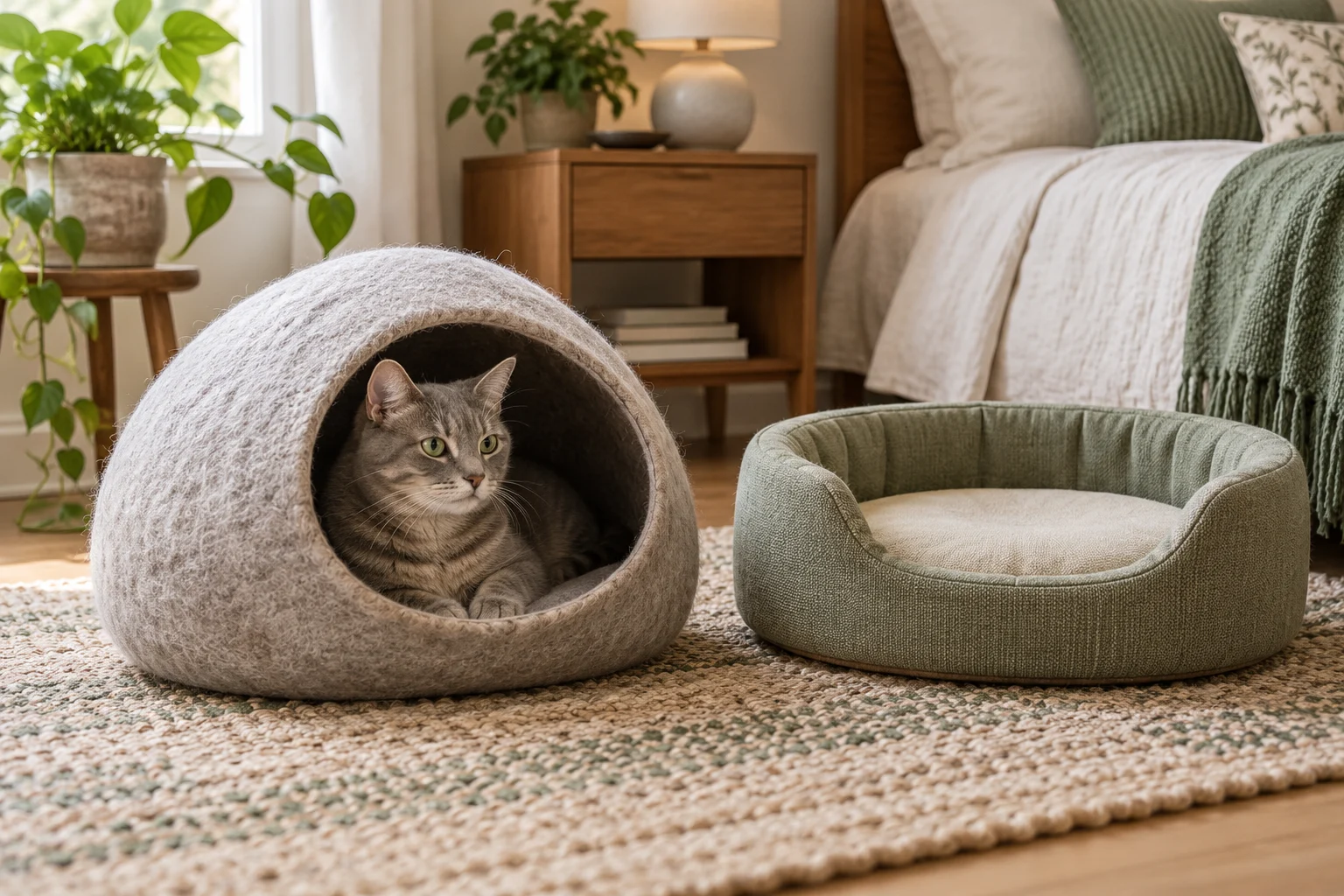
Choose a covered bed around the entrance, usable sleeping area and cleaning of each part. Bedsure’s soft igloo offers a removable cushion and an open-bed configuration; the Vesper Minou provides a structured hideaway with two openings. Neither outside footprint establishes inside fit. Keep an open resting choice available and let your cat decide whether enclosure feels comfortable.
Compare the options
| Option | Enclosure | Cleaning distinction | Main fit check |
|---|---|---|---|
| Bedsure 44 cm igloo | Soft convertible tent | Inner cushion: cold machine wash | Shell stability and usable floor |
| Vesper Minou | Rigid two-opening hideaway | Body and cushion need separate care | Interior and both openings |
A covered cat bed can provide a quiet place to withdraw from a busy room. The useful features are less obvious than the shape: enough internal room, an entrance that is comfortable to cross, a shell that stays open and parts you can actually clean.
This comparison puts a soft fabric igloo alongside a rigid hideaway. They serve the same broad resting need in different ways. It is a deliberately small shortlist, with emphasis on fit and ownership rather than decorative variations of the same bed.
For room setup, Cats Protection’s preparation guide places resting areas somewhere quiet and private. Give the bed a suitable location before assessing whether the enclosure itself is appealing.
Use the sleeping habit your cat already shows
Look at where your cat chooses to rest when the home is quiet. A cat that regularly slips under a chair or into a roomy open box may appreciate enclosure. A cat that sleeps stretched along a sofa may need more floor length than a small cave offers.
Do not interpret every hidden sleeping place as a request for a tight entrance. The attraction may be quiet, warmth, elevation or freedom from disturbance. Try a suitably roomy ordinary hideaway before investing in a bed whose shape is hard to return or clean.
A familiar open bed should remain available. For floor access without a roof, compare low-entry cat beds. For a larger sleeping outline, our beds for large cats focuses on usable resting area.
For a soft enclosure: Bedsure 44 cm igloo
Bedsure cat cave igloo, 44 × 44 cm
Best for: A soft enclosure with an open-bed option
A soft-sided cat tent with a removable cushioned insert. It can be flattened into an open bed, but that flexibility also means the shell is less rigid than a wooden hideaway. The inner cushion is washable in cold water.
What stands out
- Cushion separates for washing
- Can be used in an open-bed configuration
Keep in mind
- Outside size is not the usable interior
- Do not assume the shell has the cushion’s wash instructions
- 44 × 44 cm listed footprint
- Removable inner cushion
- Cold machine wash for inner cushion
The selected Bedsure igloo has a listed 44 × 44 cm footprint, faux-linen outer fabric and an inner cushion with a plush surface. Its appeal is a soft enclosure that can also be flattened into an open-bed configuration.
That convertible design is a practical distinction. A cat that wants a roof in one room may prefer an open resting shape in another. Check how well the tent holds its intended shape after unpacking and during ordinary use; do not assume it will behave like a rigid shell.
The maker permits the inner cushion to be machine-washed in cold water. Keep that instruction attached to the cushion, not to the entire igloo. Confirm the shell’s separate care instructions and drying needs before choosing it for a cat that frequently soils bedding.
An attached dangling toy is another part to inspect. Remove or retire damaged features in line with the maker’s instructions. The entrance should remain a clear route into a resting space, not a place where a loose cord or worn toy needs stepping around.
For a structured two-opening hideaway: Vesper Minou
Catit Vesper Minou hideaway, oak look
Best for: An enclosed resting place with two exits
A curved, rigid hideaway with two entrances, a memory-foam cushion and a replaceable sisal scratching mat. It suits a cat that chooses an enclosed resting place, while leaving another route out.
What stands out
- Two entrances rather than a single cave opening
- Resting and scratching in one piece
Keep in mind
- Outer measurements do not show usable sleeping space
- The rigid body cannot go in the washing machine
- 36 × 37 × 40 cm outer size
- Memory-foam cushion
- Replaceable sisal mat
The Vesper Minou has a rigid curved body, a cushioned hiding space and two openings, with a scratching mat outside. Its listed outer dimensions are approximately 36 × 37 × 40 cm. It is a floor-level hideaway rather than a climbing tree.
The structured body provides a defined space that will not flatten into an open bed. That can suit a cat that likes a stable enclosure, but it also makes fit less forgiving. Check internal floor dimensions, opening dimensions and the room needed to turn; the outside height includes the body itself.
Keep both openings clear. A second exit loses much of its value if it faces a wall or a storage basket. Think about the path beyond each opening as well as the opening itself, especially where another cat tends to wait.
The rigid body needs a different cleaning routine from a soft cushion. Do not soak the entire assembly or put it in a washing machine. Follow the cushion’s label and the maker’s surface-care instructions separately.
Measure the entrance and sleeping floor as separate decisions
| Part to check | Measure or ask for | Why it matters |
|---|---|---|
| Entrance | Clear opening height and width | A roomy interior is unhelpful behind an awkward entrance |
| Sleeping surface | Usable length and width after padding | Outside footprint includes walls, seams and framing |
| Threshold | Step from the floor into the bed | A low roof can still hide a difficult rim |
| Internal shape | Room to turn and change posture | A curved shell narrows near its edges |
Make a rough floor outline using the cat’s familiar bedding as a reference, without enclosing or restraining the cat. Compare that space with confirmed internal measurements. Avoid buying at the smallest theoretical fit, particularly when a thick cushion takes up part of the interior.
If the seller cannot provide useful inside dimensions, choose a returnable option or another bed with clearer information. A photograph of a cat inside is not a reliable scale reference.
Give the bed a quiet approach and a useful view
Position the bed near an established resting area with a comfortable temperature and freedom from draughts. Keep the entrance away from door swings, noisy appliances and frequent foot traffic. A bed at floor level still needs a place where people will not routinely step over the cat.
Avoid aiming the only opening directly into a narrow route another pet controls. In a multi-cat home, provide separated resting choices rather than expecting one attractive cave to solve every sleeping need. Move the new bed thoughtfully if the location is wrong; repeated changes can make it difficult to judge what the cat prefers.
Our bed placement guide covers the room-wide decision. Enclosure should add a comfortable choice, not reduce access to the rest of the home.
Plan the washing and drying before purchase
Check which parts lift out, which can be machine-washed and which require spot cleaning. Ask whether a replacement cushion is supported if that will matter to you. A removable insert with no replacement supply is still useful to wash, but it is not a promise of easy future spares.
A thick enclosed bed can take longer to dry than a flat cover. Keep another resting place ready during washing and return the cushion only when fully dry. Do not hide residual dampness under a clean blanket or add strong scents to disguise it.
The cat-bed washing guide separates cover, filling and shell care. For frequent washing, a simpler washable bed may be more practical than a heavily padded cave.
Let the cat establish whether the enclosure works
Set up the bed in its normal supported configuration, add only familiar bedding that fits without blocking the entrance and allow voluntary investigation. Keep the surrounding area calm. Avoid reaching into an occupied cave to encourage the cat out unless there is a genuine need.
Choose Bedsure for a soft convertible format when its usable interior and care routine fit. Choose Minou for a structured two-opening hideaway when its smaller defined interior is suitable. If neither matches the cat’s sleeping posture, select an open bed instead. The best bed is one the cat can approach, use and leave comfortably.
Frequently asked questions
Do cats prefer covered beds?
Some cats choose an enclosed resting place; others prefer an open bed or alternate between the two. Observe familiar sleeping locations and offer choice. An enclosed shape is not a guarantee of relaxation, particularly if the entrance faces busy traffic or another pet can block it.
How do I measure my cat for a cave bed?
Measure the floor area your cat normally occupies when curled and stretched, then compare the actual internal sleeping surface. Check entrance height and width separately. Allow space to turn and change posture rather than choosing a cave that only just matches the cat’s body outline.
Can I wash the whole covered bed?
Only when the care instructions permit it. A removable machine-washable cushion does not mean the shell, foam or rigid frame can go into the machine. Check each component and drying method before buying, especially when the cat may bring in mud or have toileting accidents.
Is a two-opening hideaway always better?
Two clear openings can provide another way out, but the whole arrangement matters. A wall or chair can block one exit, and both routes can still pass the same pet. Check internal room and place the bed so the cat can approach and leave comfortably.
Why will my cat not use its new cave?
Possible reasons include location, unfamiliar smell, a small entrance, an unstable shell or a preference for open sleeping. Keep the bed available in a quiet familiar area without placing the cat inside. Persistent new hiding or other behaviour changes should prompt veterinary advice.