
Practical guide · Scratching posts & pads
Where to put a scratching post
Place a scratching post beside the habit it needs to serve. Plan floor grip, a full stretch, separate household resources and gradual changes.
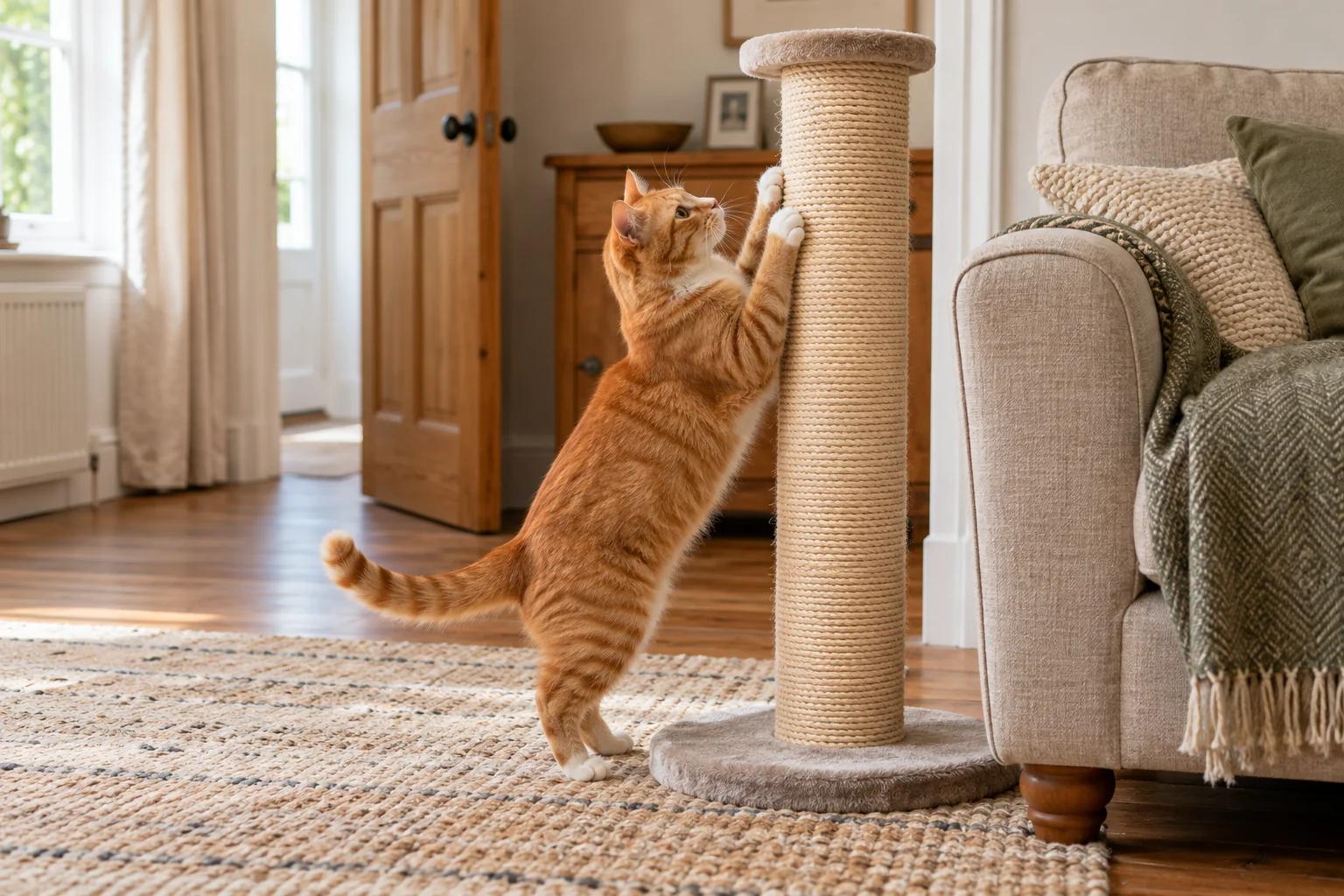
The short answer
Put the outlet where the habit happens
Start beside the place your cat already scratches, or near a familiar resting place where it stretches after waking. Leave room for a full reach and a clear way past. Choose a stable upright surface for an upright habit, or a horizontal pad for floor scratching, and provide separate useful locations in a multi-cat home.
Start beside the behaviour, not the spare corner
The most useful place for a scratching post is usually connected to something the cat already does. If it stretches up the end of the sofa, a suitable upright post beside that area is a more relevant first position than an isolated post in a room the cat rarely enters.
Scratching is normal behaviour. It helps maintain claws and can also leave visual and scent communication. The aim is to provide a useful outlet and understand the surroundings, rather than find a way to make scratching disappear entirely.
Cats Protection's scratching advice supports matching the outlet to the habit, using a stable surface and considering positions near resting places. Apply those principles to your room's actual routes and the cat's choices, not a fixed distance from every piece of furniture.
Observe the direction and starting position
Notice where the cat places its back paws, how far it reaches and which part of the surface receives the claws. An upright stretch asks for a different outlet from scratching along the floor. A small post cannot be made suitable for every movement simply by putting it closer to the target.
Look at the approach as well. Does the cat arrive from its bed, walk through the room or pause near a doorway? A product that fits the visible scratch marks but leaves no room for the cat's body may still be awkward to use.
You can record the pattern without interrupting or repositioning the cat. A simple note about location, orientation and nearby activity helps you choose one change to try. Avoid turning the observation into repeated handling or forcing the paws onto a new surface.
Beside a sofa: leave room for the full stretch
Place the post next to the area being used, while allowing the cat to stand squarely and reach the available scratching surface. The base should lie flat on the intended floor. Do not lean a freestanding post against the sofa as a substitute for proper assembly or restraint.
Check the sofa when it is in use. Reclining mechanisms, footrests, blankets and a person's feet can occupy space that looks empty during a tidy-room inspection. The scratching position should remain predictable when people sit down.
If there is a table beside the sofa, keep its edge out of the cat's reach-and-release route. A post squeezed between two objects may be accessible from only one direction. A slightly different arrangement of the furniture can be more useful than buying another post with the same restricted space.
Near a bed: support the waking stretch
A post near a familiar sleeping place can offer an outlet as the cat gets up. Keep it close enough to be an ordinary choice, but leave the sleeping patch, access and escape route usable. The post should not wobble over the bed or force a cat to squeeze past its base.
If the bed is raised, trace the whole route down to the scratching area. A floor post beside a shelf does not automatically provide a safe climbing step. Use furniture only for its intended purpose and follow instructions for any wall attachment or supporting structure.
This can be an additional location rather than a replacement for the sofa-side outlet. Resting and communication habits may occur in different places. One centrally chosen post does not have to serve every activity in the home.
Upright and horizontal examples
Upright scratching
SmartCat Ultimate scratching post, grey
A tall, straightforward post with a woven sisal surface and a broad square base. It is a useful option for a cat that chooses upright scratching and needs room to stretch, without adding a whole climbing tower.
Check: Needs assembly and a flat, steady position
View on Amazon ↗The SmartCat Ultimate is an upright woven-sisal example, with an overall height around 81 cm and a base around 41 cm square. Those dimensions help you plan its position, but the height includes more than a promise of usable scratch length. Check the cat's full reach and the maker's assembly directions.
It is a substantial floor-space commitment beside a sofa. Mark the square base and then allow room for the cat to stand outside it. A heavy-looking post still needs correct assembly, a suitable floor and checks for loosening or wear.
Floor-level option
Amazon Basics curved cardboard scratch pads, 2 pack
Two curved, double-sided cardboard pads for a cat that prefers scratching near floor level. The separate pads also let you offer a surface in two places without buying two large pieces of furniture.
Check: Cardboard wears and can shed pieces
View on Amazon ↗The Amazon Basics curved pads illustrate a horizontal alternative, with two separate 41.9 × 20.6 cm pads in the selected package. Place one beside an existing floor-scratching patch if the usable area fits the movement. Check that its light structure stays put during use.
These examples are here to show how orientation changes the placement decision. For broader comparisons, see the tall-post guide or horizontal-scratcher guide. There is no need to add a product if an existing suitable outlet already works in the proposed position.
Keep ordinary walking routes open
A busy hallway can expose the cat to footsteps, opening doors and interruptions. A post that forces people to sidestep into the cat's space may not remain a calm predictable outlet. Check the room at its busiest ordinary time, including when bags or shoes arrive near the entrance.
Avoid obstructing a cat flap, a stair or the only route to water or a litter tray. A scratching surface should be an activity the cat chooses, not an obstacle everyone must pass. Leave enough clearance to walk around it without brushing against the post or cat.
A quieter side of a frequently used room can be more practical than a completely separate quiet room the cat does not visit. Balance familiarity with usable space. You do not have to hide the post to make it part of a considered room layout.
Windows and doors need context
Scratching near a window or door can be linked to communication or insecurity, including the presence of other cats. Adding an outlet can support normal scratching, but it does not explain or resolve the whole situation. Notice what happens around the location rather than assuming the furniture alone caused it.
Keep a post clear of door swings, blind cords, curtain loops and mechanisms. Opening a door should not strike the base or alter the usable space. Do not place a scratching surface where ordinary use brings the cat close to an unsafe window opening.
If the behaviour is new, widespread or associated with tension, seek appropriate advice about the cat and home. Repeatedly moving the post without addressing that context can leave the underlying problem untouched.
Give each cat a useful option
Several posts touching in one corner do not necessarily provide separate choices. Another cat may control the shared approach, even if every item is technically available. Spread suitable scratching locations around the places cats already use.
Watch whether one cat waits nearby, blocks the route or repeatedly interrupts another's use. Keep additional paths and resources accessible. A larger shared tree can provide some scratching surfaces, but it should not be assumed to replace every separate outlet.
There is no universal number of posts that resolves every household layout. The quality of the locations and how the cats use them matter. Start with separate useful options and adjust around observed patterns and suitable welfare guidance.
Introduce and move it gradually
Put the post in its planned position, assemble it properly and let the cat investigate voluntarily. Avoid forcing paws onto it. Keep your response to unwanted scratching calm, and support appropriate scratching without punishment.
If the initial location begins to work but needs changing, make gradual adjustments while observing continued use. Keep a reliable outlet available through the change. There is no useful fixed promise that every cat will accept a move within a particular number of days.
Change one factor at a time where possible. A new material, new room and unfamiliar scent introduced together give you little information about which difference mattered. Predictable surroundings make practical comparisons easier.
Five checks for the chosen spot
0 of 5 checks complete
Sources and practical limits
Cats Protection provides the behaviour and positioning principles. Product examples use their selected brand and manufacturer specifications. A location can improve access to a scratching outlet, but this is not a guarantee of a particular preference, a furniture cure or a substitute for investigating changes in behaviour.
Frequently asked questions
Should a scratching post go beside the sofa?
If that is where the cat already scratches, a suitable post beside the chosen area is a sensible starting point. Leave room for the cat to stand and stretch, and keep the walking route clear. A distant post may not serve the same location or behaviour.
Can I put the scratching post in a corner?
A corner can work if it leaves enough approach space and the whole scratching surface usable. Do not wedge the base so tightly that the cat cannot brace or reach around it. Consider another cat’s access and whether a door or furniture movement could catch the post.
Should the post be near the cat’s bed?
It is a useful position to consider because cats may scratch and stretch after resting. Keep the bed and post independently accessible, with no unstable object leaning over the sleeping area. An existing sofa-scratching habit may still benefit from a separate outlet beside that location.
How quickly can I move an established post?
If a location change is needed, make gradual changes while watching whether the cat continues to use it. There is no universal distance or timetable. Avoid abruptly removing a reliable scratching outlet just because a new corner looks tidier to people.
Will putting a post by the window fix stress scratching?
Position alone may not address the reason for scratching. If another cat outside or conflict inside is involved, the wider situation needs attention. A new surface is an outlet, not a diagnosis or guaranteed remedy; seek suitable veterinary or behaviour advice when needed.