
Practical guide · Play & enrichment
How to clean cat food puzzle toys
Remove crumbs, wash food-contact areas and dry puzzle toys fully before reuse. Includes separate care for Catit Digger cups and the TRIXIE Fun Board.
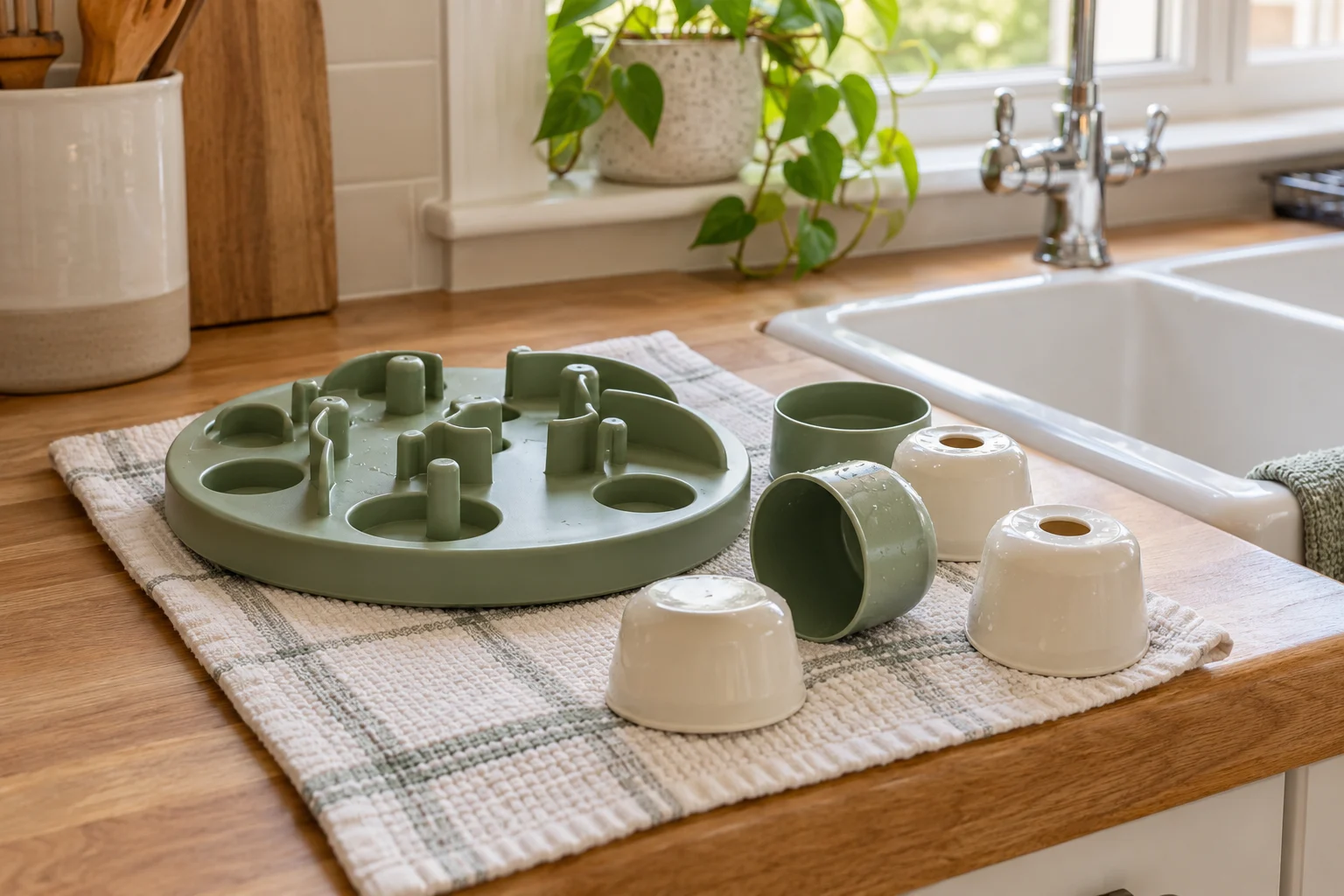
The short answer
Clean the hidden food route, then dry every part
Empty uneaten food, separate only the parts the maker permits, wash every accessible food-contact surface and rinse thoroughly. Dry cups, channels and joins fully before reassembly or adding dry food. Follow the exact toy’s dishwasher and material instructions; a plastic appearance does not establish dishwasher safety. Retire cracked or inaccessible dirty parts rather than hiding residue under fresh treats.
A food puzzle can look clean from above while crumbs sit underneath a cup or grease collects in a narrow channel. Cleaning needs to follow the route the food takes, including the places a paw pushes it out of sight.
The best routine is simple enough to repeat after ordinary use. Choose a toy you can take apart as intended, wash without damaging it and dry fully before the next session. A complicated puzzle is a poor match if its care requirements are impractical in your home.
Empty and inspect after the session
Remove remaining rewards before storing the toy. Count puzzle food within the cat’s usual feeding plan; do not keep topping up an unmeasured supply. Discard food that is damp, dirty or no longer suitable rather than returning it to the main food bag.
Look inside cups, under removable sections and around anti-slip parts. Check for saliva, hair and food pressed into joins. Turn the toy over on a clean surface so loose crumbs can be removed before washing, without tipping them onto a food preparation area.
Inspect for cracks, rough edges, missing parts and damage from chewing. Cleaning cannot repair a split cup or a sharp rim. Keep the toy away from the cat while pieces are separated, and store any small components safely.
Identify what can be separated and washed
Read the exact maker’s instructions, including any base, insert or rubber component with different care. Removable parts are not necessarily all dishwasher safe. A decorative or weighted base may need a different method from a plain plastic cup.
Do not prise apart glued pieces or unscrew a concealed mechanism unless the maker provides that procedure. Photograph the normal assembly if it helps you put the right cup or cover back in its original position.
| Puzzle construction | Main cleaning concern | Suitable starting point |
|---|---|---|
| Removable plastic cups | Residue around rims and locating holes | Separate as instructed and hand-wash |
| Grooves and channels | Food pushed into narrow corners | Soft tool that reaches without scratching |
| Fixed or enclosed sections | Hidden residue and slow drying | Confirm supported access before use |
| Cardboard or fabric toy | Material may not tolerate soaking | Follow its own label; replace if no longer cleanable |
A homemade cardboard activity has different limits from a washable feeding toy. Replace damp or food-soiled cardboard rather than treating it as a reusable plastic bowl. See budget indoor enrichment for simple activities with manageable materials.
Catit Senses Digger: remove the five cups
The Digger has three short and two long cups in a shaped base. Remove the cups as intended and clean the cups, base and accessible contact areas with warm water, dish soap and a soft sponge. Catit advises avoiding aggressive detergents and abrasive tools.
Paw-based puzzle
Catit Senses 2.0 Digger
Five removable tubes hold dry treats or kibble for your cat to retrieve with a paw. Begin with an easy-to-reach reward and watch whether the activity appeals before making it more challenging.
Check: Treats still count towards the normal feeding plan
View on Amazon ↗Work around the cup openings and the base recesses rather than only rinsing the visible surfaces. Rinse away the soap, then let every part dry before putting the cups back into their appropriate positions. Do not put dry kibble into a damp recess and assume the next session will dry it out.
For a cat learning the puzzle, leave an easy reward accessible when you reintroduce it. Cleaning day is not a reason to make all five cups more difficult at once. The beginner puzzle-feeder guide explains the starting difficulty.
TRIXIE Fun Board: inspect each activity area
The selected Fun Board, 4590, combines five activity modules on a 30 × 40 cm board. Treat each food area as part of the wash, including channels, edges and the underside where the design permits access.
Several activity styles
Trixie Cat Activity Fun Board
A 30 × 40 cm board with five different dry-food activities. Begin with the easiest accessible area rather than filling every module, then introduce a different action when your cat is comfortably finding the reward.
Check: Some modules are harder than a first puzzle needs
View on Amazon ↗The maker identifies this model as dishwasher safe. Follow the actual supplied care instructions for placement and any removable pieces; do not transfer that permission to a different puzzle simply because it has the same brand name.
A hand-cleaning approach can also make it easier to inspect whether food has lodged in a difficult corner. Use a soft cleaning tool that fits the opening without gouging the surface. Rinse, inspect and dry before rebuilding the activity.
Wash without creating new hiding places
Use the supported detergent and method rather than a stronger chemical because food smells remain. Avoid heavily scented residues that may make the toy unappealing. Do not mix household cleaners or assume a disinfectant is suitable for food-contact pet equipment.
A dedicated soft brush may help narrow areas, but do not use sharp metal objects to dig food out of plastic. Scratches make the next clean harder and can leave a rough edge. If a channel is impossible to reach, reconsider whether that toy suits the food and cleaning routine.
Keep pet-food equipment separate from dirty litter-cleaning tools. Wash hands and the cleaning area afterwards. When illness requires a specific infection-control process, ask the vet for a suitable procedure and confirm that the toy material tolerates it.
Dry the places that are slowest to dry
Drain components in a clean, ventilated place where the cat cannot take loose pieces. Check the underside of cups, deep channels and rubber contact areas by inspection before putting everything away. A surface that feels dry on top may still hold water underneath.
Do not seal damp pieces in a storage box. If the toy cannot be ready before the next meal, serve food in the cat’s ordinary dish and use the puzzle later. Having a small rotation is more practical than rushing a favourite toy back into use while damp.
Never speed drying with heat that the maker has not approved. Distorted plastic can change how parts fit or create an opening that catches a claw. A poorly fitting part after washing is a reason to stop and inspect, not press harder.
Reassemble, check and start simply
Confirm that every required part is present and seated, the base sits normally and there are no loose fragments. Add a small measured reward and observe the next use. The cat should retrieve food comfortably without a cup rocking out or a sharp edge catching a paw.
If your cat suddenly stops using a familiar toy, check residue, altered assembly and difficulty as well as interest. A persistent change in eating or comfortable movement warrants veterinary advice, rather than repeatedly buying a harder puzzle.
Use toy rotation to make cleaning and drying part of a manageable routine. Manufacturer care details are available in Catit’s Digger cleaning guide and TRIXIE’s Fun Board instructions.
Frequently asked questions
How often should I clean a cat food puzzle?
Inspect and remove leftover food after each session, then wash as needed to remove food residue and according to the maker’s instructions. Wet, greasy or contaminated material needs prompt attention. A dry-looking puzzle can still have crumbs and residue hidden in channels.
Can the Catit Senses Digger go in a dishwasher?
Use Catit’s specified hand-cleaning method: warm water, dish soap and a soft sponge, followed by thorough rinsing and drying. Do not infer dishwasher permission from the fact that the cups are removable. Check the supplied instructions for the exact version.
Is the TRIXIE Fun Board dishwasher safe?
TRIXIE identifies the selected Fun Board 4590 as dishwasher safe. Follow its supplied loading and care instructions, and separate only the parts it permits. That permission does not automatically apply to other TRIXIE puzzles, wooden toys or accessories added by the owner.
Can I use wet food in any puzzle feeder?
No. Check that the particular toy is designed for wet food and can be cleaned appropriately. The Digger and Fun Board examples here are used with dry rewards. Do not smear wet food into inaccessible channels simply to make a dry-food toy more interesting.
What if food is trapped where I cannot reach it?
Check the maker’s supported disassembly and cleaning method. Do not force glued or fixed parts apart. If residue cannot be removed and the toy cannot be cleaned and dried reliably, stop using it and ask the manufacturer whether the part can be replaced.