
Buying guide · Cat beds & resting
Best cat beds for large cats
Compare a large mattress, bolstered bed and flat fleece for bigger cats. Choose usable sleeping room, an accessible entrance and a realistic washing routine.
The short answer
Choose the sleeping shape before the size label
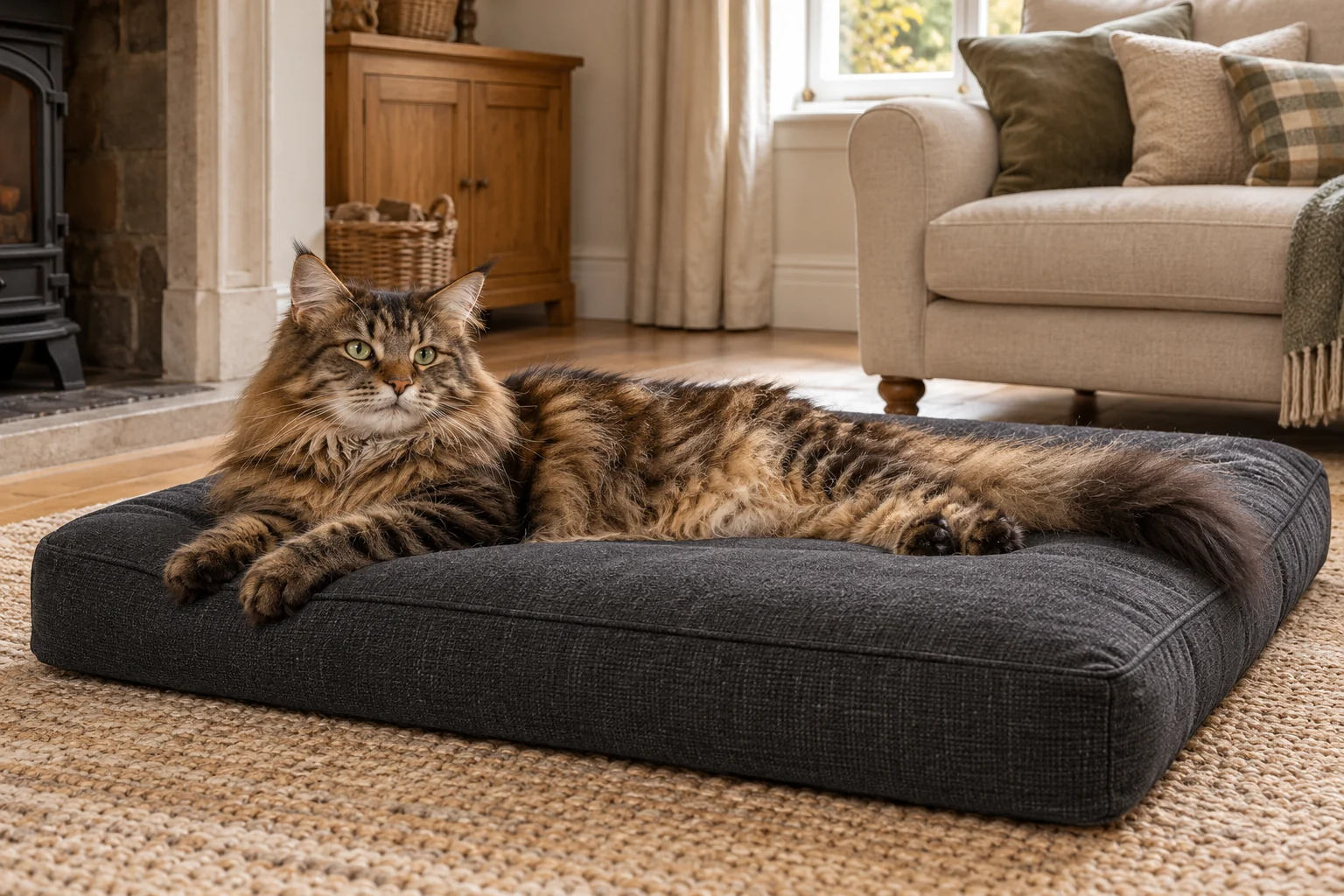
For a large cat that stretches out, start with the Scruffs Chester large mattress; for soft enclosing sides, consider the Chester large box bed after checking its inner cushion size. Vetbed Original is a flat alternative when low access and a flexible resting surface matter. Measure the cat asleep, not just standing, and distinguish the usable sleeping area from the outside footprint.
Compare the options
| Option | Overall size | Useful for | Main check |
|---|---|---|---|
| Scruffs Chester large mattress | 100 × 70 × 10 cm | Open stretching space | Full floor footprint and washing drum |
| Scruffs Chester large box bed | 75 × 60 × 18 cm | Resting against soft bolsters | Inner cushion and entrance size |
| Vetbed Original grey | About 102 × 76 cm | Broad flat fleece surface | Grip; not the Non-Slip range |
A large cat does not necessarily want a huge enclosed nest. Some sleep curled tightly against a bolster; others lie on their side with their legs out. A bed that suits one posture may leave half the cat hanging over the edge in the other.
Our shortlist compares three useful shapes rather than ranking by a breed label. The Scruffs options add substantial fabric-bed choices, while Vetbed provides a flat resting surface. Selection is based on dimensions, design and published care instructions.
Separate the floor rectangle from the sleeping surface
A mattress, bolstered bed and flat fleece can occupy similar-looking spaces in photographs while offering different resting shapes. Converting their stated outlines gives a clearer starting point for the room.
| Selected option | Outside dimensions used | Calculated rectangle | What the number cannot establish | Source |
|---|---|---|---|---|
| Scruffs Chester large mattress | 100 × 70 cm | 0.7 m² | Uninterrupted shape still needs checking at rounded or stitched edges | [1] |
| Scruffs Chester large box bed | 75 × 60 cm | 0.45 m² | Bolsters reduce the usable inner cushion area | [2] |
| Vetbed Original 40 × 30 in | 101.6 × 76.2 cm | 0.7742 m² | Exact inch conversion; a flat fleece is a different construction from a mattress | [3] |
The mattress rectangle is 55.6% larger than the large box bed’s outside rectangle. Bolster thickness is not published here, so the difference in usable sleeping area remains unknown.
The 40 × 30 inch fleece converts to 101.6 × 76.2 cm, rather than exactly 102 × 76 cm. Use the precise conversion for planning, then check the actual supplied piece and its secure support.
Sources for this comparison
- Scruffs Chester graphite mattress — Large 100 × 70 cm.
- Scruffs Chester graphite box bed — Large 75 × 60 cm outside.
- Selected Vetbed Original 40 × 30 inch piece — Selected catalogue size; Original backing differs from Non-Slip.
Measure the space your cat actually uses
Watch a relaxed nap on a sofa, rug or existing bed. Measure the patch occupied by the body and legs without waking or stretching the cat. Repeat for a curled sleep and a long side stretch if both are common. A photograph beside a familiar cushion can help you estimate without disturbing them.
Use those measurements to compare sleeping surfaces. Leave practical spare room rather than buying a cushion exactly as long as the cat’s current pose. The aim is to let them change position without being pressed into the sides. There is no universal allowance that makes every bed comfortable.
For bolstered beds, ask for the inside cushion size. For a mattress, consider whether curved edges or deep stitched channels reduce the broadest usable area. For a mat on furniture, the supporting surface must hold the entire mat securely; a larger mat overhanging a narrow shelf does not create a larger safe bed.
Best for stretching: Scruffs Chester large mattress
Scruffs Chester large mattress
Best for: Room to stretch
A 100 × 70 cm rectangular mattress with no enclosing bolster. Its generous footprint suits a larger cat that prefers stretching out, provided there is room for the full bed.
What stands out
- Open rectangular sleeping surface
- Whole-bed washing rather than cover-only care
Keep in mind
- Large drum and drying space may be needed
- Do not tumble dry or bleach
- 100 × 70 × 10 cm overall
- Whole bed washable at 30°C
- Non-slip base
The Chester large mattress has a 100 × 70 × 10 cm overall size and an open rectangular shape. It is the most straightforward starting point here for a long cat that changes between curled and extended sleeping positions. There is no enclosing rim taking a large bite out of the middle.
That footprint is generous for many cats but substantial in a small sitting room. Measure the whole rectangle on the floor before ordering. If the bed will sit beside an armchair, check the space left when someone reclines, opens a cupboard or walks through with a laundry basket.
The 10 cm height is still a step. It should not be described as a floor-level mat or assumed suitable for every cat with reduced mobility. Check how the filling compresses and whether your cat can approach comfortably. For a flatter option, see the low-entry bed guide.
Scruffs specifies whole-bed washing at 30°C, with no bleach or tumble drying. A large bed may need a larger drum. That affects the real cost and convenience: a washable label is useful only if you can wash and dry the item properly.
Best for soft sides: Scruffs Chester large box bed
Scruffs Chester large box bed
Best for: Cats that prefer bolsters
A bolstered fabric bed with a 75 × 60 cm outside footprint. It offers a more enclosed resting shape, but the inner cushion is smaller than those measurements.
What stands out
- Soft enclosing sides
- Non-slip base and whole-bed washing
Keep in mind
- Outside size does not establish inner sleeping room
- Large bed may need a larger washing-machine drum
- 75 × 60 × 18 cm overall
- Whole bed washable at 30°C
- One-piece construction
Choose this shape when your cat already sleeps against a cushion, the sofa arm or a raised bed edge. The bolsters offer a soft boundary and a place to lean, rather than an uninterrupted platform for a full stretch.
Its 75 × 60 × 18 cm overall measurements are not an internal sleeping measurement. The difference matters especially for a broad-shouldered or long-haired cat. Confirm the inner cushion and entrance before buying; if a seller cannot supply those details, do not infer them from a product photograph.
This is the large Graphite version. Other sizes in the Chester family have different footprints, so check the selected Amazon option before ordering. An XL label on a neighbouring listing is a separate choice rather than evidence that the linked large version has those dimensions.
The one-piece construction is intended for whole-bed washing at 30°C. As with the mattress, allow adequate drum space and air drying. The raised sides make this a different access proposition from a flat fleece, even if a cat is able to step over them today.
Best flat alternative: Vetbed Original grey
Petlife Vetbed Original, grey 40 × 30 in
Best for: A flat fleece resting surface
A flat washable fleece with the Original green backing. The selected listing is a generous 40 × 30 inch piece, useful when you want a continuous resting surface rather than a bed with raised sides.
What stands out
- No bolster reduces the flat sleeping area
- Can be washed separately from surrounding furniture
Keep in mind
- Original backing is not the Non-Slip range
- Check the supplied care label rather than borrowing another backing’s wash settings
- 40 × 30 in listed size
- Original green backing
- Machine-washable mat
The linked 40 × 30 inch piece is roughly 102 × 76 cm, offering a broad fleece surface without a raised fabric wall. It can suit a cat that prefers a low, open resting patch, or provide familiar bedding on a suitable stable surface.
This is Vetbed Original with green backing, not the separate Non-Slip version. Do not assume it will grip a polished floor. Test the intended position and use a secure arrangement that will not slide, curl or become a trip hazard. Keep it away from moving chair mechanisms and narrow perches.
It is a fleece mat, not the same depth of mattress as the Chester. Choose it for the surface and access rather than treating all three products as interchangeable cushioning. Follow the label on the supplied item for washing and drying; care claims vary between Vetbed ranges and versions.
Match the shape to the sleeping habit
A cat that stretches on cool flooring may appreciate an open mattress or mat more than a deep plush nest. A cat that pushes into the corner of the sofa may prefer a bolster. Offer choice where possible, rather than assuming that the most padded or most expensive design will be preferred.
For a very long cat, prioritise usable length in the common sleeping direction. For a broad cat that curls, the inner width may be the limiting measurement. For a cat that often changes position, an open shape gives more flexibility. None of these observations replaces checking how the specific cat uses the bed.
A cave can look spacious from outside while offering a narrow entrance and limited roof clearance. If your cat dislikes enclosed spaces, a bigger cave is not automatically a solution. Start with a shape already reflected in their chosen resting places.
Check the approach as well as the bed
A large bed beside the busiest doorway can remain unused. Put it in a quiet area with a clear route, comfortable temperature and separation from litter, feeding and drinking stations. Cats Protection’s sleeping-place advice recommends several options, accessible elevated places and freedom from disturbance.
Avoid putting a large floor bed directly beside a heater or where strong sun falls for the whole afternoon. A cat should be able to choose another resting place. Do not cover floor vents, block exits or balance a bulky bed on furniture too small to support it.
The cat-bed placement guide helps plan the location. If a cat suddenly stops using a previously comfortable bed, consider changes in household activity and access, and discuss changes in mobility or general behaviour with your vet.
Make the washing routine realistic
Before buying, check the drum capacity, care label and where a thick item can air dry. Do not compress a large bed into an unsuitable machine just to complete the wash at home. A damp core is easy to miss when the surface feels dry; let the filling dry fully before returning it.
Keep an alternative resting place available during cleaning. Wash beds in rotation so your cat still has a familiar-scented option. Avoid adding strong fragrance to make the bed smell “fresh” to people; the cat’s response matters more than a laundry scent.
A removable cover and a whole-bed washable design solve different tasks. A removable cover may dry quickly, but it does not necessarily mean the inner filling is washable. The two Scruffs choices here are specified as whole-bed washable; retain the supplied care instructions for the exact version.
Spend on fit before extra features
A useful shortlist starts with four answers: how the cat sleeps, how much inner space they need, how they will step onto the bed, and how you will clean it. Marketing terms such as calming or luxury do not resolve any missing measurement.
For a stretched sleeper with enough floor room, compare the Chester mattress first. For a cat that likes leaning against soft sides, investigate the box bed’s internal area. For a low, adaptable resting surface, consider Vetbed while making a separate plan for grip.
Keep the existing favourite resting spot available during the introduction. Place the new bed nearby and allow voluntary exploration. If the cat chooses the old cushion, look at location, texture and temperature before assuming another purchase is necessary. Our washable cat bed guide covers smaller options when the large footprint is more than you need.
Once the bed fits, follow bed placement and washing and complete drying. A larger outer size does not remove the need to check usable sleeping space or access.
Frequently asked questions
Can a large cat use a dog bed?
Yes, if the bed suits the cat’s resting shape, access and care needs. A dog label does not make the dimensions unsuitable for a cat. Check the actual sleeping surface, any raised edge and the washing instructions. A very large bed still needs a quiet place where the cat feels comfortable.
What size bed does a Maine Coon need?
There is no reliable single size for every Maine Coon. Measure your individual cat in the position they normally sleep, including a stretched posture if they use it, then compare the usable inner area. Breed photos and outside dimensions cannot establish whether a particular cat will fit.
Is the Chester large box bed’s 75 × 60 cm size the sleeping area?
No. Those are overall measurements. The padded sides take up part of that footprint, so ask for the current inner cushion dimensions before buying for a broad or long cat. If generous open space is the priority, compare the mattress shape as well.
Are these beds orthopaedic or treatments for joint pain?
This shortlist makes no treatment claim. Padding, a lower edge and a stable surface can affect access and resting choice, but they do not diagnose or treat pain. A change in jumping, posture or willingness to get into a bed is a reason to speak with your vet.
Should two large cats share one oversized bed?
Only if they choose to rest together, and they should still have separate alternatives. A large shared mattress does not replace independent resting places. Avoid making the only comfortable bed a resource that one cat can occupy or guard.